
Joyce Glasser reviews Project Hail Mary (March 20, 2026) Cert. 12A, 156 minutes
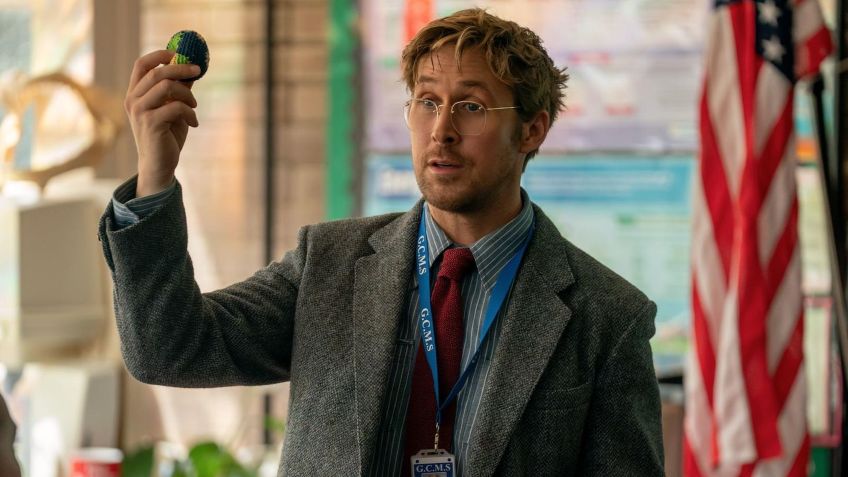
Bafta winning and Oscar nominated actor Ryan Gosling is one of America’s most consistently charming hit-makers. He is probably best known for the big-budget studio films Barbie and La-La Land, but at age 26, he was nominated for an Academy Award for his role in Half Nelson, playing an unorthodox middle-school history teacher with a cocaine habit. Gosling plays a teacher again in the fun but flawed Project Hail Mary, where he once again seamlessly shifts from lovingly goofy to intellectually brilliant and from humour to distress to poignancy.
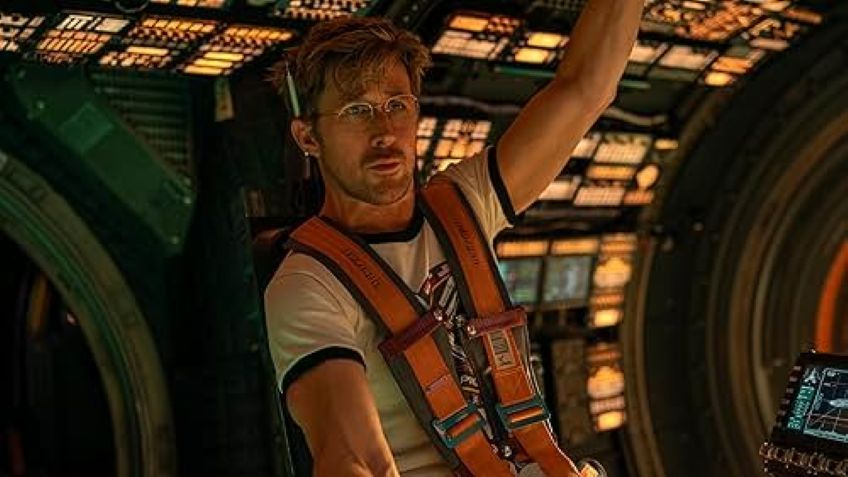
In Philip Anderson Lord and Christopher Robert Miller’s (Cloudy with a Chance of Meatballs, The Lego Movie, and the Spider-Verse film franchises) adaptation of Andy Weir’s Sci-fi novel, Gosling is Ryland Grace, a former molecular biologist turned biology teacher. Grace’s scientific background is important to lend the plot some credibility as Grace is asked to ascend a learning curve a lot steeper than Dr Ryan Stone’s in Gravity or Dr. Mark Watney’s in The Martian.
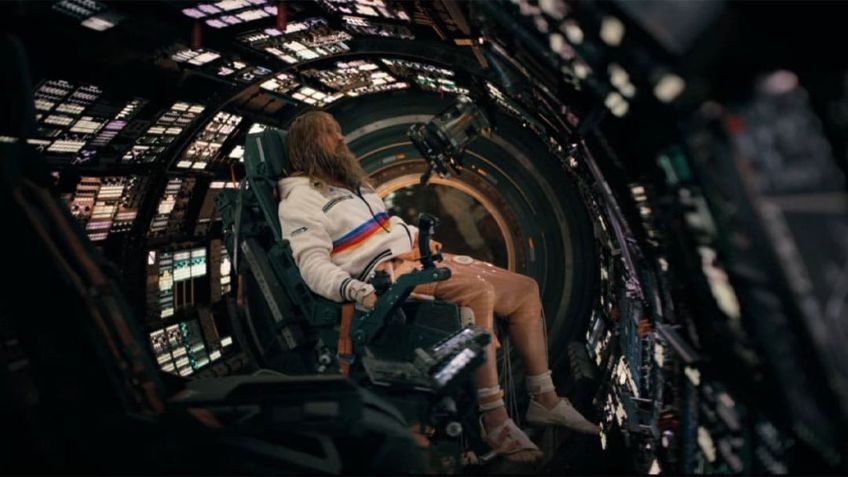
A bedraggled man (Gosling) wakes up in a kind of strait jacket encased in a machine as though designed to keep him asleep for a long journey in space. He escapes the robotic machine that tries to pull him back. Disorientated, the hirsute man soon discovers his colleagues are dead, and he is alone on a space craft.
Gradually, through frequent flashbacks, we learn the background to a story that continues to evolve.
Grace’s Ph.D. thesis, which argued not all species depend on water and air, earned him notoriety as a scientist, but is of interest to UN space agency scientist Eva Stratt (Sandra Hüller). The Sun is dimming and Stratt has wide powers in her urgent mission to save the Earth from an Ice Age by discovering the cause of the dimming and stopping it. She is focussed on tiny organisms that are generating an infrared line between the sun and Venus that is called the Petrova line.
Stratt hires Grace to investigate a sample sent back to Earth. In a makeshift laboratory, he discovers that single-celled organisms dubbed Astrophage are consuming electromagnetic radiation from the Sun, oxygen from Venus, and are killing other stars.
Only a star called Tau Ceti has proven immune and Grace soon finds himself on a space craft called Hail Mary, heading 11 light years away to Tau Ceti. There are two problems. The first is that there is only enough Astrophage fuel for a one-way mission. Data will be sent to earth, but not the human crew.
The other problem is that Grace doesn’t share his colleagues’ altruism when asked to fill a last-minute gap in the crew.
Fortunately, for his survival, Grace, who never trained as an astronaut, physicist or engineer, is a fast learner. You may wish you had his capacity for catching on to the technical twists and turns of the Interstellar – like plot.
But here, the film resembles Ridley Scott’s The Martian, adapted from another Andy Weir novel, in which astronaut Matt Demon summons all of his resourcefulness to survive alone on Mars.
The filmmakers try to infuse their film with the humour that made The Martian so entertaining, but it doesn’t really work. If anything, Gosling’s laid back quirky manner diminishes the tension and the audience’s feeling of dread.
When Grace notices that an alien spacecraft made of xenon, also heading to Tau Ceti, has docked with the Hail Mary and is trying to communicate, we leave The Martian and head into the realm of E.T., The Extra-Terrestrial or Enemy Mine.
And that’s because there’s a lone pilot on the alien ship, too, one whose crew has also died on a mission to investigate the dimming Sun. The alien turns out to be a pentapedal creature from the planet of Eridian, whose flesh looks like rock, earning him the name Rocky, after Rocky Balboa. And like Balboa, it talks.
This cuteness becomes momentarily sentimental when we learn that among the casualties was Rocky’s partner – whose name is Adrian, suggesting an evolved society. This leaves both Grace, and lonely, heart-broken Rocky in need of a friend. The rest of the film obviously becomes a buddy movie as Grace finds purpose and even that selflessness, he could not muster up on Earth.
The space narrative is continually punctuated by scenes between Grace and Stratt that are among the best in the film. There is nothing as cheesy as an affair, although a karaoke song Stratt belts out to relieve tension comes close. Gosling and Hüller have a chemistry of people who harbour intuitive feelings of respect, empathy and longing that they cannot, or need not, express.
If the denouement strains credibility, and the film’s length is excessive, the real problem in Project Hail Mary is the curious dearth of cosmic wonder. Scriptwriter Andrew (Drew) Goddard, who also wrote the screenplay for The Martian, and Lord and Miller, who share an abundance of imagination and visual flair, seem to be hamstrung by the daunting adaptation and by the challenge of turning the now familiar buddy story into something fresh and profound.