by Joyce Glasser
On June 12th, at 11:32 I heard the news that David Hockney died. My immediate reaction was what a wonderful, full, long life he lived – with his extensive address book, his multi-faceted talent and his beautiful homes in England, America and France.
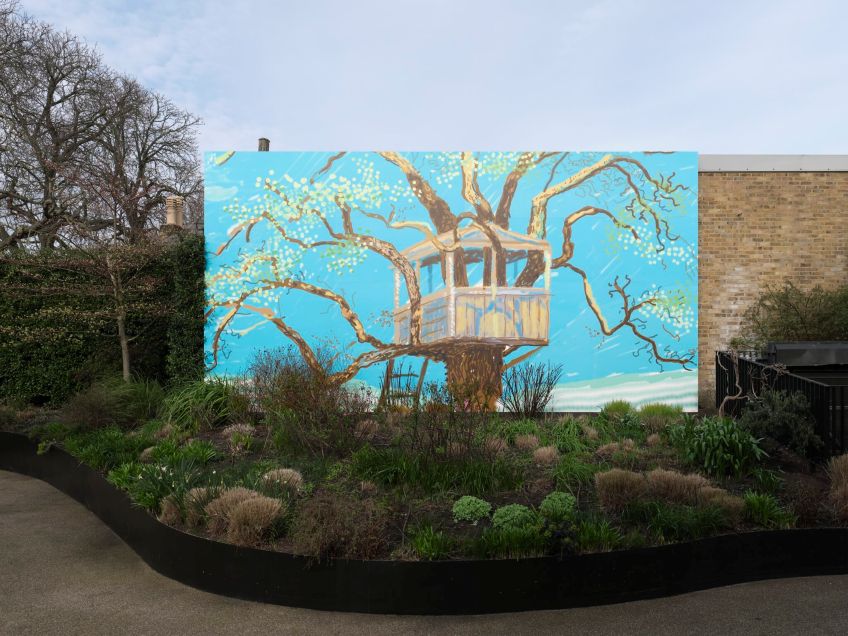
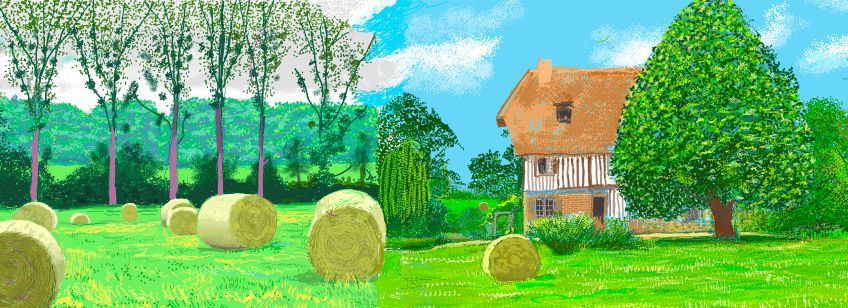
He lived to see an exhibition of A Year in Normandie and Some Other Thoughts about Painting. This ambitious artwork, a continuous view of the changing seasons at Hockney’s estate in Normandy, was made on an iPad and displayed like a tapestry around the Serpentine Gallery. It was, in a way, his answer to the Bayeux Tapestry that is coming to the British Museum later this month. (He was against that fragile work travelling).
The exhibition at the Serpentine Gallery began in early spring and is on until August 23 2026. Only now people are coming with flowers and leaving bouquets in front of the gallery.
Hockney also lived to see his major retrospective take place at the Louis Vuitton Foundation in Paris during the same period last year. That honour might just be the crowning achievement for an artist today. The Frank Gehry designed Foundation is immense. You have to be able to fill it, and with art worth transporting and insuring. No other venue in the “free world” has the capacity and resources to display so much priceless art.
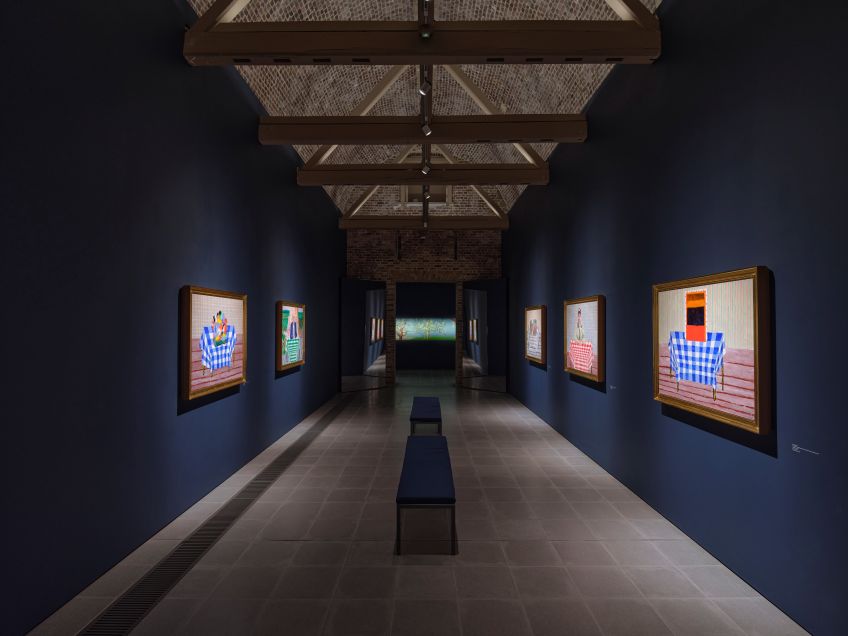
Hockney’s retrospective came after those of Mark Rothko (d. 1970, age 66) and Gerhard Richter (age 94). He knew that he was considered at their level in international stature and earning power. His Serpentine exhibition includes a few paintings made just after the Louis Vuitton exhibition that are not part of the iPad tapestry. They make reference to Rothko and Richter, as if to pay tribute to them – and to himself for being in their company.
I saw Hockney once many years ago, not long after the 1973 documentary, A Bigger Splash was released. The title of this biographical film refers to Hockney’s 1967 swimming pool painting and explores his relationship and break-up with his partner Peter Schlesinger. Hockney first moved to LA in 1964, and his iconic painting was made three years later, in the same year as Hollywood released The Graduate, Bonnie & Clyde, The Dirty Dozen and In the Heat of the Night.
When I saw Hockney one day in the mid-1970s, I was a student in Paris doing some shopping in La Samaritaine, the historic, art nouveau department store on the Seine. He was also there – with a group of male friends looking at a batch of underwear that was on sale. With his abundant blond hair, he was easily recognisable and I approached, telling him I had seen A Bigger Splash and asking him where I could buy one of his paintings! He gave me an address – which I somehow lost, although after A Bigger Splash, I could never have afforded a Hockney.
I am less a fan of Hockney’s admittedly daunting technical and artistic achievements with an iPad than of his earlier art. In painting, printmaking and photo collages (he also did stained glass and textile design) he was innovative and a brilliant colourist. His works – portraits, landscapes and collages always seem fresh, intriguing and multilayered. Some would argue that he was a designer above all, but no one can overlook the quality of his drawings and elegant paintings.
My overriding memory is of his stage design. I saw my second opera, Wagner’s Tristan und Isolde, and my first stage design by Hockney, at the Los Angeles Music Center in the Dorothy Chandler Pavillion in 1987.
Placido Domingo was, in 1984, appointed Artistic Consultant, then Artistic Director and finally General Director of what became known as The Los Angeles Opera. His long leadership role continued until 2019 when he resigned over allegations of sexual misconduct.
As a young “gringa” working for the US subsidiary of Mexico’s telecommunications giant, Televisa, in Los Angeles, I was introduced to Domingo in 1986. The occasion was his fundraising for victims of the Mexican earthquake when he was singing “Perhaps Love” as a duet with the American country/folk music singer John Denver. I was to interview him but offered to postpone the interview to spare his voice.
Domingo was also rehearsing what is considered his greatest role, Otello. Otello was the fledgling Los Angeles Opera’s first production, just before Tristan und Isolde. Grateful for the interview postponement, Domingo invited me to a rehearsal of Otello, where he seemed to be co-directing – rushing about, speaking to the cast and crew in about four languages. He asked me to hold his – Otello’s – cape while he made a phone call, and when he was longer than expected, the director asked me where he was as though I were an assistant. Following the rehearsal, Domingo gave me tickets for two of the best seats in the house to attend the opening night performance.
Peter Hemmings was The L.A. Opera’s formidable Executive Director in those early years. With L.A. considered a musical backwater, he knew that the company had to make a bigger splash to put it on the map. For the 1987 production of Tristan und Isolde, the legendary St John’s-Wood-born physician, actor, author, theatre and opera director Jonathan Miller was hired to direct and the Bombay-born Zubin Mehta to conduct.
Bradford-born David Hockney was hired to create the sets and costumes. The previous year he completed his ground-breaking photographic collage, Mojave Desert, Pearblossom Highway 11-18 April 1986, #1 which explored the intersection of art and photography (Richter’s lifelong preoccupation). In 1981 he had worked with The Metropolitan Opera on the sets of an ambitious triple bill. Hockney not only loved opera but saw his paintings as drama. This is most evident in his 1976 painting My Parents and Myself which looks like a set design with curtains pulled up around a horizontal curtain rod to expose the scene of an older couple seated in a living room on either side of an image of the artist in a mirror.
In the 1987 Tristan und Isolde the three acts are divided by light – more or less corresponding to morning, day time and, of course, night, so significant to that opera. Did Hockney have a hand in that? Whatever the case, the relatively minimalistic set – emphasising perspective and emptiness with its bold, symbolic colours, creates an unsettling, existential effect that is also mythical, reminding us of the story’s roots in Celtic folklore.
If Hockney was to sign the stage director’s poster in blue, it might be because he had dressed Tristan in melancholy blue. Hockney was known for his blocks of primary colours that packed a punch. Isolde is in red representing passion and the burden of a regal heritage. But the light, like the drama, is shifting toward night, representing death, and when the lighting changes, so do the sets and costumes. Although it was a long time ago, the production remains the best Tristan und Isolde I’ve seen and I emerged into the late, downtown night drenched in tears. This was before the era when directors separated the lovers on each side of the stage to express, perhaps, the limits of physical love in the solitary journey to death. But in Miller’s achingly romantic interpretation, the characters embodied Wagner’s lyrics literally.
If there was a programme, I no longer have it. But I do still have the original poster – also designed by Hockney. The poster is now framed but alas, it was never signed.
But the late Christoper Thomas Hayden, the opera’s stage director, famously had a poster signed with some 40 signatures from the cast and crew. The signatures on the poster include David Hockney’s – who, as mentioned, signed in blue ink. All the others signed in gold ink, including Miller, Mehta, Jeannine Altmeyer (Isolde), William Johns (Tristan), Florence Quivar (Brangane), Martti Talvela (King Mark), Roger Roloff (Kurwenal), Elliot Palay (Melot), Jonathan Mack (the Sailor and the Sheperd), and Peter Van Derick (Helmsman).
Hockney’s contribution to that production was not only influential but has since become famous. His set design was, for example, mentioned in the weighty souvenir programme of Grange Park’s excellent Tristan und Isolde in 2023, and in the Louis Vuitton retrospective.
Image captions:-
Main Image:- David Hockney: A Year in Normandie and Some Other Thoughts about Painting, installation view, Serpentine North, 2026 © David Hockney. Photo: George Darrell
Image 2:- David Hockney: A Year in Normandie and Some Other Thoughts about Painting, installation view, Serpentine North, 2026 © David Hockney. Photo: George Darrell
Image 3:- A Year in Normandie (detail), 2020-2021, composite iPad painting © David Hockney