Music in the Round’s 2026 Chamber Music Festival, curated this year by special guest soprano Claire Booth, is a festival of nothing but unique, delicious highlights. Over nine days, more than twenty events, performed both in Sheffield and out in the beauty and birdsong of Peakland at sunrise and sunset, deliver exciting, wide-ranging programmes of works from well-known composers along with countless, irresistible treats from diverse, less expected quarters.
For a festival that celebrates the glories of dramatic storytelling as expressed through close blends and intertwines of words and music, guest performers join the revered musicians of Ensemble 360, as do Brahms, Beethoven, Vivaldi, Saint-Saens, Mozart, Mendelssohn, Weir, Messaien, Birtwistle, Weber, Korngold, Britten, Walton, Strauss, Rachmaninov, Sibelius and Wagner.
Playing out dramatic, musical stories for youngsters come Peter and the Wolf, Izzy Gizmo and Henny Penny while broad-sweeping genres mix and match in the jazz of Gwilym Simcock, the Birdsong of Rutter, Sweeney and Harbron, in Poulenc’s stupendous take on Cocteau’s La Voix Humaine, in Kurtag’s Franz Kafka Fragments, expressed through Tamsin Waley-Cohen’s violin and Claire Booth’s voice, and in tonight’s unique Feldman-Beckett programme. This time, through drama, music and storytelling, weird and wonderful works from the master of the Theatre of the Absurd, Irish playwright Samuel Beckett, command the stage, partnered in Words and Music by the music of composer Morton Feldman (1926-1987) played by members of Ensemble 360.
Beckett’s work, grim, depressing and bewildering though it often (mostly) is, also amuses, beguiles and delights immeasurably, thanks not just to its puzzling, thought-provoking ideas but particularly also to the hypnotic rhythms, sounds and pacing of words as they twist, turn, stop, start, howl and groan through all that’s said, creating musical patterns of their own. For just as music often goes beyond words in expressing more deeply and directly what words cannot, great musicality can flow, to greater and lesser degrees, in the sounds, rhythms, shapings and timing of carefully chosen words. Like music, speech can evoke mood and drama through pauses, silences, repetitions and echoes, fugal phrases, emphases, resonances, speedings up and slowings down, and not only in what we call poetry.
The dark stage is set first for Rockaby (1980) Samuel Beckett’s haunting, wonderfully constructed, fifteen-minute play. As the old, world-weary woman in black, slouched, unkempt, in her rocking-chair (a part once taken by Beckett’s favourite, Billie Whitelaw) is Siobhan McSweeney (Amandaland, Derry Girls), directed by Vicky Featherstone. Slouched in dark silence as the audience assembles, she waits for her pre-recorded monologue to begin and the chair to start its slow, silent rocking as it turns, too, for the benefit of an audience in the round. Her expressionless face, dimly lit by a lamp that travels with her, speaks but odd words that join in with her recorded thoughts, thoughts that tell, in the third person, of a lifetime of wearied waiting and futile hoping that her claustrophobic loneliness might even now find some connection with another living soul like herself, a little like herself. The poetic music of words that circle, repeat, echo, resonate or end in prolonged silences say it all as she strives to cling to life and hope, calling out, live, for “More!” each time the rocker stops rocking, less convinced each time, until she finally lets down the blinds as her black-clad mother did before her, and calls out no more when it stops. Whilst getting the most out of hanging silences on the air, McSweeney’s somewhat robust conversational expression and intonations don’t fully embrace and relish the underlying, brooding musicality of the words with their slow, circling patterns, rhythms and assonances, elements that give the piece even more chilling, poignant impact.
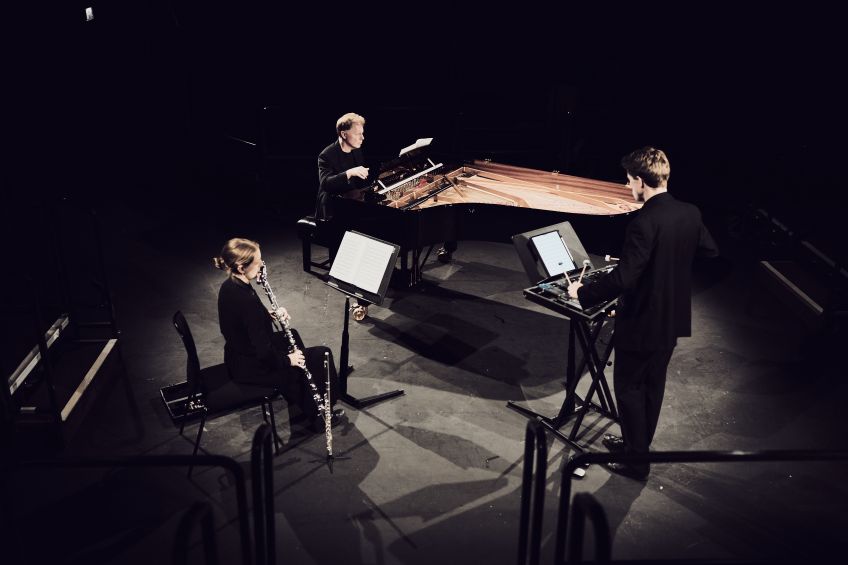
Feldman’s beguiling Why Patterns? composed in 1978, was played by Tim Horton (piano) Lewis Lee (glockenspiel) and Clare Jeffries (flutes). To bathe in this unusual, beautiful sound world is a delightful, soothing experience as notes, high and low, hover and float on the air on a thirty-minute avant-garde journey, full of raw, very immediate, rhythmic innovation. Changing tempi and complex configurations of piano, glockenspiel and flute (alternating bass and alto flutes, too) bring clinks, plinks, bell-like tinklings and heavenly reverberations that flow in calm beauty in spite of their often spiky, disconnected nature. Why Patterns? answers its own question: elements of predictable patterns of ascending or descending notes and progressions, repetitions, arpeggios and ongoing riffs emerge along the way, elements that, by their very nature, soothe, reassure and charm the human psyche, while the impact of the sparse, spiky, enigmatic and off-kilter beguiles with fresh wonder, each note delicately, lovingly, tunefully placed. Enthralling.
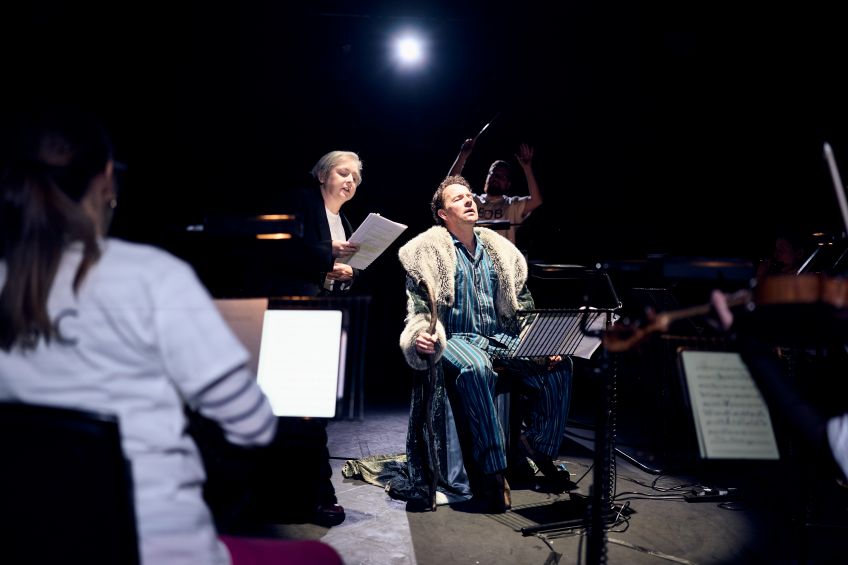
After words and then music, comes Words and Music, a composition about composition itself, played out in a mix of dramatic dialogue and live music that explores the profound relationship involved in closely combining the two. Song and word partnerships result in exceptional creations (Gilbert and Sullivan, Rodgers and Hammerstein, Elton John and Bernie Taupin, Lloyd-Weber and Tim Rice etc) yet partnerships are almost inevitably also subject to battles and bitter conflict at times – as we now see.
Written as a radio play, the original music for Words and Music came from Beckett’s musician cousin John in 1962. In 1987, though, not long before his death, Morton Feldman partnered his friend Beckett in this “text-music tandem”, coupling a sparse, uneasy, minimalist score with Becket’s deep philosophising. In spite of Beckett’s tyrannical control over all aspects of direction and delivery onstage, Feldman had free rein to do his own thing with the music. So he did.
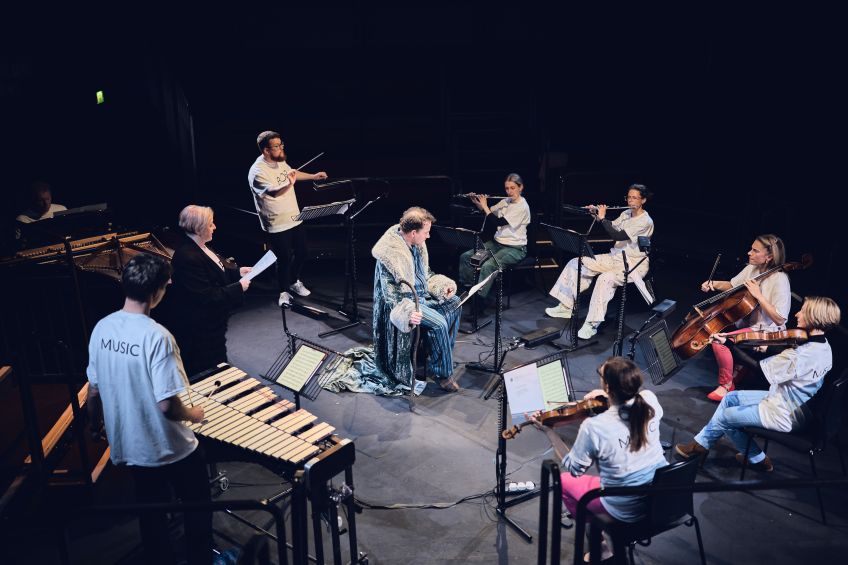
Adding visual performance to a radio play does distract somewhat from a drama all about sound, but it also adds interest and humour. On the radio, with no physical form, an invisible grumpy, mysterious being, Croak, despairs as he commands in vain an invisible Bob (representing music) and an invisible Joe (the words) to come together in harmony. Onstage, into the little arena of the Crucible Studio parades an entire string of musical Bobs, the name Bob writ large on their white T-shirts as they take their places to play piano, xylophone, flute, piccolo, violin, viola and cello or, in the case of George Morton, to conduct the choppy, fragmented proceedings, which involve loud tuning up and a good deal of discordant music that sounds like tuning up. The T-shirt of Siobhan McSweeney alone reads “Joe”, and on the reverse, “Words”. She like Jonjo O’Neill’s Croak reads out her words from a paper script as if in a radio studio.
In this minimalist allegory, words and music are at loggerheads, trying to outdo one another, drowning each other out and failing to come up with anything harmonious or constructive as the despairing, grouchy Croak, in dark pyjamas and fur-edged velvet gown, shuffles about, taps his shelalagh and groans. He orders them to collaborate on a theme, but all is friction, tension, competition, frustration, muddle and incompetence – a complete shambles! A section does emerge when words and music flow together in delightful harmony – but it doesn’t last. After another effort Croak finally drops his stick, shuffles away and all ends (of course) in silence. It all goes to show how difficult human communication is in whatever form, but maybe music does have the edge over words. Still, with Beckett seeing human existence as absurd and the struggle for meaning completely futile it hardly matters, anyway.
A unique, intriguing programme of pieces – for one night and for one night only.
Eileen Caiger Gray