

Here is Chapter Two of our travel writer Nigel Heath’s French home-owning odyssey
Our Stairwell Discovery
Now as we sailed out from Portsmouth early on a sunny morning in late July, we began pondering the challenges which lay waiting just over the horizon.
We would soon become familiar with the 90-minute drive due south, firstly along the dual carriageway away from Caen, through a flat landscape dotted with small towns and wind turbines and then on along quiet roads through a more rolling and wooded landscape.
Driving down a long hill and around a sharp bend, we crossed a flower-decked bridge to enter the charming 13th century village of Puntanges-Pont-Ecrepin on the banks of the meandering River Orne.
We were to stop here on many occasions over the years ahead to have lunch at the hotel overlooking the square.
From there, the next milestone on our journey was the hilltop town of Le Ferte-Mace, and a few miles beyond that, the spa town of Bagnoles-de-Orne, hidden from view in woodland below.
Now after passing through the small crossroads village of Couterne, it was a short drive up and over a plateau, across the top and down into Lassay, where our friends who had encouraged us to buy the house had “put the kettle on.”
Just after 10am the following morning we drove down to the square and in a state of nervous excitement, duly presented ourselves at the property agency to collect our house keys.
But alas our friendly English-speaking agent, Marc, had clearly not received our email saying we were coming and had now gone off on his long summer vacation without leaving his staff any instructions.
To make matters a whole lot worse, we had to notify EDF, the electricity company, that we had taken possession and give them the details of our new French bank account.
This should have been a relatively easy exercise, but we had since been told they had recently changed their policy, so the switch now had to be made by the applicants themselves at their offices in the nearby town of Mayenne and not by a French person acting on their behalf.
After a couple of confusing minutes, Marc’s most helpful lady assistant, Monique, whose English was light years ahead of our French, had produced the house keys and wonder of wonders, she volunteered to call EDF to see if she could get the transfer made for us.
It took what seemed like ages for her to navigate her way through all the electronic telephone options, which would probably have floored all but competent French speakers, and then we all sat around listening to a lively jingle and waiting for an advisor.
A highly tense 20 minutes later, punctuated by the agent relaying unexpected questions about insurance and other options to two more or less uncomprehending Brits, and the transfer was completed.
We thanked Monique profusely, called in at the elderly florist next door and returned with an orchid as a token of our heart-felt appreciation.
We had one more favour to ask and that was for her to return to the shop with us and explain that we wished to send flowers to the elderly lady from whom we had purchased the house. As the florist was our new neighbour and this was a small place, it was clear she would know where to deliver them.
Mission accomplished, we picked up the house keys and were soon entering our new holiday home.
Then challenges two and three presented themselves in rapid succession. There were no keys to the French windows opening out onto the street and we had an antiquated hot water system operating at full steam ahead, with no obvious way of turning it off.
Monique called the previous owner’s family, who arrived hot foot from a nearby town the following morning. They had managed to find two keys, which fitted, and we eventually figured out how to turn off the hot water.
Had their mum received the flowers, Jenny enquired using Monique as her interpreter? She was now in a care home just up the slope from the rose garden and had been delighted with them, came the instant reply.
The next fortnight vanished in a haze of dust and internal demolition as we literally gutted the interior of our 200-year-old-property.
There was never a thought for the fact that for every hour we spent in destruction mode, there would be literally months of renovation work ahead.
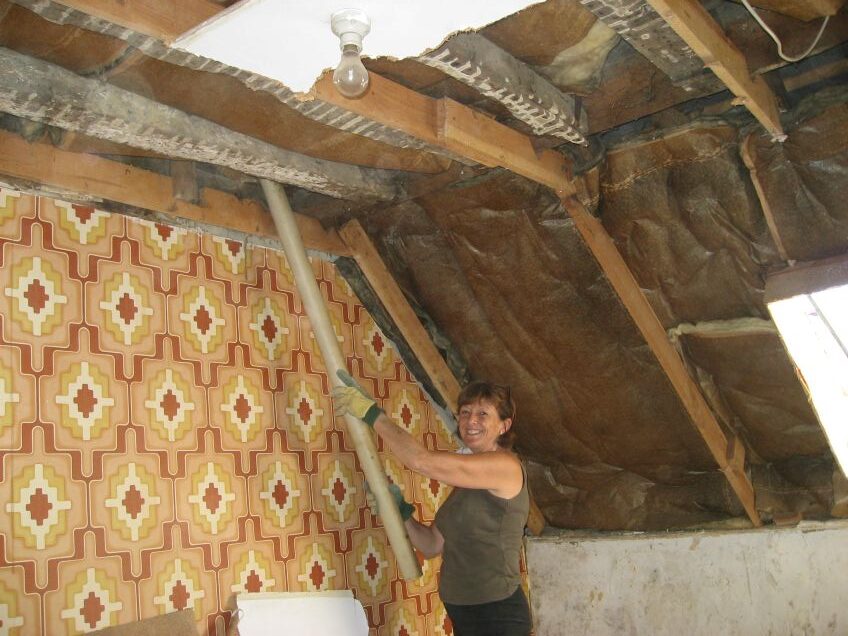
The stairwell from top to bottom was decorated with a ghastly and now faded floral patterned wallpaper so it would have to come off we agreed on that first memorable day in our new home.
I tried tearing off a strip, but wait a minute it was adhered, not to a solid wall, but to large sheets of hardboard, so they would all have to be removed straight away, we agreed.
I managed to get the claw end of a small hammer head behind the bottom sheet of hardboard and began applying a little pressure. I felt it giving just a little, so I applied more pressure and then with a tearing sound, it suddenly came away and I was covered in clouds of dust, as it fell into the stairwell beside me.
There, now totally exposed in front of us, was the original lathe and plaster wall, which had not seen the light of day for many a year and would now have to be completely replastered by a professional at some later stage and that was not going to be cheap, we reasoned.
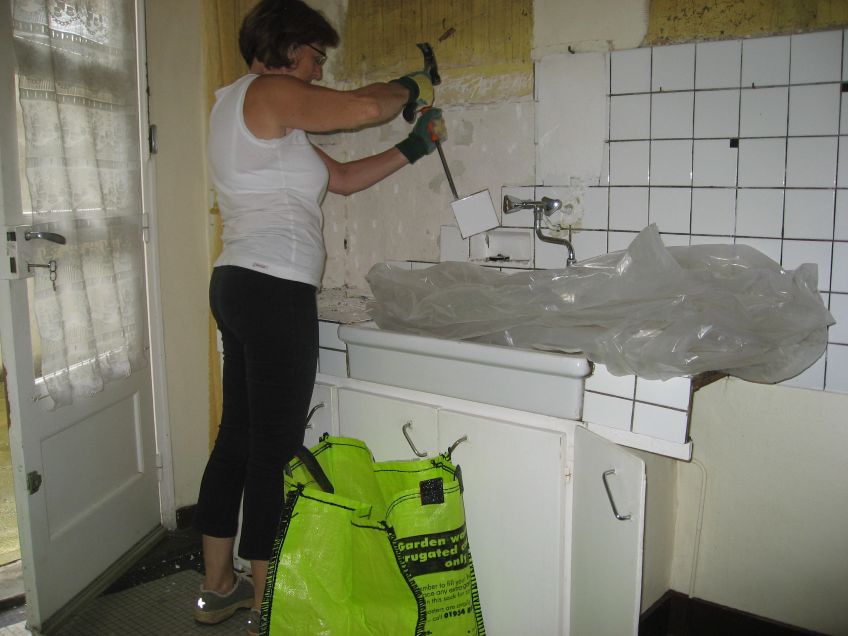
Needless to say it took me hours working my way slowly up the stairs and removing the old white door leading to the top landing enroute, while Jenny got cracking, stripping off the old white wall tiles in the kitchen and later stripping out the smaller of the two top bedrooms
For lunch, we nipped through our alley for pints of cool and refreshing lager, while munching our way through a couple of large cheese baguettes
By mid-afternoon, our Ford Galaxy affectionately known as The Gal, was full of hardboard sheets so the first of endless journeys to the dechetterie, or local tip, was needed.
This, we had earlier discovered, was back up the main road out of the village, past our insurance agency and a turning off to the left and was an endless hive of activity during all its opening hours.
Here we often set eyes on other Brits on similar waste disposal exercises like ourselves as they moved their assortment of cars, vans, and pick-up trucks from one skip to another.
We soon began to realise we were part of a huge migration of English folk from all over Southern Britain, crossing the channel and buying up lovely old properties in a sorry state of repair and converting them into holiday homes, tempted by what to us Brits were ridiculously cheap prices.
Take our house for example, if it had been situated in an English country village with a separate barn and garden it would have cost closer to £750,000 and not be all ours for £58,000 plus the £30,000 it was probably going to have cost by the time we had finished.
The French, it soon seemed to us, generally preferred to abide in neat homes surrounded by lawns on small new estates at the edge of towns and villages and there were already several of these around Lassay.
One of the reasons for this, we learnt, were the French inheritance laws, whereby all the children and not the spouse, have an absolute right to inherit part of a deceased person’s estate.
That would be fine if all the children were in agreement over the division of their inheritance, but if they were not and that was often the case, then old properties could be left empty for years and even eventually fall down.
This is probably a complete generalisation on my part, but it seemed to me that many young married couples in the vast areas of rural France would far prefer a new home to moving into an old one, often in need of complete renovation.
As I was leaving, I also noticed a separate concrete-based bay, wherein lay a mini mountain of what looked like compost with several folk busily shovelling it into wheelbarrows and sacks.
Again, I later learnt that all the green waste tipped into the appropriate steel skip was carted away, turned into compost, and then returned for villagers to take away free of charge!
What a brilliant idea. Why couldn’t we do something like that back home in Wales I thought?
During the course of that first, never-to-be-forgotten fortnight, besides stripping out the stairwell, we also managed to dump the old maserator from the first-floor bedroom, destined to become our bathroom, get rid of the old wood burning stove and clear the kitchen so it was back to being an open and airy space.
But we did not venture onto the top floor because that was going to need some far more experienced assistance.
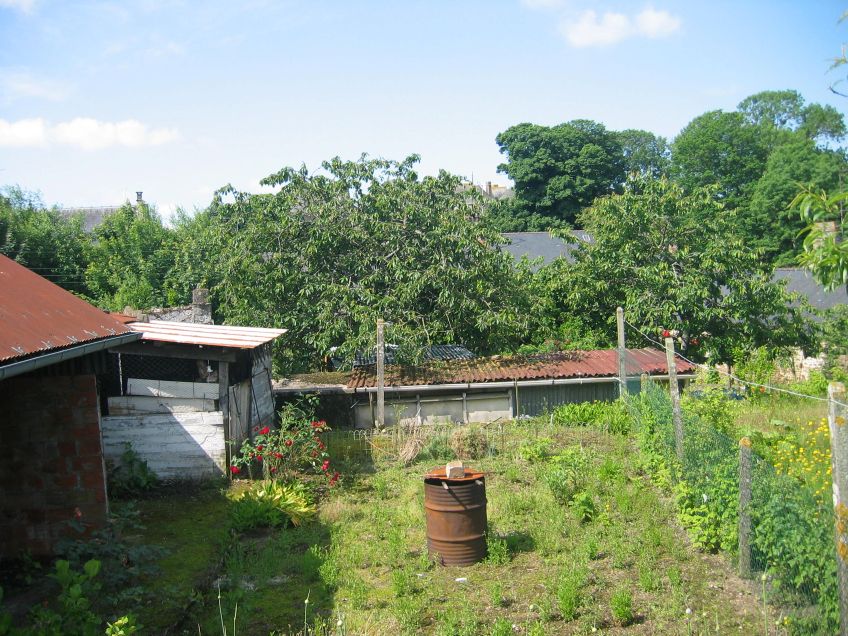
When we were ready for a change of scene, we took our precious heavy metal key and some bottles of water, together with an assortment of tools, and headed for our ramshackle old barn and completely overgrown garden.
This had huge potential because Jenny is a keen gardener and her cottage garden back home in Wales is a picture from Spring until Autumn.
Our way led back along Rue Dore, past a derelict hotel on the corner, across the main road and through a couple more small streets with old houses, to emerge onto a quiet lane leading directly past several more houses and up to our barn and small walled garden.
The key turned easily in the old wooden door and we stepped into the barn with its ground floor open to the garden on the right, which we had not set eyes upon since our whistle-stop visit with Marc some five months earlier.
The first thing I noticed was an old wooden ladder giving access through and open trap door to an upper floor and the temptation to climb it immediately was irresistible.
Popping my head through the opening, I gazed along an empty space, luckily high enough to stand up in the middle and with a planked wooden floor, which looked capable of taking my weight.
In a few moments I was up on my feet under the roof made of old corrugated iron sheets and looking down into the garden. What a great storage area this was going to be for our tools and other things.
Walking along the open garden side of the barn, we came upon a lower single-storey corrugated section with and old chicken shed coming out at right angles.
Something made me look down and there, almost hidden among rampant clumps of weeds, was a small knife with an open blade. “I wonder what that might have been used for,” I said, half-thinking I already knew the answer.
Standing back and surveying the scene, we realised that if we demolished the chicken shed and then stripped the corrugated sheets off the lean-to, we would create a large pergola for grape vines and so our creation of an English garden in a French village began to take shape.
In Chapter 3 of Our French Pied-a-terrre Adventure to follow we take a well- deserved day off.
You can read Chapter 1 of Our French Pied-a-terrre Adventure by following this link.