Joyce Glasser reviews Alessandro Mendini at the Estorick Collection, London until 10 May 2026
When you walk into the two large, airy rooms of this, the late Alessandro Mendini’s first exhibition in the UK, you might think you got off at the wrong underground and are in the Young V & A in Bethnal Green. The Pop Art colours, the doll-like sculptures and objects, the miniature chairs, the Alice and Wonderland-like oversized arm chairs and whacky furniture are bright, bold and so much fun!
But then you see that you cannot touch. And gradually you realise there is a strong intellectual undercurrent at work connecting this world famous designer and architect to a tradition of 20th and early 21st century European art and literature in ingenious ways.
Young Mendini’s career was predestined in a case of nature and nurture. Born in 1931, he was raised in a Milan household surrounded by modern paintings, including works by the futurists (1909-1944) who were to exert a strong influence on his art.
In the first room we are greeted by a set of masks in enamelled metal – each one very distinct and assigned to six Futurists: F.T. Marinetti, Boccioni, Sant’Elia, Severini, Giacomo Balla and Fortunato Depero, to whom Mendini also dedicated two abstract tapestries with futurist motifs. The masks were made shortly before Mendini’s death, as if these were death masks to accompany his soul and his work into posterity.
Mendini knew a lot about the Futurist artists behind the paintings on the walls of his family home. Sixteen years before his birth, Balla and Depero had published their manifesto Futurist Reconstruction of the Universe which appealed to Mendini much more than Marinetti’s manifesto, which glorified machines, speed, and war.
Balla and Depero proposed a synthesis of artistic disciplines (which we see evidence of everywhere in Mendini’s work) and an ambition to transform the everyday environment into an aesthetic experience. It is Mendini’s witty and imaginative execution of this latter ambition that appeals to the child in all of us. Mendini wanted to downgrade function by transforming the functional objects in our lives into a beautiful and happy environment.
Considering himself an avant-gardist, Mendini’s work is inspired by key artists of the avant garde in European art and literature. Proust predeceased Mendini by nine years and he was a baby when Paul Signac, who adopted his friend George’s Seurat’s Pointillist style of painting, died, but their artistic environment spoke to him.
Mendini wanted to unlock “involuntary memories” and associations just as Proust was doing in his thick, era-defining masterpiece, Remembrance of Things Past. Proust was a writer as well as a great reader, and to read Remembrance, one would need a big, solid armchair. Signac knew Proust through artistic and social circles they shared, and Mendini decided to pay tribute to Paris’s golden age with his Proust chair, decorated in neo-impressionist dots.
Although his lively post-modernist architectural work is not included in the exhibition, Mendini was a successful designer, architect and businessman. When his Proust chair took off, he exploited it in his mission to rid the world of dreary functionalism. On offer are tiny porcelain Proust chairs, dotted coffee pots, puppets, corkscrews and watches.
But even in this exploitation he was creating “involuntary memories” because the Proust chair is, at its most basic, a nod to Marcel Duchamp who invented the “readymade.”

Mendini might object to the word exploitation. He would prefer “redesign,” a term that he owned and championed, claiming his dots were migrating to other surfaces as though design was continually evolving in a mystical, organic way when mortals are sleeping.
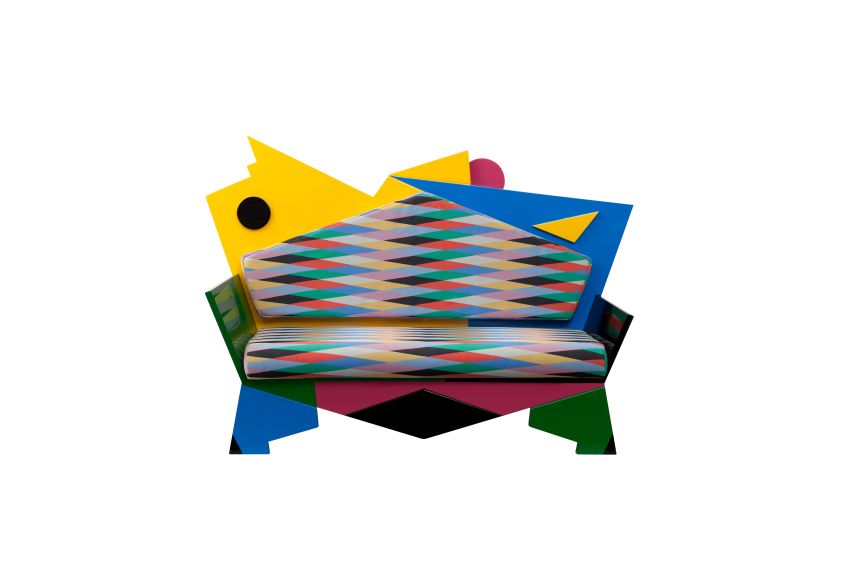
Mendini based his decorative motif for another series of objects on the abstract imagery of Wassily Kandinsky. He distorted Kandinsky to Kandissi since he was not copying but translating his reading of Kandinsky’s spiritual lessons (Kandinsky wrote the influential book, The Spiritual in Art). The Kandissi sofa, a two-seated sofa that, according to the catalogue, was eventually called the K2 “as if its destiny were to scale new heights by means of Pop colours and psychedelic fabrics.”
It is Mendini’s inspiration by the avant garde Ukrainian/Russian artist Kazimir Malevich that is the most curious, and also controversial. Malevich was famous for his Black Square (on a white background) which, in 1915, was celebrated in Russian culture as arguably the first great abstract painting. It was heralded as the pinnacle of the Suprematism movement which aimed to move away from figurative art.
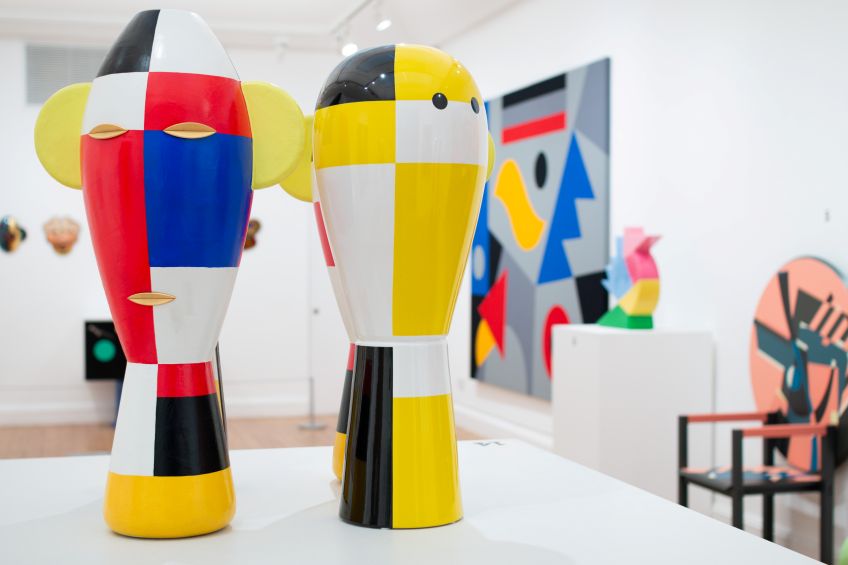
But in the late 1920s until his premature death from cancer in 1935 Malevich switched to figurative painting with a kind of naïve “peasant art.” Mendini latched onto this “abrupt shift” with his “Neo Malevic” designs. He celebrated Malevich’s versatility and his embrace of popular culture, which was at the centre of Mendini’s design world. If Giotto’s Angel – the most beautiful object in the exhibition – is a Neo-Malevic, this nod to Italy’s 14th century painter of angels is an odd one.
But there’s another ambiguity. There is no evidence in the exhibition or catalogue that Mendini appreciated that Malevich was forced by the Stalinist dictatorship to accept the Soviet idea of popular culture. His Black Square was condemned as “bourgeois” and “counter-revolutionary.” In the event, Malevich died in poverty and obscurity always signing his reluctant peasant art with a defiant black square.
Main image: Kandissi sofa, K2
Middle image: Neo-Malevic totums with Futurist tapestry (For Depero)
Bottom image: Kandissi, acrylic, untitled