

Joyce Glasser reviews Eleanor the Great (December 12, 2025) Cert 12A, 98 mins.
‘A’ list actresses Scarlett Johansson and Kate Winslet are both making their feature directorial debuts this week, and both directors made a conscious decision to give older, female actresses meaty, central roles. Hurray!
Winslet’s Goodbye June, stars 80-year-old Helen Mirren. Johansson’s Eleanor the Great stars 96-year-old June Squibb as the eponymous Eleanor whose epithet is neither earned nor ironic. While Squibb enjoys her late blooming film career, Johansson is sidelined by first-time scriptwriter Tory Kamen’s complex psychological drama whose potential is lost in a muddled and contrived story.
Since the death of their respective husbands, twelve years earlier, decades-long friends Bessie Stern (Rita Zohar), who is Jewish, and Eleanor Morgenstein (June Squibb), who converted to Judaism upon marriage, have lived together in Florida.
Suddenly one night Bessie confesses to her friend that she fears dying before being able to tell her, and, in particular, her murdered brother’s, Holocaust story. Bessie recites her story in tears, with a strangely old-world accent. The story is fictional or “stock” Holocaust and we are so removed from the story that audiences are unlikely to share Bessie’s emotion. Shortly thereafter, Bessie dies, leaving Eleanor distraught and lost.
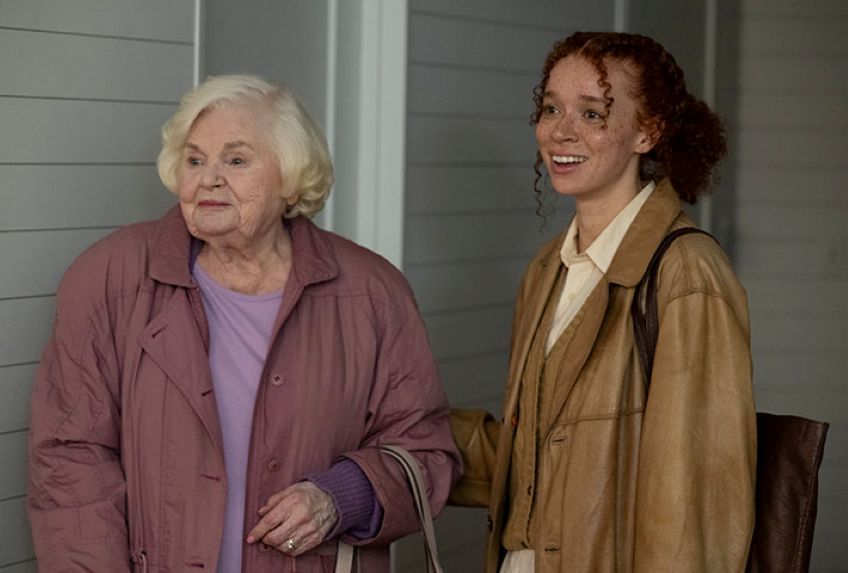
Eleanor’s daughter, Lisa (Jessica Hecht) moves Eleanor to her apartment in Manhattan which she shares with her teenage son Max (Will Price). A single mother who is opening a new restaurant, Lisa arranges for Eleanor to go to the Manhattan Jewish Community Centre where the lonely, old lady can make friends. Due to a misunderstanding that Eleanor does not correct, she ends up in a Holocaust Survivor’s Group and moves everyone (except the audience) to tears passing off Bessie’s story as her own.
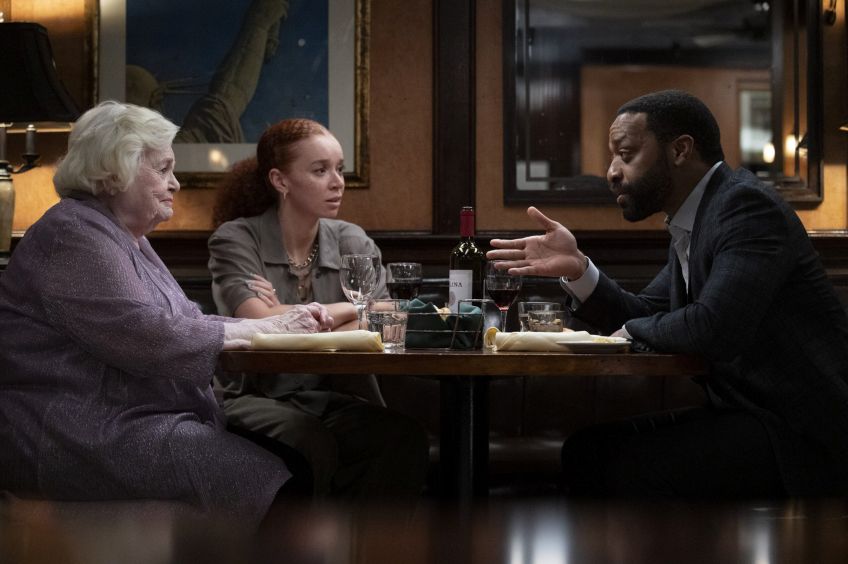
Auditing the session is sensitive, mixed-race college journalist, Nina Davis (Erin Kellyman), who is, by coincidence, grieving the recent death of her Jewish mother – or trying to. She is struggling to connect to her father Roger Davis (Chiwetel Ejiofor), a popular network news anchor, who is dealing with grief by distancing himself from his own emotions and from Nina.
Predictably, Nina bonds with Eleanor, who sticks to her own story of loss and loneliness, and, in time the two become fast friends, eating pizza, walking the High Walk, shopping together and discussing old age. ‘How is it being 94’, Nina asks. ‘I don’t know, I feel the same as when I was 16’, she replies.
And feeling 16, Eleanor decides to be Bat Mitzvahed in a ceremony attended by Nina and Roger, who considers the story newsworthy. Lisa, who is snowed under with the launch of her restaurant, hasn’t a clue what’s going on until Max gets wind of it with disastrous results.
The first problem is that the film’s protagonist is not a sympathetic or credible character and Squibb, valiantly trying to make her so, is miscast. Squibb who was feisty-funny and perfectly cast in last year’s Thelma and stole the show in Alexander Payne’s Nebraska with some of the funniest one-liners since Maggie Smith in Downton Abbey, but Kamen doesn’t give her any.
Early on we witness Eleanor humiliating and dressing down a young, minimum wage supermarket stocker for not knowing where the kosher pickles are if they are not on the shelves. Her daughter is opening a restaurant in Manhattan – a huge, stressful, risky undertaking – and Eleanor doesn’t show any interest.
Nor does she show any interest in her grandson, preferring the unreal Nina, a contrivance if ever there was one.
The Davis family subplot quickly takes over the main story as Eleanor’s transgression is somehow the key to reuniting father and daughter in their grief. Although Nina’s father is Black, he not only married a saintly white woman, but a Jewish one at that, who dies tragically young leaving father and daughter burying their grief in their respective work – which soon centres on Eleanor’s grief. It’s not unfeasible, but here feels contrived.
And to push the contrivance further, Roger is in a perfect position to publicise Eleanor’s story, which is a fiction of a fiction because he is a big television personality. Oy vey!
Nothing about the script quite makes sense. If Bessie and Eleanor have been friends since the secretarial pool in their twenties, can it be possible that Eleanor would not have learned about her best friend’s background in the holocaust until the day before she dies? Isn’t there among best friends a sharing of photos and memories of how you spent World War II?
And why doesn’t Eleanor ever tell the truth? All she has to say is that she was not passing herself off as Bessie, so much as trying to honour her friend by telling her untold story. Surely people would be more sympathetic to that and, here’s the pity: it would make a more plausible premise for a thought-provoking film.