
Joyce Glasser reviews The Blue Trail (April 17, 2026) Cert. 15, 86 mins. In UK & Irish cinemas.
With not only Japan, but all of Europe worried about an aged population and a declining birthrate, it was only a matter of time before filmmakers mined the issue’s dramatic potential. Japanese director Chie Hayakawa’s Plan 75 (2023) presented a depressing, quasi realistic tale of an elaborate state sponsored euthanasia programme that is only nominally voluntary. Brazilian director and co-writer Garbriel Mascaro’s (August Winds, Neon Bull) satirical thriller The Blue Trail takes a more engaging approach to state sponsored euthanasia, in which the Amazonian plays a revealing role.
Somewhere between a grim, dystopian, macho adventure saga like The Road, and a dark social satire about ageing like The Substance, The Blue Trail is set in the near-future or in a parallel universe where a cash-strapped government obsessed with economic productivity comes up with a drastic solution.
In Japan, 30% of the population is over 65 and in the UK, it’s 19.5%. In Brazil, the percentage of over 65s is only 10%. But if that government’s fixation on productivity and its short-sighted, narrow-minded plan to achieve it sounds familiar, it’s worth remembering that feature films (Oscar nominated I’m Still Here and The Secret Agent) are a Brazilian export.
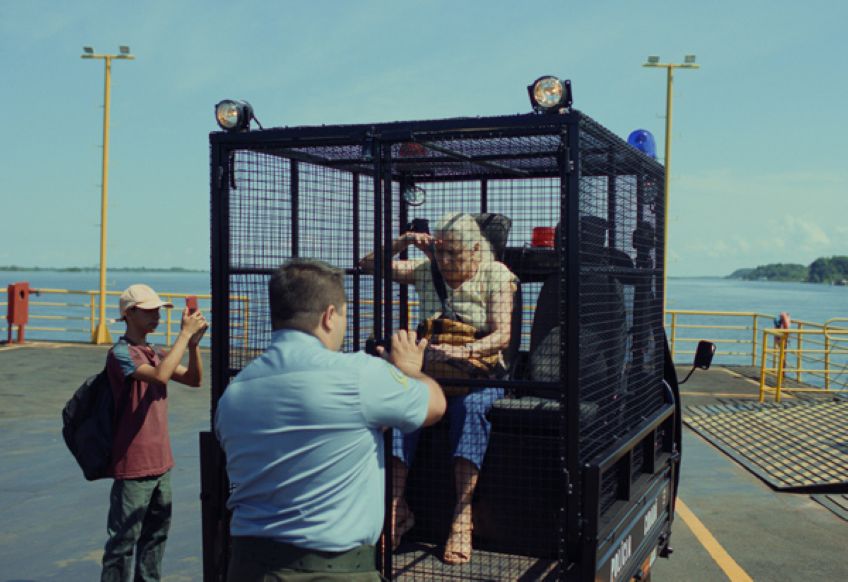
Nervous older people are starting to notice. The burdensome over 75s are being rounded up in “wrinkle wagons” and transported to the Colony, a euphemistically designated retirement community.
For years single-mother Tereza slaved in a crocodile skin factory to give her daughter Joana (Clarissa Pinheiro) a better life and, one day, to realise her own dream of flying. Tereza is tipped off to the reality of the Colony, from whence no one returns. The only way around this fate is to escape.
But escape is all but impossible. Under the government’s new laws, Joana becomes her mother’s guardian with full power of attorney, and the expectation that she will do the state’s bidding. All doors are shut to the older person without a guardian’s written permission. Instead of being grateful for her mother’s sacrifice and helping her escape, Joana selfishly thwarts Tereza’s flight plan.
Here, Mascaro cranks up the irony as Tereza proves every bit her daughter’s – and the state’s – match. Productivity is not the domain of the young. She cleverly evades the authorities and embarks on an Odyssey as varied and surreal as Ulysses’s, although it lacks a good ending.
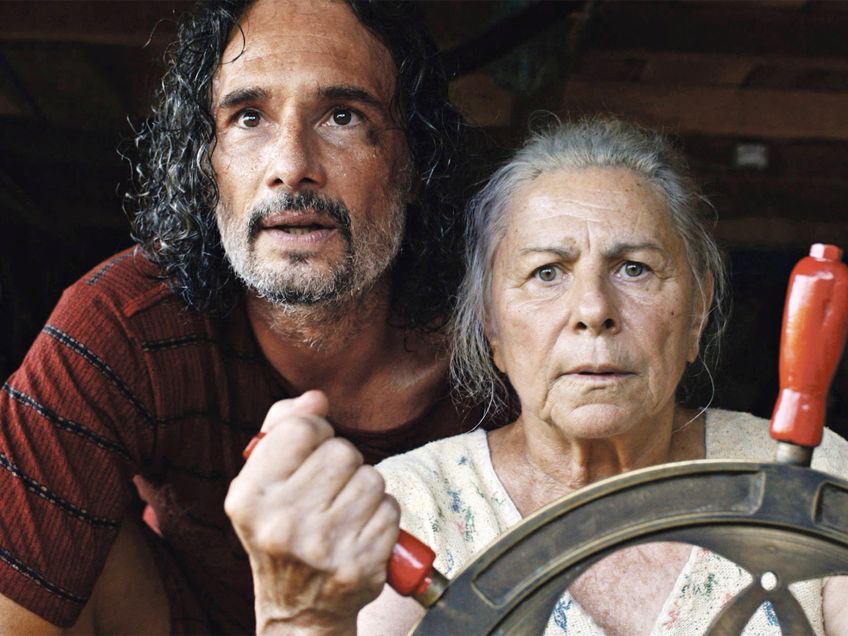
Substituting the Amazon River for the road, Mascaro despatches his 77-year-old protagonist Tereza (Brazilian actress/theatre director Denise Weinberg) on a rebellious quest of self-discovery, like the trail of the blue slime snail.

Along the way Mascaro pays tribute to The African Queen, sending Tereza to the cargo port of Itacoatiara with Cadu (Rodrigo Santoro), a heart-broken riverboat merchant. Their rocky relationship grows when Cadu teaches Tereza to operate his boat and puts her in charge, while imbibing the hallucinogenic bile of the blue snail.
Conspicuous and in danger of being apprehended as an elderly woman alone, Tereza joins forces with maverick septuagenarian Roberta (Miriam Socarras). Roberta, known as “The Nun,” has escaped the Colony by hawking bibles and blessings from the boat she owns. On the river everything is for sale.
Eager to secure her future, Tereza, who abhors gambling, sneaks away one night to stake Roberta’s boat on The Milky Way, an endangered fish in an illicit casino.
The marvellous Weinberg is no instant wonder woman. She takes us along on a journey with a steep learning curve during which she survives on instinct mixed with rapidly gained experience. As a fugitive Tereza discovers her own resilience and unwittingly turns every threat into an opportunity.
Mascaro eschews the needy, helpless, submissive Japanese seniors in Plan 75 and creates in his 77-year-old protagonist a heroine for our times. In the process, he shows us an unromantic side of the Amazon and an unsentimental side of old age.