
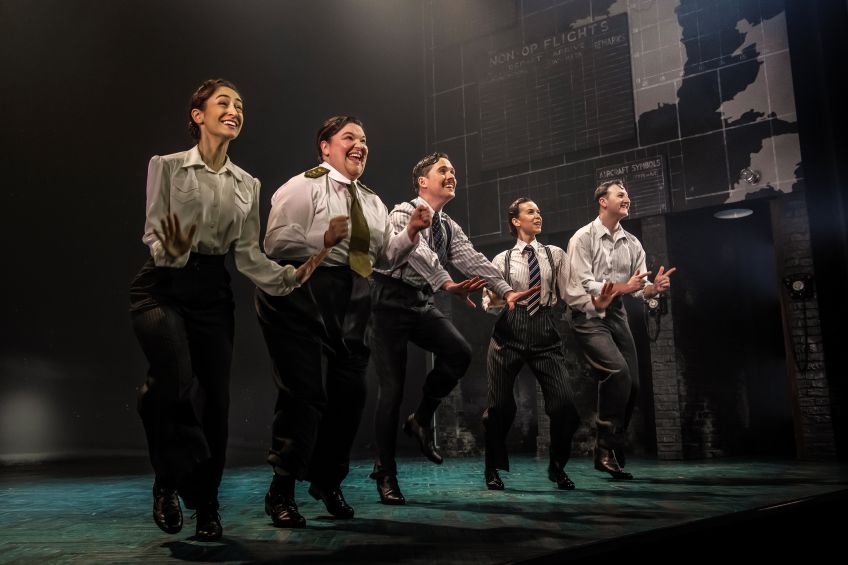
Creative joy, exuberant enthusiasm, intimate charm and vibrant talent pour forth on all fronts from start to finish in a show, directed by Robert Hastie, that’s perfectly unpretentious and unpretentiously perfect, while the personal relationship that the performers establish with the audience is very special indeed.
To take a bizarre, somewhat macabre, true story from WWII and turn it into a whimsical, comical, singing, dancing, endearing musical seems unlikely until we consider what the likes of the Monty Pythons or Terry Deary and the Horrible Histories teams have done. Then it becomes blatantly obvious that perfect nonsense very often makes perfect sense. It makes perfect entertainment, too, especially when tempered with appropriate respect and sensitivity.
The story boils down to MI5’s quirky brains being racked in 1943 to come up with a cunning plan to get Nazi troops to move off the island of Sicily so that Allied troops could land there with the Nazis expecting them not to. The quirky plan was…to source a suitable corpse from a mortuary (or whimsically in song – “gather a cadaver”), launch it into the sea off the coast of Spain, then let it wash ashore with various falsified papers stashed about its dead person, which Nazi spies would (hopefully) seize upon and be fooled by. Hmmm.
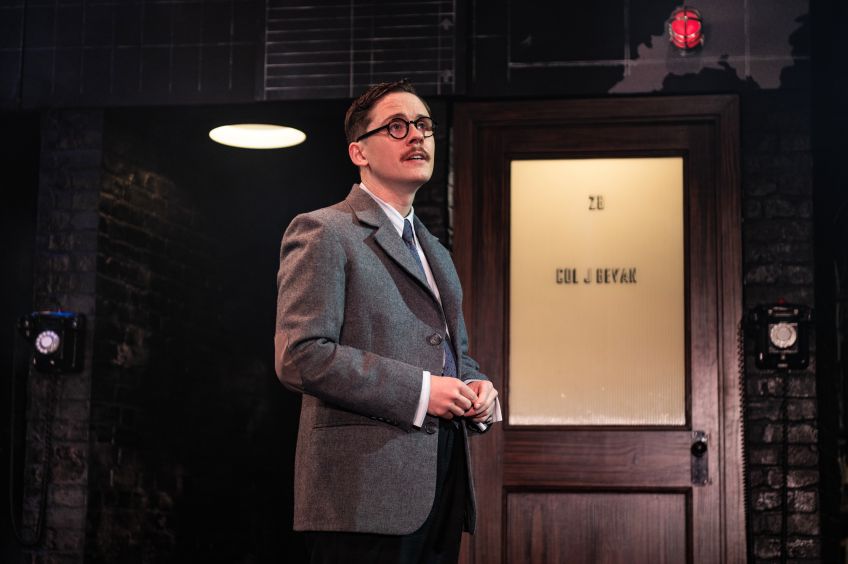
A fine, song-and-dance-free film of the operation was made in 1956 in The Man Who Never Was, all in black, white and shades of grey. This musical version, written by its original four performers, grew up through the pandemic era to accelerate skywards into a colossal, award-winning West End/Broadway phenomenon. Now it’s touring the world. A 1940’s black/white greyness is retained onstage in Ben Stones’ set, a section of soot-blackened, pock-marked London brick wall standing to the side of MI5’s tall, tall office walls of squared, black and white grids and blackboards. Here hang clipboards, a clock set forever at 11.00 o’clock (the end of WWI), and big black phones with long, curly cords just waiting to get their wires crossed. But don’t be fooled by all that drab grey and the plainness of MI5’s wooden desks! At any moment, shimmering, dancing neon lights and breathtaking, colour-drenched, decibel-laden light-shows may burst forth to stun with glitz and glitter, and even a humble blackboard may hide surprises. And the finale? Well, think BIG.
With performers embodying rather than enacting their wonderful characters, the acting is superb; every detail of delivery and comic timing is meticulous, as is the clarity of diction, both spoken and in engaging songs that number almost a score. The cast’s individual, natural voices blend deliciously in harmony and no-one adopts any annoyingly homogenous, big-belter “musical” style even in bigger numbers. Furthering mood and narrative come ballads, folk shanty and quick-talking, word-rapping, patter-chatting songs in intriguing, intimate variety, sensitively orchestrated for drum, bass and key combinations (with beautifully sparing piano parts for ballads) while delightfully choreographed movements and routines add further special charm throughout.
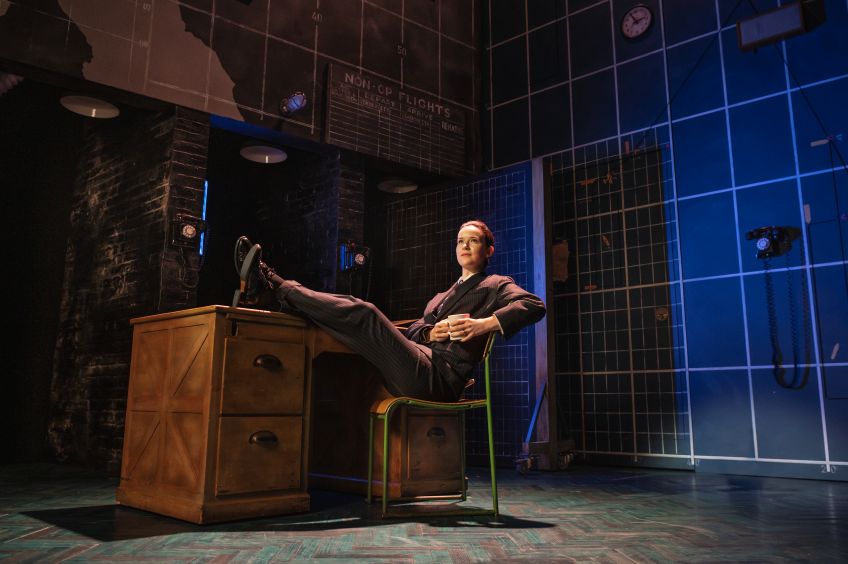
The many gender-switched roles work beautifully, especially with digs and witty quips on gender roles and privileged classes dropping freely into the mix, and its charisma all the way in the performances. Holly Sumpton commands the stage with captivating sparkle, especially in her main role as smartly be-suited, well-spoken man of utter privilege, Ewen Montagu, while tall Christian Andrews also totally captivates as delightful Hester Leggatt in trousers, shirt and braces with a long kiss-curl right in the middle of her forehead. His Spilsby, creepy corpse-supplier, works a treat, too, in black apron, patterned with handsome bloodstains of red glitter, while his US airman (complete with plane!) also nicely hits the mark. Jamie-Rose Monk shines as Col Johnny Bevan, strong, loud and in command, also playing MI5 agent Ian Fleming in bow-tie and tux, always at the ready with ideas for inventive, highly impractical gadgets and missions and tedious plots for a novel. Charlotte Hanna-Williams takes the more traditional female role as secretary/tea-maker/imaginative brain Jean Leslie, joining the others at the drop or swap of a hat to become a Spaniard, submariner, shiny, spoof Nazi, Yank or caricature Cockney. As shrinking, shoved-aside Charles Cholmondeley, the chap who actually comes up with the successful plan but is too shy to say so, Sean Carey is wonderfully endearing – non-loud, non-forceful and obviously, therfore, a non-Eton boy.
Some of the character changes and changes of set, costume and/or props are performed in the breathtaking blink of an eye, at the drop of a woolly hat or in the sudden flash of a torch, while the BIG full-on, glitzy-glam finale delivers not just top-hat dancing down a big, brightly lit staircase but aerial dangling from ropes and the rapid descent of A Genius Man into Anus Man.
Poignant respect and reverence is duly paid to the man who truly was instrumental in helping win the war, Glyndwr Michael, a Welshman in life who died homeless in London but who became a hero in death with his forged identity and staged drowning as William Martin. He was buried in Huelva, Spain with full military honours, his name added to the grave in 1996 when his true identity was at last uncovered.
Swept up and carried along on never-ending waves of joyful excellence and tides of comedy, intrigue, song, dance, beautiful lighting, sudden surprises and actual, historic facts, audiences everywhere enjoy the same elation and exhilaration, for the whole thing is decidedly outstanding.
Eileen Caiger Gray