Joyce Glasser reviews Exhibition on Screen: Turner & Constable (March 10, 2026) in cinemas
After going on the run with Caravaggio from the papal palaces and back allies of Rome to glory and disgrace in Naples, Malta and Sicily, the intrepid Exhibition on Screen duo David Bickerstaf (director and co-writer) and Phil Grabsky (producer and co-writer) are back on home soil taking on two of the biggest names in British landscape art: J.M.W. Turner and John Constable.
To mark the 250th anniversary of the artists’ births (23-04-1775 and 11-06-1776) the film coincides with Tate Britain’s ambitious blockbuster: Turner and Constable, Rivals and Originals on until 12 April 2026. With over 170 paintings and works on paper – several borrowed from U.S. museums, and private collectors – this is the first major exhibition to showcase the two artists, revealing their intertwined lives, careers and legacies.
Whether or not you approve of the side-by-side approach, the film guides you through the overwhelming content, miraculously managing to cover the essentials in ninety minutes. We are given time to take in a painting before or after a perfectly judged commentary by four articulate experts who do not interrupt our visual experience by talking over a painting. The title and date of each artwork is helpfully captioned on the screen.
Anxieties about the Napoleonic wars (restricted travel focused painters and buyers on local beauty) social injustice, political upheaval, and industrialisation and advances in science filter through the art works. Both artists were inspired by romantic poetry and affixed to their titles the poetry of James Thompson, read in the film by Robert Lindsay.
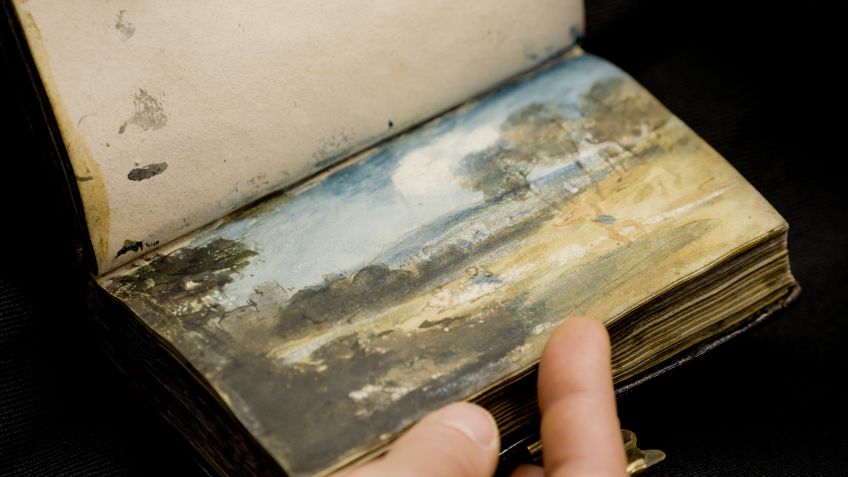
We learn about the artists’ respective painting techniques, styles, palettes and preparatory studies. Constable’s often criticised rapid impasto brushstrokes are the result of painting in oil outdoors long before the Barbizon School and Impressionism. Turner relied on sketchbooks, using recently manufactured blocks of watercolours to compose a portable palette, experimenting with the latest colour innovations. When peace enabled Turner to travel to the Italy he had imagined, his paintings became infused with every shade of synthetic chrome yellow, creating a vibrant luminosity.
Two portraits from 1799 greet us in the first room. One is Turner’s self-portrait age 23 or 24, made in anticipation of or to mark his election to Associate Member of the Royal Academy (RA). Attired as a Georgian gentlemen he stares directly at the viewer, confidently announcing his arrival.
A Covent Garden wig-maker’s son, Turner was city-wise and commercially orientated, opening his own gallery and reaching a wider public through printmaking. His proud father would display his son’s artwork in his shop window where Academicians from nearby Somerset House, where the RA was then located, might stroll by.
At 14, Turner was accepted by the Royal Academy School, where the following year, he exhibited The Archbishop’s Palace, Lambeth, a watercolour that reflected his previous internship as an architectural and antiquarian draftsman.
Turner’s 1796 oil painting Fishermen at Sea contributed to his election to Associate Member of the RA in 1799. On display was the 21-year-old’s ability to assimilate the styles of 17th and 18th century Dutch and French marine painting and express Edmund Burke’s recipe for the “sublime,” while capturing the nation’s fascination with shipwrecks within the context of merchant traders and the Napoleonic naval battles.
The painting also announced the sea as a major preoccupation – late in life Turner adopted the persona of a retired naval officer, Admiral Booth – and his determination to elevate the lowly landscape genre to the heights of the venerated history painting. It was probably a seascape commissioned from the Duke of Bridgewater in 1800 (not in the exhibition), that led to Turner becoming the youngest member of the RA in 1802.
Ramsay Richard Reinagle’s portrait of John Constable is the other 1799 portrait in the first room, marking Turner’s arrival in London to enter The Royal Academy School in 1800. With his downcast gaze, Constable appears deep in contemplation, appropriate for a student who delved into theories of art and old masters and, as we shall see, studies of clouds. But three years later we see a self-portrait in which Constable confronts us directly with one eye and without Turner’s self-confidence.
Turner was born in East Bergholt, rural Suffolk. His father, a wealthy corn merchant, owned two mills and a boat to transport the grain to London. The first image known to have been created by Constable is a wooden fragment from the East Bergholt windmill on which, in 1792, he carved the mill and his name. This artifact (on display) expresses the teenager’s determination to be an artist despite his father’s protestations, but equally, his preoccupation with painting his father’s mills and labourers, and the changing light of the English countryside.
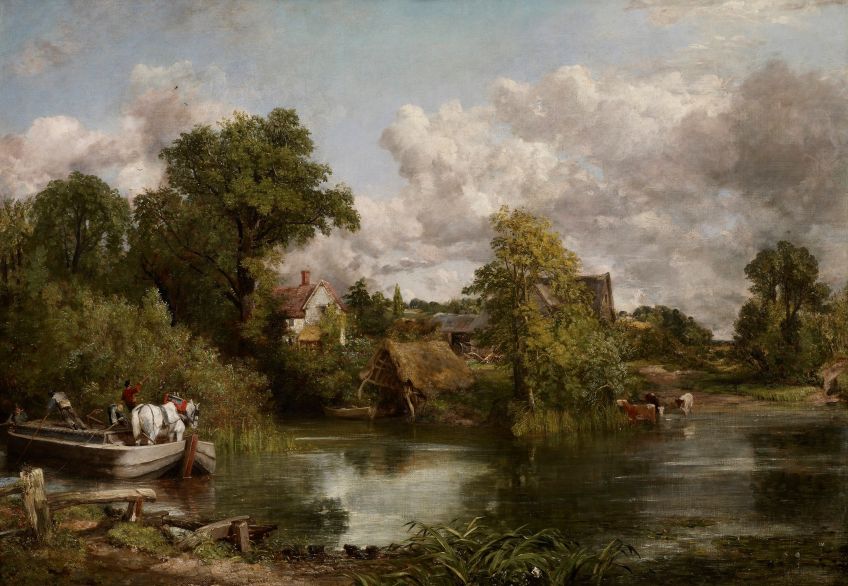
Constable was 43 before becoming an Associate Member in 1819 following the successful exhibition of his first “six-footer” painting, The White Horse, on loan from the Frick in NYC. The successful painting changed the dejected artist’s resolve, fortunes and way of painting. He ceased making completed oil paintings in situ and depended on sketches to finish the huge canvases in his studio. In contrast to Turner’s meteoric rise, however, it took Constable another ten years to be made a full Academician (1829).
Another “six-footer,” The Hay Wain, failed to find a buyer when exhibited in 1821, but was reassessed in London after it was awarded a gold medal by King Charles X of France. All of Constable’s paintings exhibited at Paris’s 1824 Salon were praised by Theodore Géricault, the great painter of the Raft of the Medusa, emulated by Turner. Recognising their radical nature and universality, Constable’s Suffolk scenes influenced a whole generation of French artists, including Eugène Delacroix.
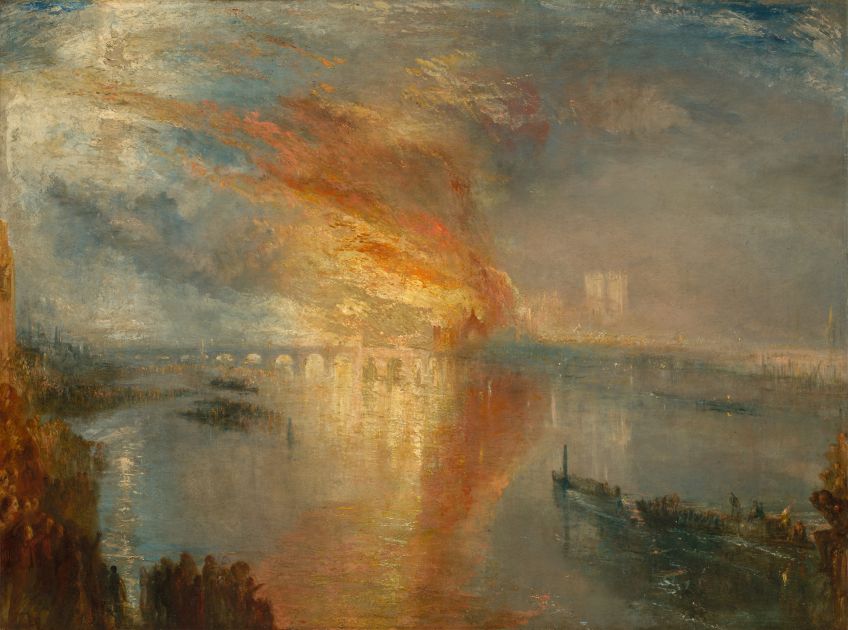
Turner outlived Constable by 15 years, neither becoming President of the Royal Academy. Once praised as the English Claude Lorrain, the 17th century painter he most revered, in later life Turner continued, in paintings like Snow Storm off a Harbours Mouth (1842), to push the boundaries of paint, but beyond the critic’s and buyers’ ability to comprehend. Yet artists today, several of whom are included in the exhibition, have run with his fiery torch.