Joyce Glasser reviews Exhibition on Screen: James McNeill Whistler (September 14, 2026) PG, 90 mins.
Do not miss the illuminating exhibition at the Tate Britain, James McNeill Whistler, which closes September 27th. If you have seen it, Exhibition on Screen’s superb documentary coverage of the exhibition will compel you to return. The extensive selection of oil paintings, watercolours and prints in the exhibition are certainly the visual embodiment of Whistler’s prodigious talents, going from the French realism of Gustave Courbet to British aestheticism to the early impressionism, that angered the staunch Victorian critic John Ruskin, just as JM Turner’s experimental later paintings had done.
But the film is better able to summon up the roller-coaster life and larger-than-life personality of the man and the theories and opinions of the artist. It accomplishes this daunting task in a lean 90 minutes through readings from Whistler’s correspondence; through his published writings (The Ten O’clock Lectures); an animated narration by Bret Jones, and through vividly evoked descriptions by the expert contributors.
The paintings are never second place, however. In the film they are markers in the transformations of Whistler’s peripatetic life: expressions of where he came from, what he believed, who he loved, how he saw, and where this visionary was going.
With Whistler, we are told, the cult of the personality was born. The various self-portraits in the film and exhibition only hint at his sensitivity, individualism and theatricality. Twenty years older than his friend (although the two fell out), Oscar Wilde, Whistler was an equally larger-than-life personality, expressing his aestheticism through his flamboyant appearance (he had a white curl in his black head of hair sometimes tied with a ribbon), the way he walked and talked, and through his aphorisms. His monogram, which we see on his paintings and the frames he designed, was an elegant butterfly with a sting in its tail.
He was a charmer, and an original, but, like Wilde, combative, earning him the credentials to pen The Gentle Art of Making Enemies. Both men’s stubborn adherence to their beliefs saw them lose everything in misguided lawsuits for defamation.
The film mercifully hurries through Whistler’s well-known libel suit against the Victorian art critic John Ruskin, retaining just the bits that illuminate Whistler’s personality and dedication to his aesthetic principles. Writing about Whistler’s 1877 masterpiece, ‘Nocturne in Black and Gold: The Falling Rocket’, Ruskin accused Whistler of “asking two hundred guineas for flinging a pot of paint in the public’s face”. When Ruskin’s barrister accused Whistler of asking 200 guineas for two-days’ work, Whistler retorted: “No;—I ask it for the knowledge of a lifetime.”
With that, he won the trial but lost his famous White House on Tite Street and declared bankruptcy. He was only awarded a token farthing which he wore on his watch chain.
The film spends longer on the famous Peacock Room dispute and rightfully so as the room is impressively recreated in the exhibition, but insufficiently labelled. The film chronicles the commission: Whistler’s patron, the shipping magnate Frederick Leyland wanted small modifications in his dining room when the Japanese influenced architect
Thomas Jeckyll fell ill. We learn how Whistler lost his greatest patron with his “improvements” that so transformed the room that the sight sent Jeckyll to his grave.
‘Ah, I have made you famous. My work will live when you are forgotten,’ Whistler told the irate Leyland. Whistler, again, was financially ruined but proven right by posterity. The room lives on in the Smithsonian Institute.
It didn’t help that Whistler had fallen in love with Leyland’s former wife while painting her portrait, Symphony in Flesh Colour & Pink from 1871-1874. Curator Susan Grace Galassi, who works amongst some of Whistler’s full length society portraits in the Frick Collection (Whistler painted 40 – his bread and butter), brilliantly conveys how Whistler channels his emotions about the sitter through his brushwork, colour and poses.
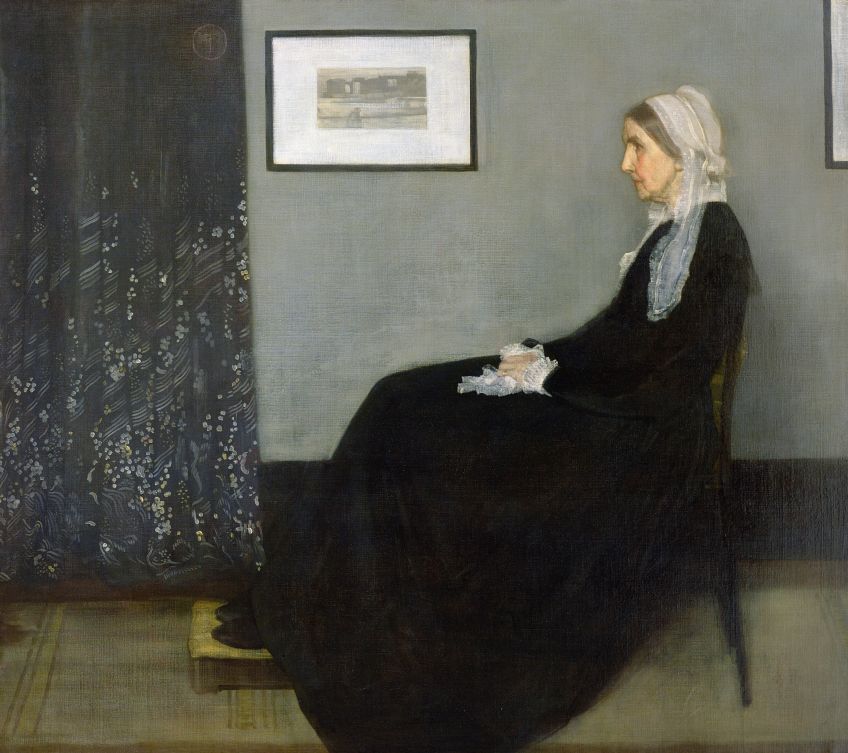
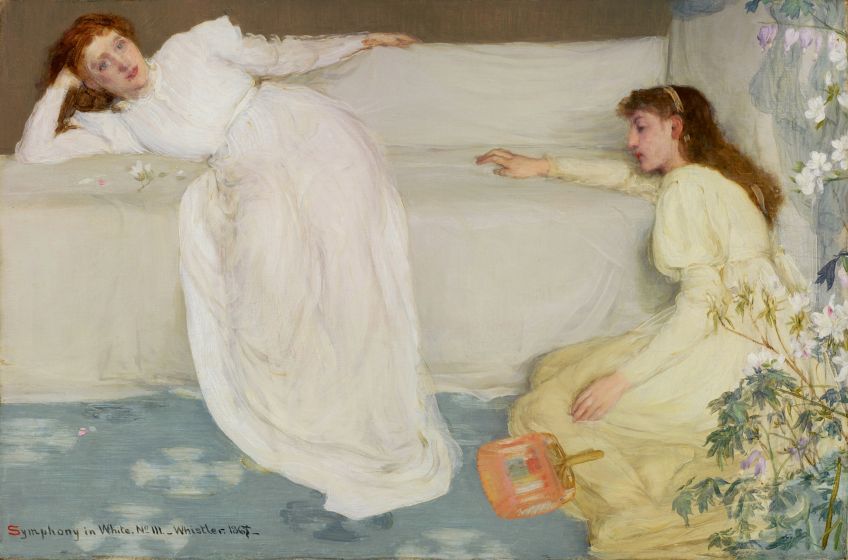
The film is strong on Whistler’s musical titles, convincing us, through his writings, that “the subject matter has nothing to do with the harmony of sound and of colours.”
Even more so than with Oscar Wilde, it was not wise to believe everything Whistler said. Whistler maintained that he was born a Southerner from Baltimore ( his brother was a physician for the Confederate Army in the Civil War). In fact, the brothers were born in Lowell, Massachusetts, James McNeill Whistler on 11 July 1834.
His beloved father was a railway engineer and military surveyor, who, when Jim was 9 was sent to work in St Petersberg where Jim grew up speaking French. Jim later went to school in England where his older sister lived, married to Seymour Haden, an art collection and etcher, whose influence on Whistler, one of the greatest printmakers in history, was immense. But at 20, inspired to partake of Bohemian city life by Charles Baudelaire and Henry Murgur, Whistler moved to Paris, leaving for London in 1859 when the French Salon dismissed his impressive dual portrait At the Piano as a sketch.
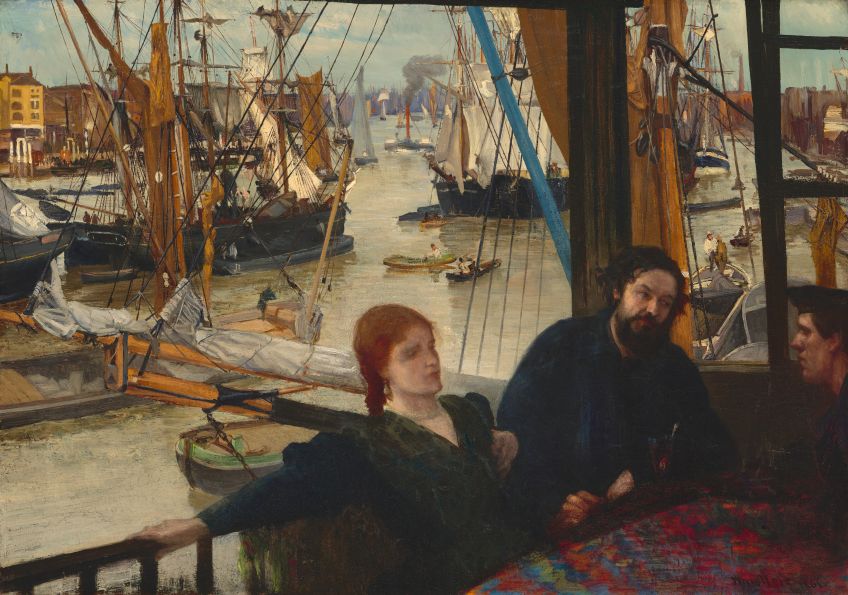
We see in paintings such as The Last of Old Westminster (1862) and Brown and Silver: Old Battersea Bridge from 1863, the influence of his father’s railway engineering, and Whistler’s brief experiences at West Point Military Academy and sketching the coastline as a military surveyor.
Whistler’s later-life travels correspond with the development of his printmaking. The film concludes with his tragically short, happy marriage to the artist/designer Beatrice. his frequent model and the former wife of the architect of Whistler’s White House, Edward Goodwin. And Whistler’s Mother takes pride of place in the exhibition and in the film.