
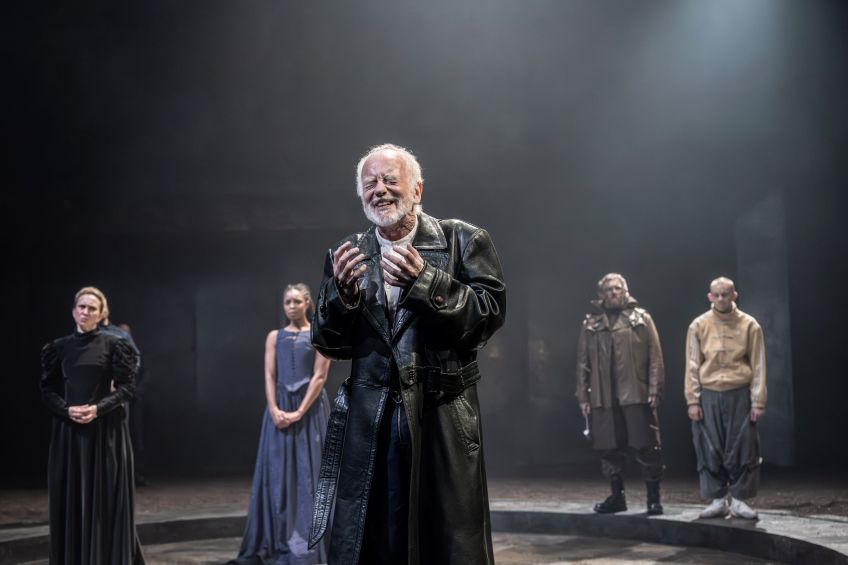
When it comes to crumbling, poisonous family relationships that head into devastating tragedy thanks to malicious, devious children who cruelly trick, abuse and betray their parents for their own selfish gain while the parents blind themselves to the truth about who their children really are, Shakespeare was way ahead of TV soap-operas set in the likes of Wetherfield, Walford or Dallas. Harrowing, up-and-down rollercoasters of trickery, extreme emotions and shocking reactions are what keep audiences riveted, along with ongoing intrigues of how it will all pan out and whether love and loyalty will ultimately win out. Riveting indeed is this powerful production of King Lear from Sheffield Theatres with MGC (Michael Grandage Company).
Often considered Shakespeare’s greatest tragedy, Lear was written at the height of his productive years, early in the reign of King James (I of England and VI of Scotland, that is). Directed by Titus Halder, engaging, very human characters keep the freshness of the storytelling buoyantly vibrant throughout, with Richard Kent’s set and costumes, Ryan Day’s superb lighting and Sarah Angliss’s soundscapes enhancing the dramatic mood and atmosphere to perfection (mostly), drawing us in at every moment.
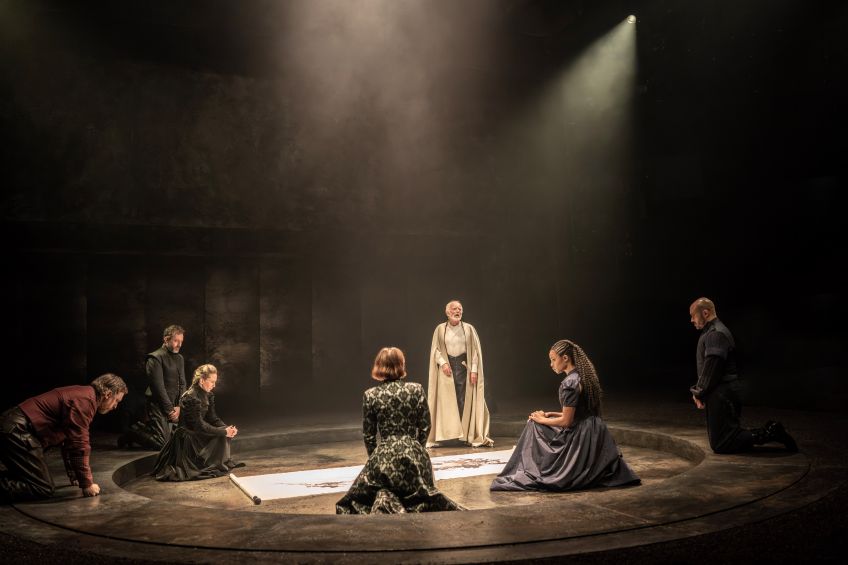
Experienced Olivier and Tony award-winning actor, Ian McDiarmid, has other valuable experience for the role of Lear, too – the experience of growing old: he’s now in his eighties. From the outset he demonstrates Lear’s frail vulnerability as he divides his kingdom (unwisely) amongst his daughters, his commands more rushed than regal as though he’s already losing his grip. As the “man more sinned against than sinning” makes his bumpy, bewildered, undignified downhill descent, McDiarmid’s intonations and speech patterns come in very natural variety, travelling through anger, mania, despair, distracted, half-clad madness and senility to arrive at realisations of how foolish he’s been.
Along with McDiarmid, Mark Holgate, in his different guises and accents as loyal Kent, and David Birrell as the duped and eventually bloodily blinded Gloucester add great impetus to the momentum of the piece. Harry Redding’s Edgar, Gloucester’s naive, ever loyal son, forced to flee, disguised as the ragged, demented wretch, Poor Tom, is also compelling and affecting, though stronger dastardliness might not go amiss in adding fuller impact to Fodo Simbo’s Edmund, Edgar’s scheming brother who will stop at absolutely nothing to oust his brother in order to gain wealth and power and, like two of Lear’s daughters, is more than willing to betray, deceive and destroy his father and sibling alike.
A great deal of visual interest stems from Max Revell’s Fool, for surely there could never be a more physically flexible Fool. Performing balances, backbends, cartwheels, jelly-limbed foldings and crab-scuttlings galore, his movements and demeanour often echo and mimic those of his master to fine effect (though sometimes, perhaps, superfluous.) His silent stillnesses, snatches of song and serious/humorous words of wisdom underline his unfailing, loyal support of his king.
Black-gowned and stony-faced, Katie Wimpenny’s cold-hearted Goneril brings to mind the heartless Mrs Danvers in Rebecca, forthright, unbending, unfeeling in her selfish cruelty and treachery. Even husband Albany (Milo Twomey) forsakes her in the end. Justina Kehinde, as her sister Regan, is equally strong, confident, merciless and cruel. Lear’s only loyal daughter Cordelia (Bebe Sanders) is strong, forthright and confident, too, but far from being the “thankless child” he believes her, she truly loves and supports her father.
The prime enjoyment of Shakespeare being in the words, it could be that, at times, a modern naturalness of speech and character may sacrifice the full, musical shape and clarity of a line for the sake of drama, but sometimes, perhaps, it’s worth it.
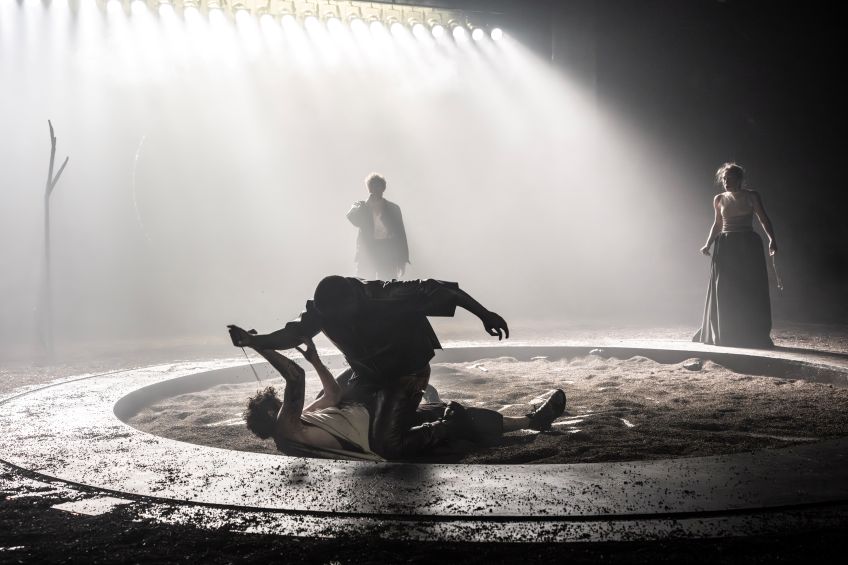
Richard Kent’s set makes superb use of the Crucible’s thrust stage in maintaining full focus on the characters, words and interactions. As with the drama itself, grim, gritty grey predominates: shaded varieties of volcanic, slate-grey fill the stage and backdrop panels, while a sunken circle at the centre forms a shallow pit with marked rim, a fabulously versatile space, wonderfully used, bare at first but filled with grit and gravel in the second half when extensively, excitingly fought in. A central trapdoor leads nicely to the hovel on the heath as required.
Towards the back of the stage, misty smoke plays a good part in evoking desolate wilds, foggy minds and bleak, murky goings-on, while subdued lighting, occasional torches, shadows and silhouettes briefly give way to sudden, startlingly bright lightning-storm flashes that assault the eye, or to long ranks of bright, bright lights that represent battle, (incongruously?) reminiscent of alien space-ship arrivals. Eerie, disquieting sounds are subtly, gently used throughout to maintain background tension with hints of Buddhist gong and gamelan ringings, prolonged notes and birdsong. (Like the spaceship lights, the few bars of voiced sounds could prove a tad much for some.) Neat in construction and deployment, too, are the few essential props: map, daggers, ropes, pieces of paper, newspaper hat, torches, blasted tree branches, dark blue bloodstains and wicker cage with chains to represent the stocks. The handsome costumes, mainly in subdued hues, are not era-specific but blend modern additions of trainers and boots with beautiful, older-style gowns, hints of armour and doublets, long, leather coats and jackets or tattered rags.
For a grueling tragedy full of cruelty, betrayal, spite, hatred, heartbreak, violence, madness and death, enjoyment factors soar surprisingly high (for the audience, at least). Wonderfully powerful, thoroughly gripping.
Eileen Caiger Gray