
Acted out intensely over 90 minutes by one man alone, Buffoon tells the anguished tale of Felix, a story powerfully charged with emotion, tinged with dark humour, steeped increasingly in tragedy and heartbreak, yet still not without hope – hope in the power of algebra: the union of broken parts.
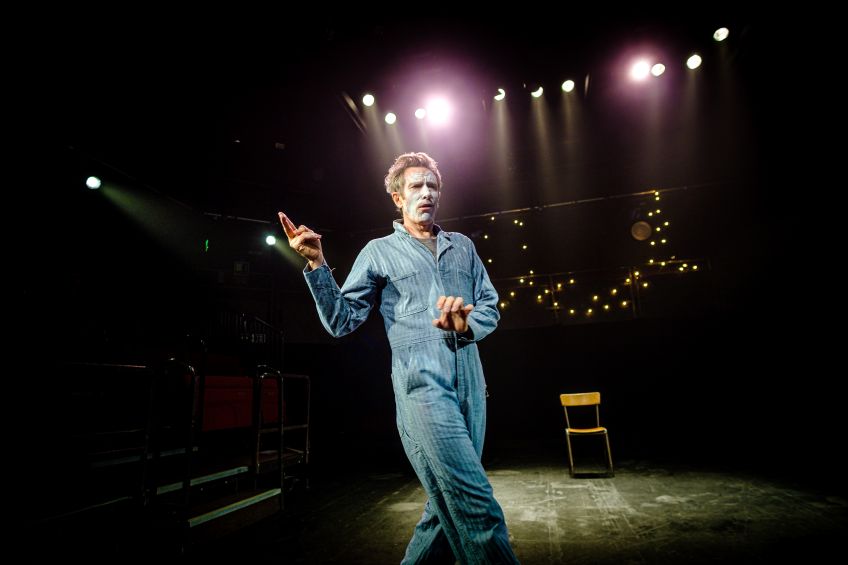
This one actor, his only prop a simple, wooden chair, has to grip and engage us through vivid portrayals of the life and character of Felix and of the people who shape him and his life, at the same time bringing to life the entire circus world into which he is born. A demanding role to say the least! Maintaining energy and keen focus throughout, Daniel Weyman does all this splendidly, as lighting and sounds integrate to build mood and atmosphere via brief, subtle bursts of birdsong, music box jingle, tense chords, or short strains of violin, of Tchaikovsky’s Romeo and Juliet or of waltz while, before the show begins, it’s traditional circus music that plays.
The piece starts with impact as we meet Felix, a seething cauldron of nervous anguish, sitting on a stark, spot-lit chair, dressed in lightweight, prisoner-grey overalls with fine stripe, his face, like a mime artist’s, raggedly patched with white chalk. So, what has brought a circus clown to this pitiful state? Right back to the beginning we go to travel with Felix/Flix through his life, starting with his traumatic, comical water birth, beside the elephants, where he emerges dramatically, full of sunny hope and possibilities like any other baby.
As Felix moves through childhood, we meet the people and events that shape his psyche and the trajectory of his life. Through lightning transitions between characters, Weyman brings Felix’s intriguing story to life, his movements fast and light as he swaps from one character to interact with it as another. There’s superb comic vibrancy in his Flying Olga, the boy’s reluctant, Russian mother, a chain-smoking trapeze artist with heavy accent, whose narrow focus is on being a great star, meaning the role of momma is one she resents and abhors. Poor abandoned Felix. Philip Larkin’s outspoken poem on parenthood springs to mind, and hints of John Irving, too.
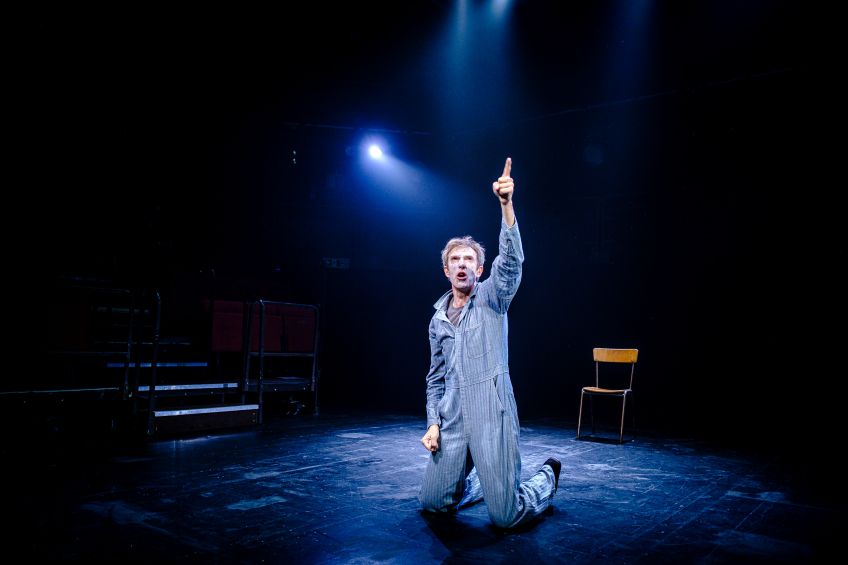
Courtesy of Weyman, Felix’s never-quite-adequate, Scots dad, The Great Frank, also puts in appearances in his fluctuating relationship with his son (though we meet the third person in the parental love-triangle, The Great Gaganga, only in the narrative). The person who actually parents young Felix is Smile, his counsellor and consoler, the well-spoken ticket-man who introduces him through novels and poetry to the never-ending joys of literature, literacy and the splendour of words – as well as to alcohol and the odd, mind-bending drug. Weyman portrays, too, the lovely Aja, Felix’s love interest from the age of seven who, even in adulthood, spends a good deal of time combing her hair with her fingers (instantly pinpointing Weyman’s role at that particular moment). As Felix questions and interacts with the people in his life he tries hard to discover what life and love really, really are, but alas, grief, loss, betrayal, heartbreak and gloom just keep piling on and on in what feels like a rather linear straggle of a struggle at times.
Buffoon (2019), written by award-winning Canadian novelist and playwright, Anosh Irani, has already found success across the Pond and now this inaugural production in Sheffield of AKP, Aisha Khan Productions, a company dedicated to bringing international, contemporary theatre to the UK, is the play’s European premiere.
Of course, stories of “the tears of a clown” and of the lives of real-life comedians whose cheery, sunny public personas bring laughter to thousands while their personal lives fall apart through depression, addiction and the like have been widely portrayed on stage and screen over decades, and the fact that some/many/most/all humans hide their real, often damaged, selves beneath a glossier public mask has always been a universal theme. Felix’s life story may be unique but it’s full of the same joys and torments shared by all humanity as individuals search to forge an identity and find love and comfort in family, clinging to hope and resilience as long as they can.
In this play the light-hearted, frivolous, escapist clown that Felix resorts to being and makes a career from being is not prominent at all, and though the play’s narration is wrapped in dark humour, the focus is mainly on Felix’s anger and bitter resentment. That we experience little of him as a proper clown and fool in convincingly sunny mask is, perhaps, a shame. When he does eventually wipe the chalk from his face to become a freer version of himself, it’s some of his destructive fear and resentment that he wipes away rather than his buffoonery, allowing a glimmer of hope to fire up, that might eventually break his vicious cycle of despair and isolation and start to mend the broken parts, bringing him the love and connection with family that he so longs for.
It is, in fact, the character Smile who wears the most effective mask in this piece. Well-balanced and wise in his kind, caring, generous, loving dealings with Felix throughout, he has broken free from his past and only towards the end do we – and Felix – find out who he really is. He’s Ismail from Afghanistan, who all the while has been hiding the intense suffering and trauma of his unspoken, unspeakable past from all the world, hiding it completely by being a different person. Perhaps this is the route Felix will take himself, if he, too, can break free from his past.
There’s plenty of food for thought as well as amusement in this entertaining tragi-comedy with its timeless themes, all impressively delivered by Daniel Weyman.
Eileen Caiger Gray