The Italian visual artist Emilio Isgrò is older than the Italian Republic which turned 80 this year. The Estorick and the Italian Consulate celebrate this milestone with an evocative, innovative and entertaining exhibition that, in turn, celebrates the artist.
Although he is pushing 90, Isgrò showed up at the Premiere of his first solo show in the UK because he has a lot to say about culture, Europe and the UK. Arguably the highlight of the show is an extensive work entitled Brexit, which Isgrò undertook at age 88 especially for us. So don’t miss it.
A lot has been written about Brexit, of course, but not much artwork concerns its lofty self with a decision that was either a necessary decree of independence, a missed opportunity or the mistake of the century. You don’t have to look much further than the title of this exhibition to know what Isgrò’s view of the matter is.
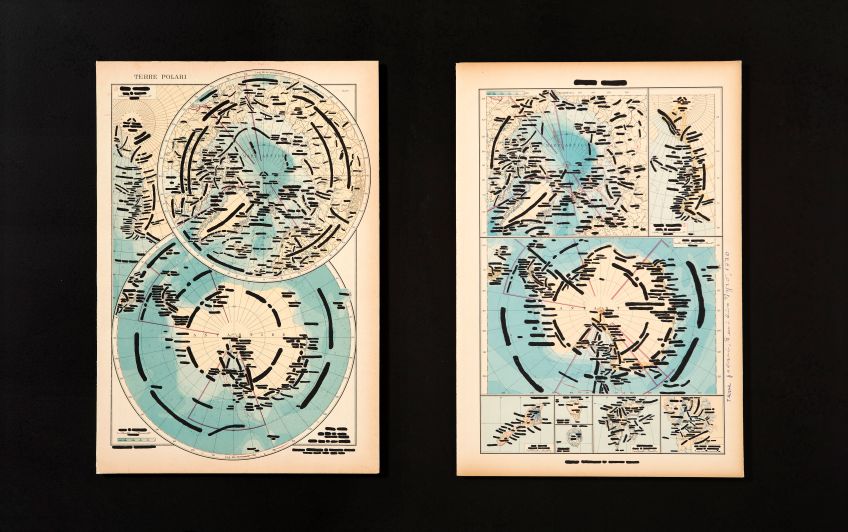
Yes, Isgrò erases. But for this artist, who is far from arrogant or didactic, erasure is not destruction, denial, removal or reduction. It is a means by which he can take a stand, offer a different interpretation and suggest other possibilities. He erases to create, with mixed media, with Indian ink and with acrylic on a variety of different material.
Arriving in Milan from his native Sicily in 1956 must have changed more than his surroundings. The poet, journalist and writer began to feel how words were too limited to express what he wanted to convey. He turned to visual art, but without abandoning his lifelong fascination with and commitment to the power of words. That this visual art becomes conceptual art makes each piece all the more challenging and bemusing.
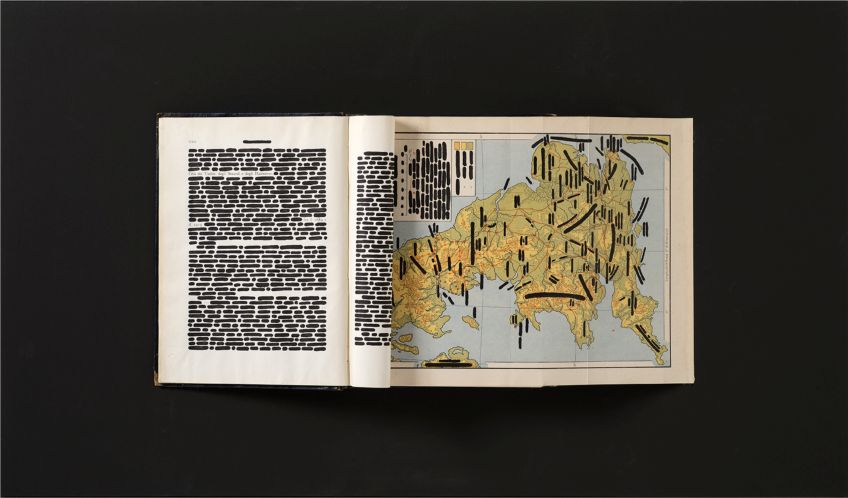
One of the best (because it’s an adroit “double” erasure) and most accessible examples is also one of Isgrò ’s earliest pieces from 1964. We are confronted with an open copy – about three quarters of the way through the book – of Vladimir Nabokov’s Lolita which had been published in Italian five years earlier.
All but three short fragments on the two pages are blotted out with black, hand drawn ink marks so that the surface looks like a brick wall with the page being the white mortar.
First, we see Lolita! then seventeen lines down, “tutto questo io cancellai” and on the adjacent page, ‘mia Lolita.’ “Lolita!….I erased all this…my Lolita.” It is significant, and fundamental to his purpose, that Isgrò has erased the word “meaning” at the end of Nabokov’s sentence, “I erased all this meaning.”
In the novel, the narrator, Humbert, erases a young girl’s true identity and agency through devious deceit and manipulation, replacing Dolores Haze with his, own sexualised, idealised dependent, Lolita (the Spanish diminutive for Dolores). Isgrò intervenes to declare that he is erasing Humbert’s seductive prose and domineering gaze. Isgrò ’s pen has physically erased Humbert’s “meaning” to reveal Lolita, not as a fetish born of a perverse obsession, but as a tragic victim.
The following year Isgrò moved from the page to canvas in a startling way. We face a total erasure. What’s left is an all-black rectangle with a large white arrow pointing down and left on the black rectangle. Below is a headline that reads, “Jacqueline bends over her dying husband”, referring, of course, to the assassination of President Kennedy. Viewers of a certain age will remember the horrific image plastered on the front pages of international newspapers like a commodity. Isgrò erases this overkill. It’s the 1960s. Like Warhol and other artists he is questioning the media culture that feeds on and regurgitates shock and violence and turns it into banality.
Isgrò is not the first artist to create spaces that contain words that are to be experienced visually. The most obvious precursors include Futurism and Dadaism, constructivism Neo-Plasticism, Concrete Poetry, and individuals like Ketty La Rocca and William Kentridge, who just directed, and designed the décor for Glyndebourne’s L‘Orféo. Isgrò is, however, unique in his approach. “Cancellatura” is different than writing on and over printed images and words in books as Kentridge, for instance, does. It is a way of excavating from a novel, a newspaper, an encyclopaedia, a photograph or a map a new thought or position in a dialogue with what is buried beneath.
The catalogue reminds us that Isgrò shares with the Italian Futurist movement the “page as battlefield.” He is not a groupie however and rejects founder and fellow poet F.T. Marinetti’s 1909 manifesto which praised machines of movement (and war) and declared war on museums and libraries – repositories of the past. In obliterating Marinetti’s rallying cry, Isgrò “turn[s] his aggression back on itself.”
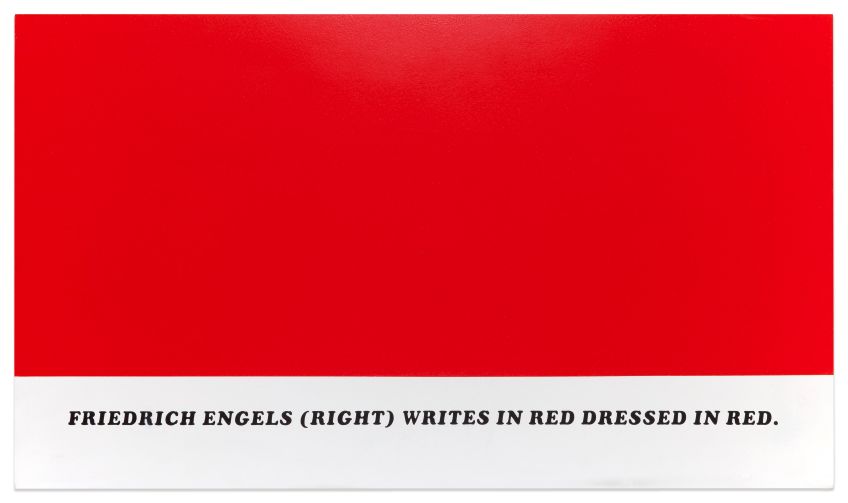
The poet Dante, the composer Puccini, the political theorist Engels, the whale Moby Dick, Scotland Yard, Europe and ants (a symbol of productivity), are some of the diverse subjects in Isgrò’s sights. Topically, the environment makes a plea in the 2024 map painting (acrylic on canvas) “Please don’t Crush Me.” An ant precariously balances on the edge of a globe. This globe, however, is full of red lines like open wounds, erasing the names of the mighty nations that are all complicit.