
Joyce Glasser reviews Midwinter Break (March 20, 2026) Cert 12A, 90 mins. In cinemas
Films aimed at older audiences are more than welcomed but cannot – as the filmmakers of last year’s Goodbye, June and Eleanor the Great discovered – take this savvy audience for granted.
Academy Award nominated actors Leslie Manville and Ciarán Hinds (who won a BAFTA for Belfast in 2021) are rare examples of septuagenarian actors working steadily in feature films, with roles worthy of their talents. And Manville and Hinds are the gifts that keep on giving in Polly Findlay’s otherwise lacklustre Midwinter Break.
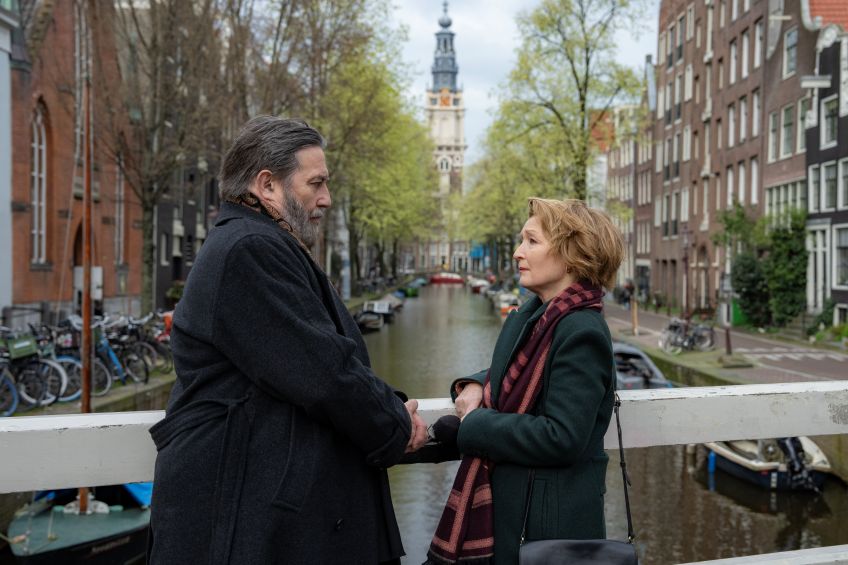
Stella (Manville) and Gerry (Hinds) are a long-married professional retired couple living in Glasgow. They moved there from Belfast during the Troubles when, as we see in a couple of flashbacks, newly married and heavily pregnant Stella is hit in the crossfires.
One Christmas Eve, while voracious reader Gerry reads in a comfy chair, restless Stella presents him with a trip to Amsterdam as a Christmas gift. He is delighted which signals to us they are on the same wavelength even after some 50 years of marriage.
But the signals prove misleading. At first the sedate stay in a hotel on a canal is typical, consisting of a lot of eating, wandering along the canals, a trip to the Anne Frank House and the Rijksmuseum where they might see their younger selves reflected in Rembrandt’s The Jewish Bride.
But while this might be a typical break, it doesn’t quite ring true for these characters. Stella, we learn was an English teacher, while Gerry was an architect. Wouldn’t they be more intellectually curious, taking a historical tour, visiting the world famous Van Gogh Museum or looking at the city’s new or old architecture?
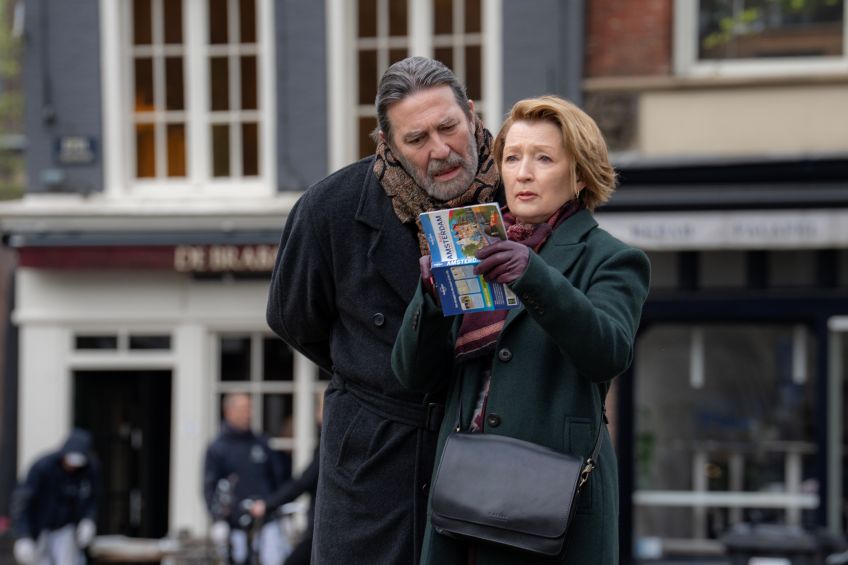
On the one occasion when they are adventurous, Stella pays a nostalgic visit to The Begijnhof (Beguines’ Court) a peaceful courtyard of two churches and alms houses she visited as an intern years ago. The courtyard was originally a home for the Beguines, a Catholic sisterhood of devout, unmarried, or widowed women who lived in a community but without taking full monastic vows.
Not overly interested in religion, Gerry leaves Stella to return to the place herself while he returns to an Irish pub the two had found. We begin to realise that somewhere along the line – related, it seems, to Stella’s incident – Gerry sought comfort in the bottle, while Stella chose religion. And until this trip, they could tolerate those differences.
When Stella returns on her own to the Beguines’ Court, she hijacks Kathy (Niamh Cusack) who had the misfortune to be passing by during the couples’ first visit. Once inside Kathy’s apartment, Stella starts sobbing and makes an emotional confession about a pact with God that haunts her as it remains unfulfilled.
Stella might have thought she was talking to a kindred soul, but poor Kathy – at a loss to react to all this – merely informs her that the community is no longer religious.
Co-writer Bernard MacLaverty, who wrote the novel on which the film script is based, and co-writer Nick Payne (who wrote the acclaimed play, Constellations and then a few disappointing screenplays) remain faithful to the novel, at least to the plot.
This might be one of the problems. MacLaverty enhances his characters and conveys meanings and emotions through his elegant descriptions of ordinary objects.
In the film all this understatement and description has to be conveyed through a camera and handled dramatically. First time film director Polly Findlay is not up to the task and the script is of little help.
Too often the mundane dialogue remains superficial. That said, there are some knock out lines that cut to the core. When Stella complains about the deception of Gerry’s drinking he turns it around: ‘I hate myself as much as you do when I’m drinking…[but] I hate myself even more when I’m not.’
It’s easy-going Gerry who comes across as the more empathetic of the two. Perhaps because the backstory seems so remote, and the emotional fall-out so rushed, it’s easy to lose patience with Stella.
Though only 90 minutes, the film feels repetitive and ponderous, as though it is waiting for the big resolution at the snowed-in airport. It’s a moment worth waiting for, as Gerry delivers a declaration of love so beautiful, you might feel a tear coming on. If, saddled with a problematic character, Manville struggles to convince, Hinds makes it real.