Joyce Glasser reviews The Bride (March 6, 2026) Cert 15. 127 mins. In cinemas
Writer-director Maggie Gyllenhaal (The Lost Daughter) scored a coup in casting Jessie Buckley in The Bride before Buckley became a shoo-in for Best Actress at the BAFTAs and Oscars. But even great actresses need great scripts and directors, and here, Gyllenhaal has let down her creation and, you could say, Mary Shelley’s. In The Bride, Gyllenhaal steps in for Mary Shelly who, she claims, never got to tell the story she really wanted to tell in Frankenstein, turned into a hit film by director James Whale in 1931.
Gyllenhaal, who clearly aims to redress cinema’s gender imbalance by giving women a voice, takes revenge on Whales’ 1935 sequel The Bride of Frankenstein in which the eponymous bride, who appears late in the film, never speaks. Buckley is made to overcompensate for that sin by having a bad case of verbal diarrhoea, most of which is either unmemorable or incomprehensible.
Rather ingeniously, though, Gyllenhaal references Whales’ two 1930’s hit films by setting hers in the 1930s with period costumes, cars, architecture, film noir cinematography, and the first drive-in movie theatres. The setting engenders the plot and characters and there are references galore.
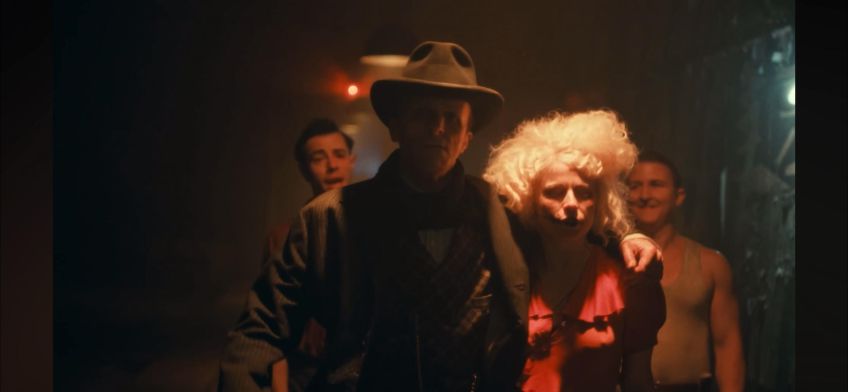
The most obvious are the Chicago gangsters (crime boss Lupino, played by Zlatko Burić); matinee idols and Fred Astaire (Ronnie Reed is played by Jake Gyllenhaal); Raymond Chandler’s novels (Peter Sarsgaard is police detective Jakes Wiles and Penelope Cruz is his assistant Myrna Malloy) and Depression outlaws Bonnie and Clyde.
Even the names Ida and her nemesis Lupino might be a homage to the British born American actress/director Ida Lupino. The trailblazer directed the film noir thriller The Hitchhiker, which also features the police in pursuit of a murderer driving across country.
We first see Ida (Buckley), seemingly a gangster’s moll, squirming at a claustrophobic table in a nightclub. She looks a bit like Jean Harlow with her yellow bob and a slinky orange dress. But there’s a strange facial tattoo that looks like a dark ink spill, or dried blood, on one side of her mouth, a perfect match for the bride’s black tongue and lips.
Bad timing. At the table, Ida becomes possessed by the feminist rage inside Mary Shelly (also Buckley). Ida suddenly starts contorting in physical spasms before spilling the beans on Lupino in a trance of mumbo jumbo that is difficult to decipher.
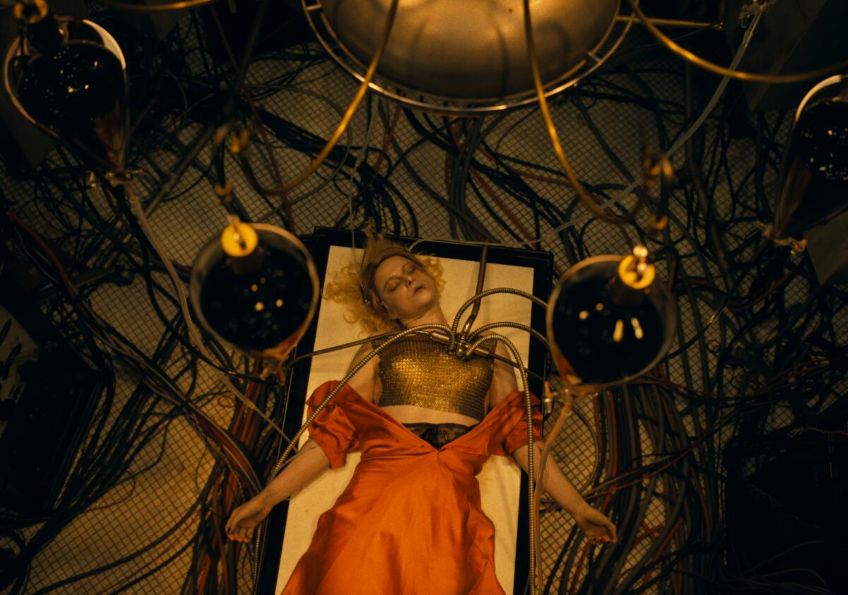
Not long after Lupino’s henchmen throw Ida down the stairs, in another part of town she is dug up by the monster (who now calls himself Frankenstein) and Dr Cornelia Euphronious (Annette Bening). We see Frankenstein, called Frank, arrive in Chicago to have Euphronious create a bride for him. The doctor balks, but Frank persuades her it’s not for sex: he is lonely after a century on his own.
Beggars can’t be choosers and the bride who emerges from Dr Euphronious’s hocus pokus laboratory is no prize. But Franke is smitten and admires her uninhibited, rebellious nature. Dr Ephronious naturally wants to keep her experiments under wraps but when the bride declares herself a free agent and walks out, Frank goes with her.
Their first date starts out conventionally. They go to movies, to see Frank’s favourite actor Ronnie Read, and then to a rave where Frank watches his date dance up a storm, although not exactly like Ginger Rogers. Frank tells Ida – who cannot remember her name – that her name is Penny, after Rogers’ character in Swing Time.
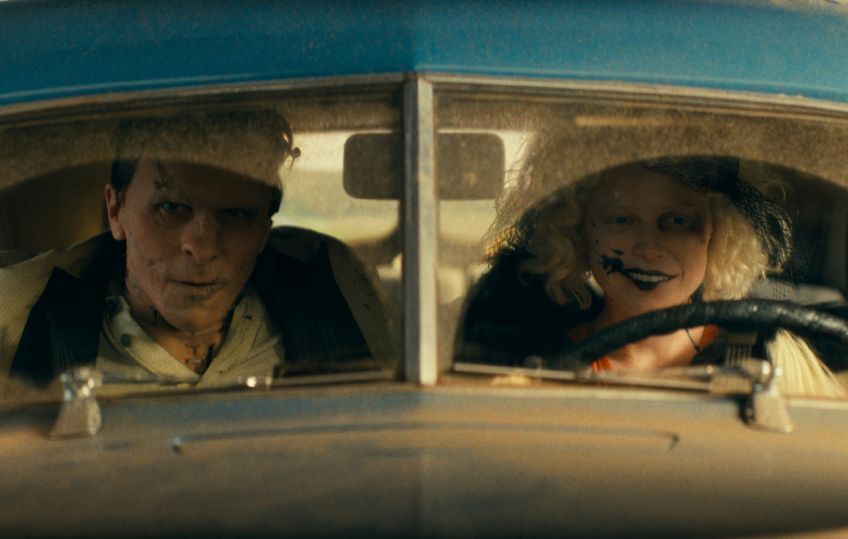
When they leave the rave, vicious thugs taunt the couple, Frank trying hard to restrain himself. But when the thugs attempt to rape Penny, Frank murders them. Realising the pair will be tracked like dogs, he orders Penny to go.
Suddenly vulnerable and lost, she tells him, ‘I don’t know where I live.’ And for the rest of the film they are like Bonnie and Clyde, on the run from detectives Wiles and Malloy and eventually Lupino, although their only crime is self-defence.
Striving for gender rebalancing, Gyllenhaal makes Whales’ Dr. Septimus Pretorius a woman, and, in a subplot that threatens to take over the main action, Wiles is outsmarted by his clever female assistant, Malloy. We follow his downfall – and his surprise revelation – along with Malloy’s trajectory to the top job.
A big dance number staged at a Ronnie Reed reception and triggered by the odd couple, is a highlight of the film. But when it becomes newsworthy, Penny unwittingly sparks a “revolution” with women sporting Penny’s blood-ink-stain tattoo. But it’s a revolution that amounts to nothing as if the revolution has been cancelled.
Christian Bale, barely recognisable with his monster make up, acquits himself reasonably well, but he lacks the romantic allure, and the combination of strength and vulnerability that Jacob Elordi brought to Guillermo del Toro’s recent Frankenstein.
Unlike the relatively small cast of characters and tight focus of The Lost Daughter, the budget of which was $5 million, here Gyllenhaal is so busy orchestrating the big set pieces of an $80 million period film, that she lets the actors do their own thing. Uncertain what the tone of the film should be, or what genre it is, cast and audience alike are at a loss. Buckley had a big year in 2024. After filming The Bride, she went straight to Hamnet, and some of the hysteria of the former role seeped into the latter. Has an actress ever won an Oscar for Best Actress and a Golden Raspberry in the same year?