
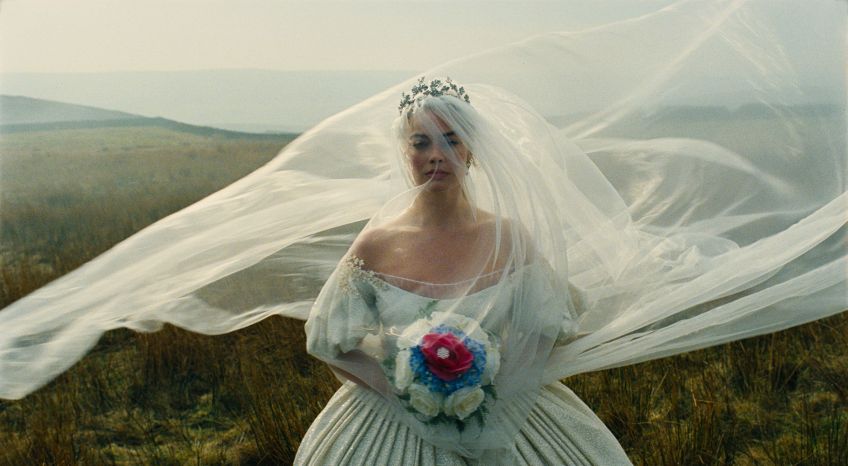
Joyce Glasser reviews Wuthering Heights (February 13, 2026) Cert 15, 136 mins.
Despite its length, writer-director Emerald Fennell’s (Saltburn, Promising Young Woman) approach to Emily Brontë’s Wuthering Heights is akin to an asset stripper’s. Like a venture capitalist buying a beloved old food company, she sells off the fruit and vegetables and keeps the confectionary department. The result might be box office gold, but it leaves the audience with the hunger of an unbalanced diet.
That confectionary department consists of the bonding of young Heathcliff (Owen Cooper) and young Catherine (Charlotte Mellington) when Catherine’s father, Mr Earnshaw (Martin Clunes), brings the dark-eyed, homeless gypsy-like boy back from the Liverpool docks.
As the mononymous name suggests, the boy is most at home on the wild heath which happens to be where free spirited Catherine is happiest. The antithesis of bourgeois, these two embrace the cold and the rain and Fennell’s rain department works overtime.
Catherine’s perverse cruelty and mood swings don’t bother sullen Heathcliff. When he gallantly takes the blame and harsh physical punishment for Catherine’s wilful irresponsibility, he vows he will always stand by her.
His love remains pure and steadfast. But capricious Catherine falters. The allure of Parisian gowns and a kind, sophisticated husband tempts 17-year-old Catherine (Margot Robbie) to accept a proposal from neighbour Edgar Linton (Shazad Latif).
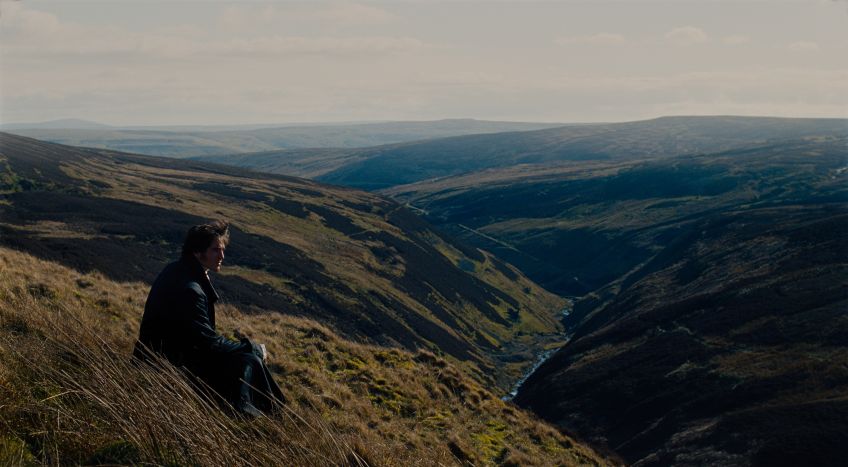
Let’s backtrack. In the novel, Catherine is 17. In this film, since Robbie is 35, it’s a fear of becoming an old maid, fostered by her father, which prompts the impetuous Catherine to accept the proposal after a quarrel with Heathcliff. She instantly regrets life without her “soulmate” but, too late. Heathcliff storms off to America to make his fortune, the better to seek revenge with.
To maximise the screen time of her two Australian assets, Robbie (Barbie, Babylon, I, Tonya) and Elordi (Frankenstein, Saltburn) Fennell dispenses with the primary narrator (Mr Lockwood) and the flashback structure. Gone is Catherine’s brother Hindley, Hindley’s son, Catherine’s daughter and the entire second part of the novel. The first person narration of Catherine’s companion or servant, Nelly Dean (Hong Chau, The Whale), is also gone, but is, to some extent, incorporated into Nelly’s role as an increasingly controlling, but ambiguous, omnipotent presence.
Dramatic licence is granted to a filmmaker in exchange for enhancing our understanding, appreciation or our perspective of the source material. In the case of a classic – there have been about 15 film adaptations in English and the book’s on the GCSE syllabus – changing around the characters that are the backbone of the story and their traits can be a licence too far.
Eliminating Catherine’s sadistic and possibly incestuously jealous brother Hindley, requires turning the novel’s good hearted widower Mr Earnshaw – who favours Heathcliff over his cruel son Hindley – into a vicious alcoholic who drinks and gambles away his respectable home, Wuthering Heights. But without the second part of the novel, Hindley would be a surplus actor on the payroll.
The character who is improved upon in Fennell’s film is Linton’s ward Isabella, thanks to an inspired performance from Alison Oliver. Heathcliff seduces the smitten teenager when he returns from the USA in order to torment Catherine with jealousy and Linton with class rage. The sadomasochism in the Heathcliff/Isabella relationship is surprisingly credible. Both of them are seeking revenge for coming in second.
Isabella would disgrace Linton a lot more if she were Linton’s younger sister, as in the novel. But Fennell has some weird notion of colourblind casting which precludes this.
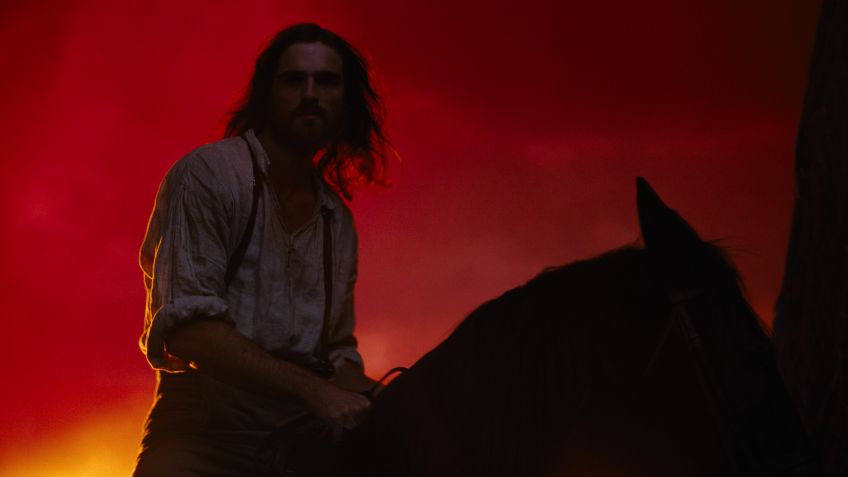
Whereas Heathcliff, who is described in the novel as though he might be a Roma, or mixed race, is played by a white actor, Nellie is played by a Vietnamese-American actress and Latif is of Pakistani/Scottish origin. With long, unruly dark hair the handsome, hunky British actor would make a great Heathcliff. More interesting than Elordi with his catwalk model looks and stature.
Since Fennell has eliminated the second part of the novel (Heathcliff’s revenge and the third generation’s redemption) she has plenty of time for long montages of the adulterous reunion between now wealthy Heathcliff and now bored Catherine, pining to leave the stuffy mansion for wild romps on the moors.
Only the chaste romps of youth are now sexual encounters. Okay, there’s no nudity, but the trysts are relentless. One after the other, on the moors, in the Lintons’ carriage, in her bedroom… You can only distinguish them by Catherine’s wardrobe changes.
The unintended result is that despite Catherine’s premature death, you feel that the pair have had a lifetime’s worth of sex by the time she dies (not in childbirth, although she’s pregnant, but of a broken heart).
The beauty of the novel is the subtle handling of the physical passion. Brontë never reveals whether the pair consummate their love, but it’s doubtful. William Wyler’s 1939 film has a brilliant cut just before a first – when Catherine is still single. But there’s no adulterous sex, making the tension of Heathcliff’s return all the more unbearable.
It is this pent up longing that makes the tears flow at the delayed gratification of the deathbed kiss and the realisation of what might have been. In Fennell’s Wuthering Heights, the tears don’t flow at the film that might have been.