
Joyce Glasser reviews Hamlet (February 6, 2026) Cert. 15, 113 mins.
In this, the home of William Shakespeare, you might think you could never have too many productions of the bard’s most famous play. Then along comes Aneil Karia’s Hamlet, adapted by Michael Lesslie (co-writer, Assassin’s Creed, and Justin Kurzel’s 2015 Macbeth) and co-produced by, among others, its star, Riz Ahmed.
Known for films like The Road to Guantanamo (2006), Shifty (2008), Four Lions (2010), The Reluctant Fundamentalist (2012) and Mogul Mowgli (2020), the British-Pakistani actor and rapper was cited in Time Magazine’s ‘100 most influential people’ in 2017. And what better way to enter the British establishment than to star in Hamlet?
We find ourselves not in Elsinore, but in contemporary East London. It’s a particularly garish, ugly London – off the tourist track for sure. It’s all dystopian motorways, back allies, polluted wasteland and sterile, massive slabs, like the warehouse/arena complex where the King and Queen’s wedding takes place.

And here, when characters refer to the King and Queen, somehow Charles and Camilla are out of the picture. Hamlet (Ahmed) who has rushed back from university to attend his father the late King’s (Avijit Dutt) funeral is referred to as “My Lord,” a title even William would not accept.
The problems arise when Hamlet grows suspicious about a concurrent event that overshadows his father’s funeral: his just-widowed mother, Queen Gertrude (Sheeba Chaddha) is marrying her brother-in-law Claudius (Art Malik), the new King.
Nothing wrong or even very novel in setting Hamlet in a British-Pakistani family. The play has been adapted to various settings and time periods around the world, including in China and in Russia where it’s been particularly popular for three centuries. But it’s never clear whether we are in a parallel universe or in an imaginary location with low production costs for hotel or airfare.
Instead of Duchy environmentally friendly products, the late King was the owner of Elsinore, a property empire. The best scene takes place on the roof of one of his soulless tower blocks where Hamlet follows what turns out to be the ghost of his father. His father commands him in Urdu to avenge his murder.
You know the rest – or thought you did. But you have to imagine it without Hamlet’s only friend, Horacio; without Rosencrantz & Guildenstern (Tom Stoppard thought them worthy of their own play); without the famous “Alas Poor Yorick” meditation of mortality; without the old grave digger; and without Polonius’s “Neither a Beggar nor a Borrower Be” speech, showing the father side of this bumbling advisor.
The soliloquys are there, more or less. Just in case you never realised that “To Be or Not to Be” means Hamlet is contemplating death, he gets behind the wheel of his BMW and races it recklessly towards the Blackwall Tunnel like an oligarch’s son burning rubber in his Lamborghini through Knightsbridge on a Saturday night.
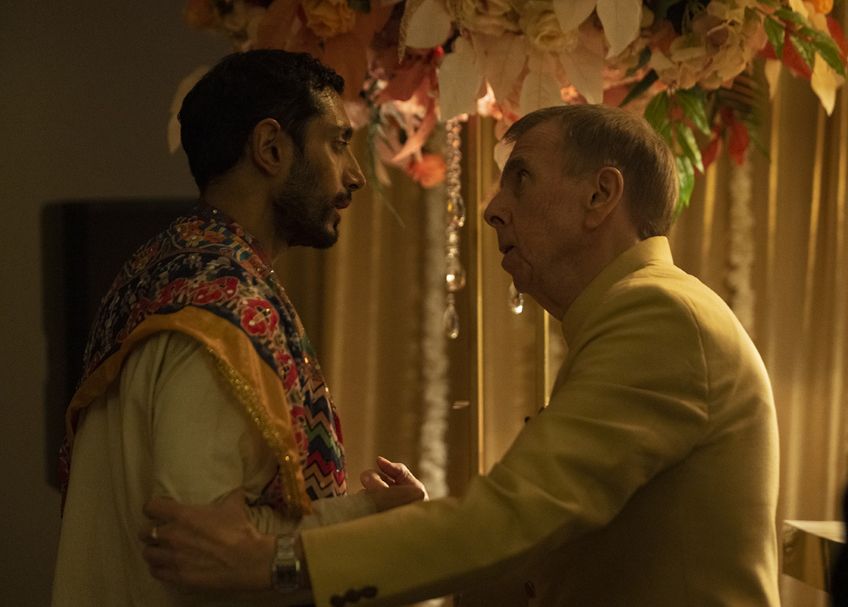
Timothy Spall as Polonius is quite a jolt but, for commercial reasons, here he is, proving that Sir Keir Starmer isn’t the only one with dodgy advisors. And what of Ophelia, who has caused problems for feminist groups of late. No update here to report.
There is so little chemistry between Morfydd Clark’s Ophelia and Hamlet that you are surprised his obvious mental health issues prompt her to commit suicide instead of calling social services. And her brother, Laertes? Joe Alwyn – so outstanding in the Oscar winning The Favourite, and Mary Queen of Scots (2018) – is completely wasted in the tricky role (here, a non-role), of Laertes.
As a platform for Ahmed, there will be those applauding, but if you weren’t convinced by much of it, and could understand less, you wouldn’t be alone. Ahmed enters sulky and troubled and gets worse, but it’s done without nuance or internal development.
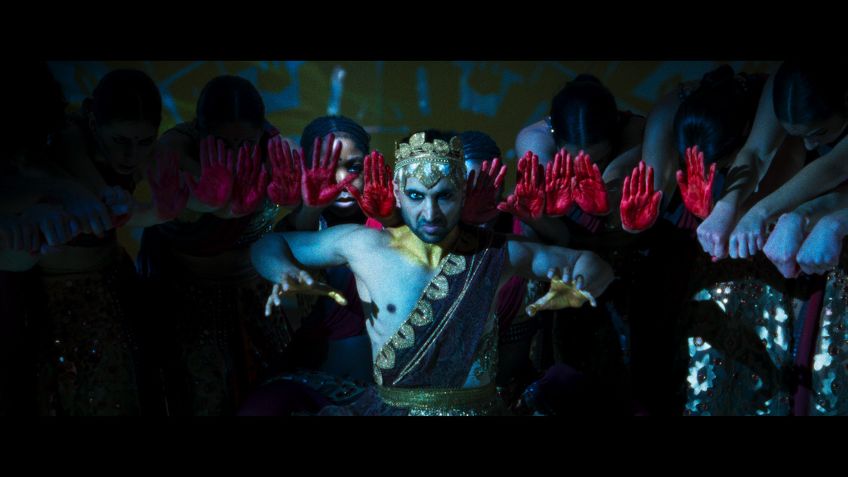
A nice touch is the “play within a play” that has been turned into a symbolic dance by the celebrated choreographer Imran Khan. Almost cancelling out that welcome scene is the disappointing climax and denouement.
Gone is the dramatic swordfight, although the game of poisoned chalices remains. Since no daggers, guns or swords are involved in the deaths, there isn’t even a bloodbath. Gone is the touching scene where The Norwegian conqueror, and Hamlet’s non-intellectual counterpart, Prince Fortinbras, enters the bloodbath and orders a military funeral for “The Noble Prince.”
Fortinbras is however, in the film. He heads up a tent city of the destitute, made homeless by Elsinore’s expansion. Hamlet visits and sympathises with their plight. What this seemingly clever displacement does, however, is make us question whether all Hamlet’s moral outrage is worth it.
Yes, King Hamlet was murdered by those who should have loved him, but was he all that worthy of love? This multi-billion pound property development empire is the legacy of a slum landlord dispossessing his portfolio of social housing and building hideous commercial premises in Hamlet’s once-fair kingdom.