
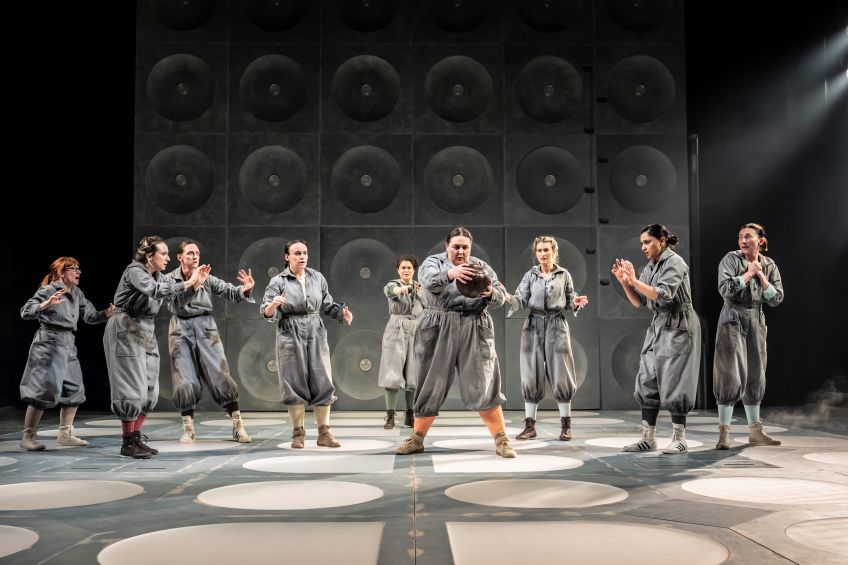
Kicking off on The Crucible stage this spring, just weeks before the snooker cues roll up, is The Ladies Football Club.
Through fictional characters this snapshot story recounts the birth of women’s football, set in Sheffield in 1917. The original work of 2019 came not from the pen of a Yorkshireman, though, but that of an Italian, the revered, much translated Stefano Massini and it hit the stage in Madrid in 2022. But now, with its world premiere aptly in Sheffield, it’s Tim (Calendar Girls) Firth’s adaptation, directed by Elizabeth Newman, that brings ladies’ football home through highly stylised theatricality and movement, thrumming music, loud words and proclamations.
Just as elsewhere, Sheffield women, freed from the traditional confines of home, took on jobs in factories when the men marched off to their various fates in the World War I trenches. Onstage eleven such women from diverse backgrounds work at the munitions factory of Doyle and Walker, making bombs and bullets, when suddenly, out of the blue, they discover and develop other strengths and skills they never knew they had – on the football pitch at lunchtime, for instance.
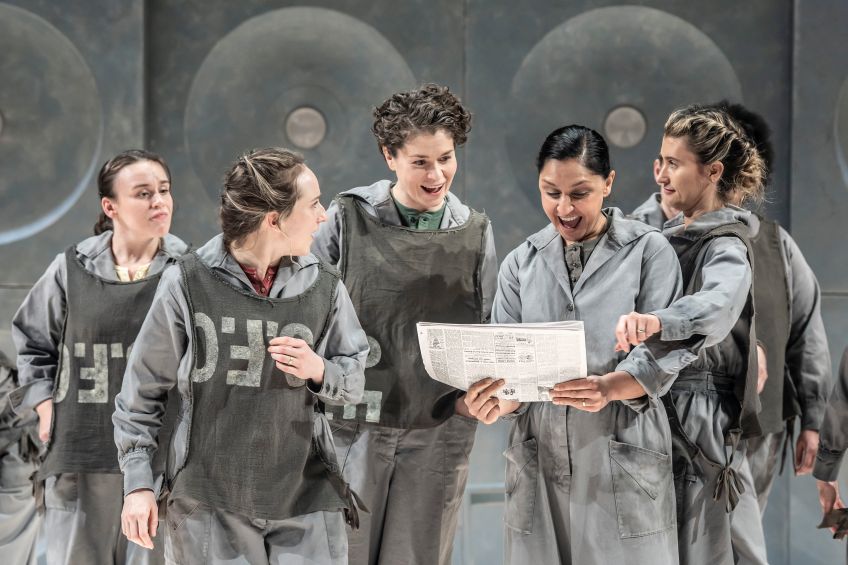
With full focus on the intensity of the characters and their increasing passion for football there’s no real attempt to evoke the 1900s other than in rapidly related snippets. The minimal, neat, grey, geometric set with its up-lit stepping-stone circles and shapes more resembles the inside of a Tardis than a dull, grimy factory from over a hundred years ago, while the demeanour of the bustling young women with their brash language and liberal use of “’f” words is more like that of women today. Apart from a short burst to tell us Tipperary is a long way to go, the music and sounds are modern, too, while costumes, mainly grey overalls, are of modern, lightweight fabric, worn with light-as-air boots or trainers.
Having eleven female characters to differentiate onstage isn’t easy, but gradually, with textual recaps now and again of who’s who (as at the start of Act II and in the finale) the individuals and their idiosyncrasies stand out to create snapshots of different women rather than fully rounded people. Violet Chapman (Cara Theobold) starts the ball rolling as narrator, speaking loud, clear and directly to the audience. As the play proceeds, frequent narration, snippety information and chirpy banter and ribbing are passed and chipped rapidly from one to another to another to another in fast-paced word manoeuvres. The speedy timing and frenetic, ping-pong delivery of top-volume lines, every one emphatic, does mean many of the words and sentiments don’t get the chance to soar through the air and fully strike home while others are lost in thrums of music. The emphasis is on light humour, some working well, some weaker, but there are a few quieter moments, too, amidst the full-on frenetic, though sadder sentiments of grief and of personal struggles and challenges are never dwelt upon or more deeply conveyed.
The eleven factory women, who together strive to break free of their traditional, allotted roles in life, represent diverse, somewhat caricatured stereotypes, well defined by those playing them. A little reminiscent of Big Bang’s bespectacled Bernadette, there’s sparky little Olivia (Bettrys Jones) who gets all her quotes from papers and magazines sold in her parents’ shop; there’s Ros (Jessica Baglow) who again ends up in goal just as she did when playing with her brothers in the streets, where all kids played back then. Lesley Hart is hard-drinking, forthright Scot, Berenice and Leah Brotherhead is the gruff-speaking, tub-thumping, fiery, red-blooded socialist Hayley, a source of much humour with her non-stop proclamations on repressed workers, unionism, capitalism and apotheoses galore. Amiable Penelope (Chanel Waddock) speaks surreal gibberish (Penelopese) but conveys as much meaning as most folks, her words standing out like butterflies on straw. Brianna (Ellie Leach) forever strikes poses as heroic Joan of Arc while hoping not to look like she’s flagging down a tram; Abigail (Charley Webb) worries and plays hopscotch; Anne Odeke’s reflective Justine hails from down South; Clair Norris plays toughie Melanie, and Cheryl (Krupa Pattani) is the quieter one who emerges as the Captain who takes the women from downtrodden invisibility to glory – before the men return and the status quo kicks back in again after the war.
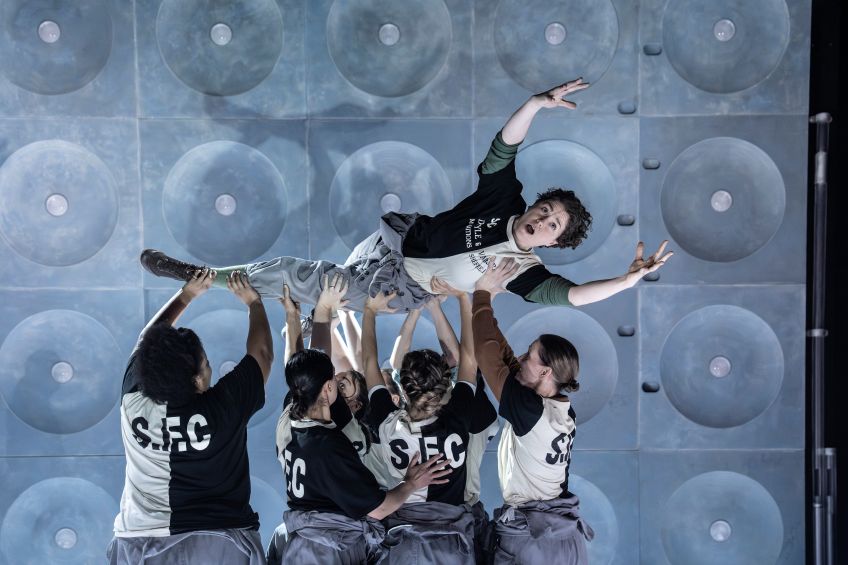
At the forefront of the piece, though, is the extensive choreography. Since this necessitates a clear, prop-free set and floor space, other than a brown, leather ball (which – whoops – might just really be a prototype bouncing bomb) all that’s needed are mist vents, a few grey, streamline stools that occasionally rise up from being invisibly flush with the floor, and some neat, grey workstations that roll in and out from the back wall. Meanwhile, the grey backdrop changes its circles and lights to display etchings and blueprint (grey) sketches of places, trajectories, dates and scores, while written commands from the big male boss above shoot like torpedoes through long, transparent pneumatic tubes. Thus, the whole, uncluttered stage space, atop neat circles and half-ovals that are lit as required, is available for extensive, stylised choreographies of slow-motion teamwork sequences that represent training sessions and matches. Bodies in grey overalls or improvised kit (no shorts allowed!) leap, kick, lift, hop-scotch, crouch, huddle, tackle, balance, fall, swoop, run, stretch or get slowly lifted, tilted, tipped and passed along by the others, sometimes to the soundtrack cheering of the crowd.
The women’s passion grew as they honed their football skills and teamwork, their games eventually attracting crowds 50,000 strong. So, happy ever after, then? Oh, no! Women playing football? That was just not on! Women don’t have the right physique! Once the men returned from war they wanted the women back in their rightful boxes. In 1921 the FA duly banned them from all professional grounds and pitches until…1970! 50 years!
Hope and inspiration return, though, in the finale as updates are given on the ladies’ fictional lives and Violet’s great, great granddaughter, Maia, dressed in modern strip, proudly strides forth onto the stage to emphasise how much the women’s game is flourishing today. Much applause.
Some may be disappointed by the lack of proper evocations of the 1900s and more rounded stories with deeper, quieter considerations but this very modern spectacle of relentless physical theatricality, energy and stridency thoroughly delights others over its two 45-minute acts and 6 minutes of extra time.
Eileen Caiger Gray