

It is a commonplace to say that A Month in the Country is the best play Chekhov did not write; but in fact, though Turgenev does anticipate Chekhov, it is still very much a romantic drama of its own times.
Turgenev, interestingly, did not intend the play to be staged. He always thought of it as a novel in dramatic form. Written in 1850, it ran into trouble with the Russian censor (who considered it an attack on marriage), and it was not performed until 1872. It did not enter the international repertoire until Stanislavski directed it for the Moscow Arts Theatre in 1907.
Natalya is one of the great emotional roles of the mid-19th century. Unhappily married, she has a devoted, platonic friend in Rakitin, whom she loves or thinks she loves, until she falls in love with her son’s 21-year-old tutor.
The situation is made more fraught by the fact that her young ward is also in love with the tutor. She decides to give him his notice; only to find that he doesn’t love her ward and had no idea that the ward loves him. The scene does not have the dramatic impact it should have; not least because Sophie Okonedo is miscast.
Two performances stand out: Alistair Petrie as Rakitin and Daniel Rigby as a cynical, money-grabbing and incompetent doctor.
Rakitin is sometimes seen as a self-portrait of Turgenev, who fell in love with the famous opera singer, Pauline Viardot, and lived as a member of the Viardot household with the full approval of Pauline’s husband for forty years. He died in her arms. Their relationship was always presumed to be platonic; though Turgenev always referred to it as an “unofficial marriage”.
I have seen four good productions of A Month in the Country and came to the Donmar with high hopes. Lyndsay Turner’s production, which uses Brian Friel’s version of the script, is, sadly, very disappointing. I was never emotionally involved.
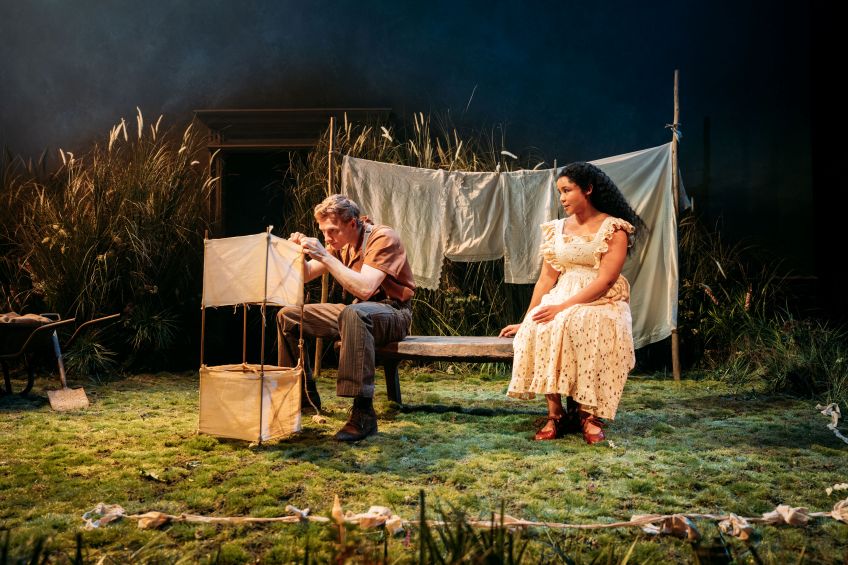
The Donmar stage is small. The actors are cramped. The clothes they wear don’t feel right. The staging is messy and unappealing. The shrubbery setting is distracting. The awkward entrances and exits through a narrow space in the back wall cause congestion.
The doctor’s famously hilariously unromantic proposal of marriage to a spinster is no longer hilarious.
To learn more about Robert Tanitch and his reviews, click here to go to his website.