The Grand Western Canal runs for eleven glorious miles through rolling mid-Devon countryside with distant views of Exmoor – all the way from Tiverton to a remote and shady Lowdwells Basin in the parish of Holcombe Rogus.
It attracts some 300,000 walkers, cyclists of all ages, canoeists, and paddle boarders a year and must be a prime example of how Britain’s industrial heritage has found a new lease of life in the 21st century.
But way back in the late 16th century this potential canal route was seen as an imaginative way of linking the Bristol Channel with the English Channel, so avoiding an often perilous and stormy voyage around Land’s End.
Goods could be easily landed at Bridgwater on the Bristol Channel transported by horse- drawn barge via nearby Taunton in Somerset and on to Tiverton in Devon and then forward to link with the English Channel at Topsham.
But not everyone thought it was a grand idea, namely Exeter merchants, who saw it as a threat to their sea-borne trade and then the ambitious project was further delayed by the Napoleonic wars.
Parliament eventually passed the Enabling Act in 1796 after the route, expected to carry cargoes including coal, lime and agriculture goods had been surveyed, but then it started to go horribly wrong due to the lack of funding and the later arrival of the railways.
Indeed, it was The Great Westen Railway company, who took over the canal back in 1888 and it was later nationalised and closed to navigation in 1962.
Going horribly is an experience that my life-long walking companion and poet Peter Gibbs and I do know something about in that anything can happen out on the trail if we should happen to miss a signpost while chatting or are not paying enough attention to our map.
So that’s the one great thing about walking Britain’s fabulous network of canals – and we have walked many of them – and that is that you always know exactly where you are going.
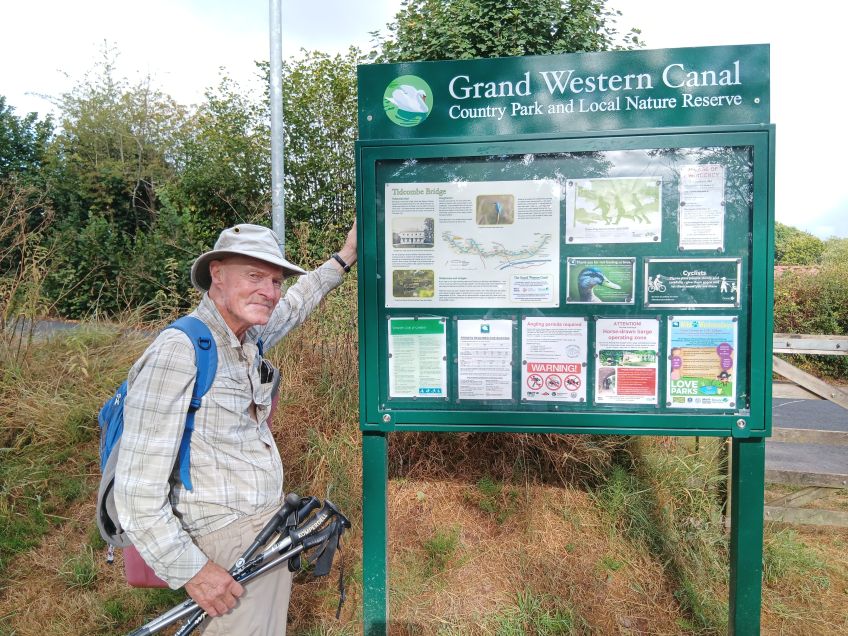
Anyway, I digress, so back to the Grand Western Canal, which Peter and I joined early one August morning after a short uphill lanes and footpath walk from the nearby Tiverton Hotel.
We might have taken ages to find the way without a “random act of kindness” from Suzie Moate, who paused on her brisk walk to open-up The Works Store in town, to hurry back to the corner and to point us in the right direction.
The canal, which turned out to be an absolute delight has been designated as a Country Park by Devon County Council, which maintains it for the whole of its length.
While ducks dabbled and moorhens chirruped from among the reeds, we twice caught the blue flash of an elusive kingfisher skimming the water ahead of us.
On the tops of occasional small posts along the way were the delicate designs of frogs, birds and fish and even one of an otter known to frequent that particular spot.
Our peaceful early morning reverie was paused at one point when we came upon the sad memorial to two young airmen, who lost their lives when their Canberra bomber on a low- level training flight from Germany crashed into the water close to 7pm one evening in November 1961.
It appears they reported a serious engine fault at 4,000 feet while flying over Tiverton but instead of bailing out stayed with the aircraft, which went on to crash into the canal possibly saving many lives.
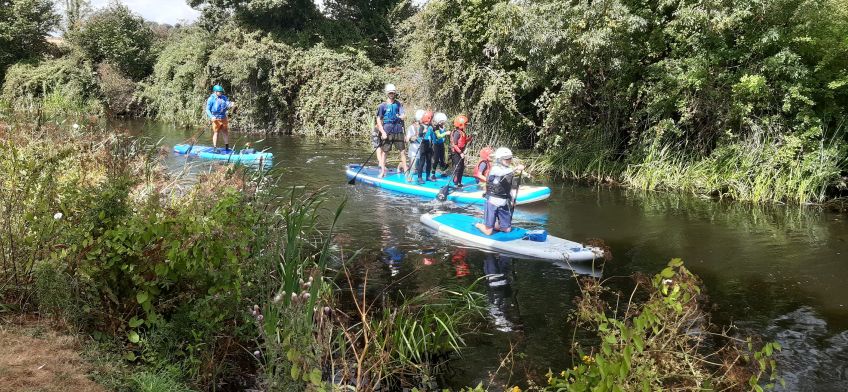
But our spirits were certainly lifted later when we heard the joyous cries coming from sixteen happy Sea Scouts from coastal town of Watchet in Somerset heading along the river on paddle boards as one highlight of a week-long holiday in the area.
By lunchtime we had reached the quiet village of Sampford Peverell about midway along the walk and popped into the canal-side Globe Inn for some light refreshments.
Later that sunny afternoon while billowing snow white clouds drifted across otherwise clear blue skies we came upon Craig Saunderson on his mowing machine.
He is a member of the Devon County Council park ranger team responsible for the continued maintenance of the waterway, including water weed clearing and grass cutting along all the way and loves the role which he has been doing since 1995.
But quite surprisingly to us, not far from the end the so far wide and well-maintained cycle way begins to deteriorate into a narrow footpath, only really suitable for skilled mountain bikers.
Here it climbs steeply to avoid a hidden tunnel before descending through gates to end several hundred overgrown yards beyond at quiet and quite deserted Lowdwell’s Basin.
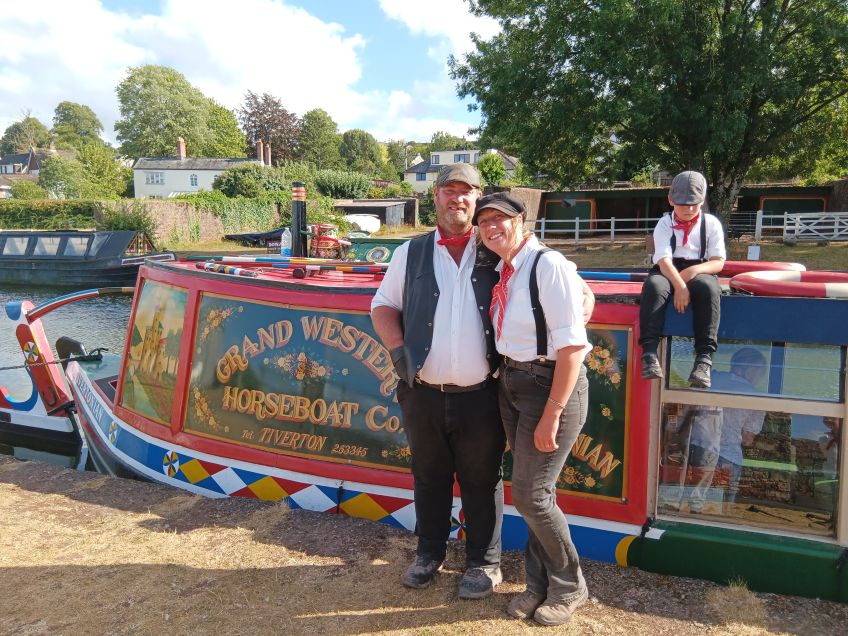
We called out our pre-arranged taxi and were soon back at the main canal basin and assembly point. Here we made our way along the waterside to the Tiverton Canal Companies shop and office where Becky and Dave Poxon who operate one of the UK’s few still horse drawn pleasure boats were just closing up for the evening.
Becky, who took over running the mini cruises earlier this year with her husband is the third generation of the Brind family to run the boat trips pulled by their Welsh Cob George and first launched by her grandparents back in 1986.
The couple are pictured by their boat with their son Jacob. George their sturdy Welsh Cob stands close by.
Horseboat by the towpath
Of Great Western Canal
Ready to go travelling
I’m certain that they shall
Recalling days of yesteryear
When waters flowed with trade
Cargoes moving to and fro
And fortunes swiftly made
Now tourists are the target
New business here to forge
Heading down from Tiverton
And towed by Welsh Cob, George.