
It’s grim, it’s glorious and, as the story unfolds through three acts and six orchestral interludes, it becomes more and more moving. Vibrant characters, wonderful singing, a super-superb orchestral score superbly played and a grim but glorious set work together with engaging immediacy and intimacy. The drama begins in silence, a pallid corpse, caught in fishing nets, lying onstage as in an oil-painting, washed up on the beach to be discovered by children. The piece ends, too, with a powerful silence that suspends us in swaying, breathtaking heartbreak.
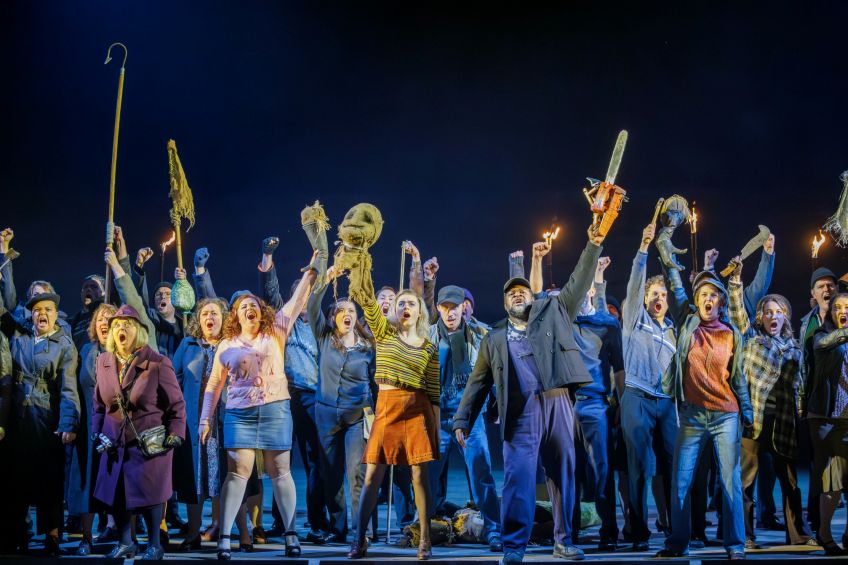
Benjamin Britten’s first opera, Peter Grimes, his most famous, premiered in 1945. Its tale is grim and gritty but the music that tells that tale is sublime. Most of the characters in the dark, disturbing story are taken from The Borough, an 1810 collection of poems by George Crabbe. Crabbe’s fisherman Grimes, though, was nothing but a cruel, heartless, demented brute, whereas Britten’s, for all his faults, is more a misunderstood outsider, an ill-fated, lonely misfit. Grimes has been legally cleared of killing apprentice lad, William, who died of thirst out on his boat, but the folk of this secluded Suffolk fishing-village won’t accept the verdict; they’ve witnessed Grimes’ bullying; they’ve seen his temper. As rumours and accusations fly and multiply, fear and hatred snowball into vigilante mob mentality and a frenzied witch-hunt with torches and blood-chilling effigy. When next apprentice, John, also perishes, Grimes’ fate is sealed.
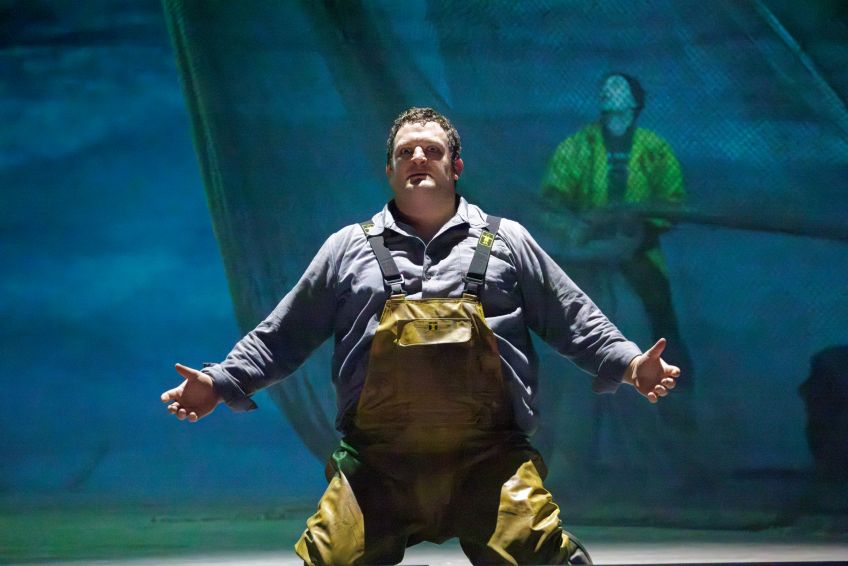
In this revival of Phyllida Lloyd’s award-winning production of 2006, previously revisited in 2013 and directed this time by Karolina Sofulak and Tim Claydon, Anthony Ward’s minimal set ensures no distraction from the focus on drama and music. A bleak sea of smudgy, grey-blue is the static backdrop throughout; above it, blackness. No beach is depicted, no village, no building other than what’s created as performers come and go with versatile, dark-wood, slatted pallets that build into platforms or create walls for courtroom, pub or church, ready for graffiti daubs. Constructed before our eyes as the Passacaglia plays, Grimes’ precarious, cliff-top hut, aptly arises like a scaffold or launch-pad. Artistically hoisted on high by cast and chorus, a vastness of pale netting creates a transparent structure that tightly encloses the frenzied mob as one claustrophobic, homogenous mass, or transforms into Auntie’s house of ill repute, The Boar, or into low-slung fishing nets. Weathered, yellow fisherman’s garb and non-distracting outfits of subdued grey-blues and browns, anywhere from later twentieth century to now, work along with looming shadows and semi-darkness to reinforce the grim mood.
John Findon’s bulky Grimes, his body language particularly still, is generally of quiet demeanour, his sensitive, expressive, beautiful singing conveying tender longings for cosy, married life with schoolmistress, Ellen. As he holds aloft the dead body of apprentice John (played lifelessly well by brave Toby Dray) he weeps and mourns, his vulnerability and humanity shining forth, again unseen by the townsfolk but earning sympathy rather than hatred from the audience. With Finden, Grimes’ sudden verbal and physical outbursts of bitter frustration, anger and violence – even when he strikes Ellen – are not overly frenzied or frantic and quickly subside. Like the sea and like the music, his moods ebb and flow, surge and plateau, and his hopes and dreams (as in a fantasy scene, in which the townsfolk warmly welcome him) quickly crash back down to the depths of hopeless despair.
Frenzied words and gestures are, in fact, more the preserve of wild-haired, bespectacled fisherman and Bible-bashing (bottle-swigging), impetuous fanatic, Bob Boles, engagingly sung and played with great fervour by Stuart Jackson. The hypocrisy of the “upright”, sanctimonious Christians who obsess over Grimes, is strongly portrayed onstage through the widespread drunkenness and debauchery of the characters – other than Grimes. Clad in deep purple hat and coat and toting a camera to collect evidence, Claire Pascoe is the very credible laudanum-partial busybody, Mrs Sedley, gossip, rumourmonger and malicious loudmouth stirrer. Supplying her needs is long-haired apothecary, Ned Keene, played lively and perkily sung by Johannes Moore. While the outwardly dignified lawyer, Swallow, sturdily played by James Creswell, is partial, too, to drink and goings-on with Auntie’s nieces, Daniel Norman’s Rev Adams also adds nice comic touches to his dabblings in that direction. Tall, businesslike and stately in black and red, Hilary Boyle is Auntie, no typical pub/bordello landlady in appearance, perhaps, but with a voice and character that have haunting impact, while her wonderfully interactive nieces are played superbly by Nazan Fikret and Ava Dodd with brighter colours, short skirts, fine humour, great liveliness and suggestive writhings. They sing fabulously together, and separately, and the glorious quartet with Auntie and Ellen Orford is a particular highlight.
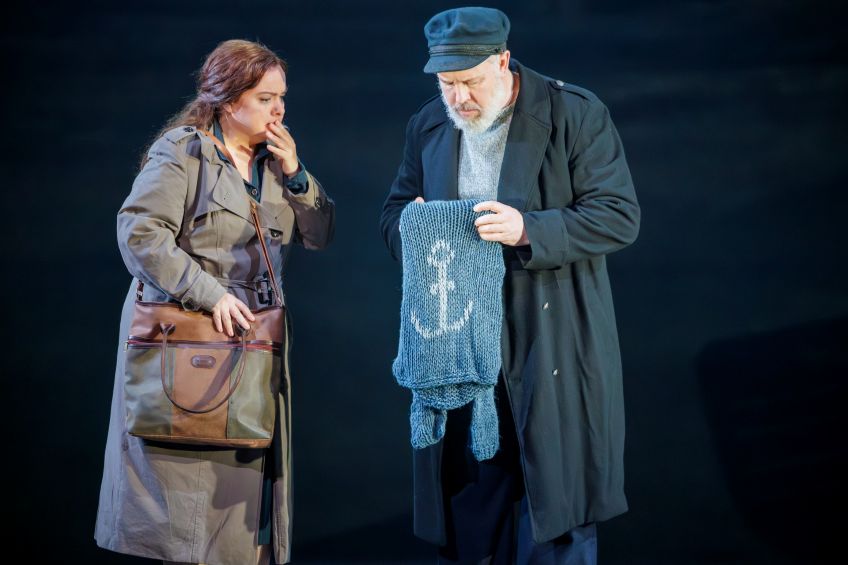
Schoolmistress and widow, Ellen, in dowdy trench-coat, is played with tender sensitivity by Philippa Boyle, her song of Embroidery in Childhood touchingly lovely. She knows life can be torture and she’s one of very few willing to treat Grimes with affection and understanding. She wants to save him from himself, but she can’t ignore his violent, bullying flare-ups and must try to protect the boy. Another who sees the bigger picture and offers Grimes help and understanding is retired skipper, Captain Balstrode, played strong and level-headed by Simon Bailey, and he knows when he’s beat. The large chorus sings and acts as splendidly as all the rest, pouring scary commitment into chillingly-lit, massed frenzies of hysteria as well as vibrant energy into operatic sea shanty, church singing and offstage chanting.
The colossal star of the entire piece is, of course, the music, whose phenomenal orchestration amazes at every moment in unique, ever-changing ways. From deep tones of tuba, trombone, bassoon and strings to percussive clashes and magical, piping shimmerings of flute, harp and violin, the infinite beauty of descriptive colours and textures are infused all the way with the ebb, flow, surge, storm and shimmer of ever-moving seas while closely reflecting the words – practical and fanciful – of Montagu Slater’s libretto and intensifying the drama, emotions and characterisations. Conductor Garry Walker ensures impact on all fronts as do the entire cast.
A haunting production.
Eileen Caiger Gray