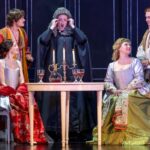
Billed as a match made in mayhem, Mozart’s rom-com, The Marriage of Figaro, always a top opera worldwide, is frantically fuelled and preposterously propelled by whirlwinds of cunning plans, twisty-turny plots and surprises, ridiculous disguises, hellish secrets and deceptions and, most especially, by Mozart’s exquisite flow and blend of heavenly music. Opera North’s fresh take on the comic masterpiece, once it settles us in, is delightful.
Figaro (former barber of Seville) and Susanna, both staff of Count Almaviva, are eagerly preparing to wed. Simple. Ah, but when multiple soap-opera spanners, cliff-hangers and crossed wires are thrown into the works nothing gets close to being straightforward or simple. The Count (as is his noble right) is intent on having his wicked way with the lovely Susanna asap while Figaro is in huge debt to former housekeeper, Marcellina, a woman who is herself determined to marry Figaro (until a jaw-dropping bombshell revelation puts paid to that). Meanwhile randy, young page Cherubino (female soprano) is caught with Barberina, daughter of bee-keeping gardener Antonio (Susanna’s uncle) while also being constantly infatuated by every female he sets eyes (and hormones) on and especially besotted with the Countess. The said long-suffering countess eventually enlists help from all quarters to entrap her philandering husband in flagrante delicto. Of course, all goes wrong at every turn and chaos and hilarity ensue, assisted all the way, thankfully, by truly terrific music and singing! Eastend Corriedale Street eat your heart out!
Far from laughing heartily at the premiere of the original comedy by French playwright Beaumarchais, though, upon which Mozart’s opera is based, many reacted with outrage and icy fear, and the play was banned in various places. This, after all, was 1784, a time when French aristocratic heads were increasingly in danger of rolling off to the guillotine and into a basket. By the time Mozart conducted his opera in Vienna in 1786 (completed in just six weeks, it’s said) librettist Lorenzo da Ponte had pruned out tirades of rebellious servants tearing into nobility, sticking instead to decrying marital infidelity, especially women’s – much less controversial!
Though Madeleine Boyd’s handsome set and costumes bring all these shenanigans into a modern, mobile-phone world – sort of – there’s still a nicely historic feel in the mix. The unworthy Count Almaviva now owns a declining, horsey English country estate, and the former dominance he had thanks to the undeserved powers and privileges afforded by class and title, is waning fast.
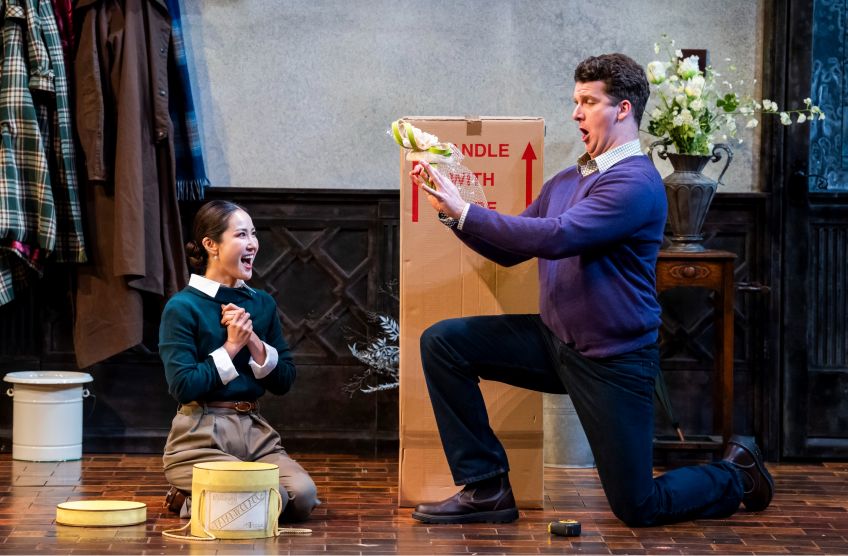
His home is so, so busy at the start there’s hardly brain-space left to listen to the glorious (King’s Speech) overture. As eyes feast on props galore, we’re bombarded with the comings and goings of countless successions of busy characters entering and leaving a large cloak/boot room area through a door, patterned with stained-glass, or seen through a large, square-paned window as they climb a broad staircase. Profusions of country coats, hats and waterproofs hang on hooks while boots, wellies, umbrellas, walking-stick, tennis and cricket paraphernalia, buckets (handy for roof leaks), a bench, a church pew and a vase of bewilderingly ever-changing flowers fill the area. Here Figaro is measuring this space (bizarrely?) for the newly-weds’ bedroom as tradesmen wheel in massive cardboard boxes, and workers, employees and contractors all call by.
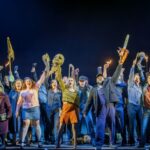
The costumes and set add massive variety and thoughtful interest throughout: the ensemble and chorus appear as cleaners, caterers, nurses and strings of assorted tourists and staff and as wedding guests who indulge in hilarious dancing, while clothing ranges from neat jumpers, check shirts, corduroy trousers, sports jackets, waistcoats and flat-caps to overalls, tabards, uniforms, hard-hats, high-vis, denim jeans and jackets and faux-fur waistcoat.
Following the overture, rapid words pour forth, the Italian written up in English translation, as characters, plots and grievances are introduced. Gradually, though, more time is afforded for reflection and digestion as plots hatch and thicken and characters come fully to life.
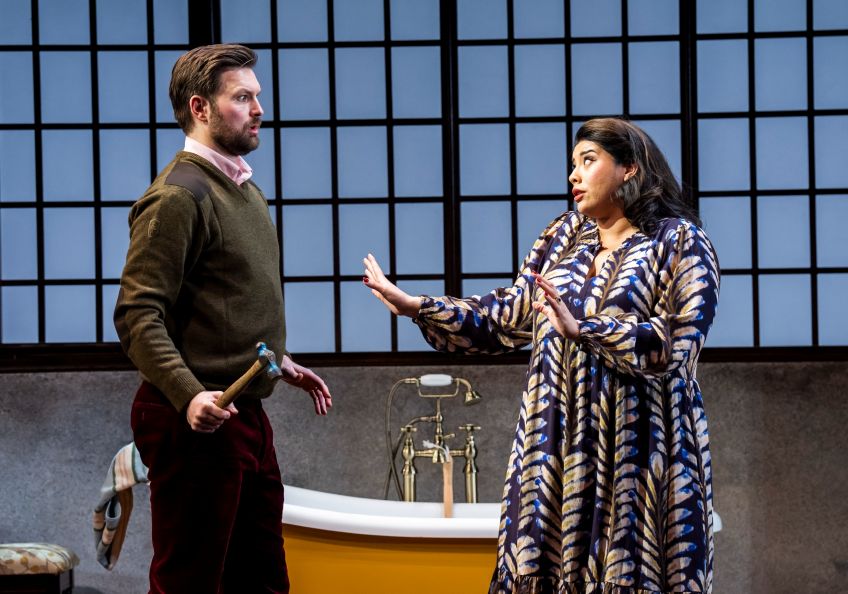
Act II is delicious, both dramatically and musically, set in a handsome bathroom with claw-legged bath, understairs cupboard, ideal for hiding in, and high windows, ideal for jumping from before the Count returns with hammers and drills. In Act III a split stage serves brilliantly to broaden our view of the characters and relationship of the Count and Countess, he at his pool table, planning infidelity and revenge, she poignantly creating a nursery and tightening bolts on a cradle into which she tenderly pops a teddy. The setting of Act IV in a straw-filled stable/barn is excellent, too, the wooden-slat partitions ideal for hiding and lurking.
As the Countess Almaviva, Gabriella Reyes is engagingly sensitive and touching in both her acting and her fine-toned, superbly expressive singing, and she brings beautifully moving nostalgia to Dove Sono. James Newby is her sturdy, assertive, jealous husband without employing heavy-handed over-exaggeration. Pantomime farce, oversized gestures and caricatures are not on the agenda, allowing a lighter, gentler flow of comedy and humour to bring greater reality and credibility to the characters and their emotions.
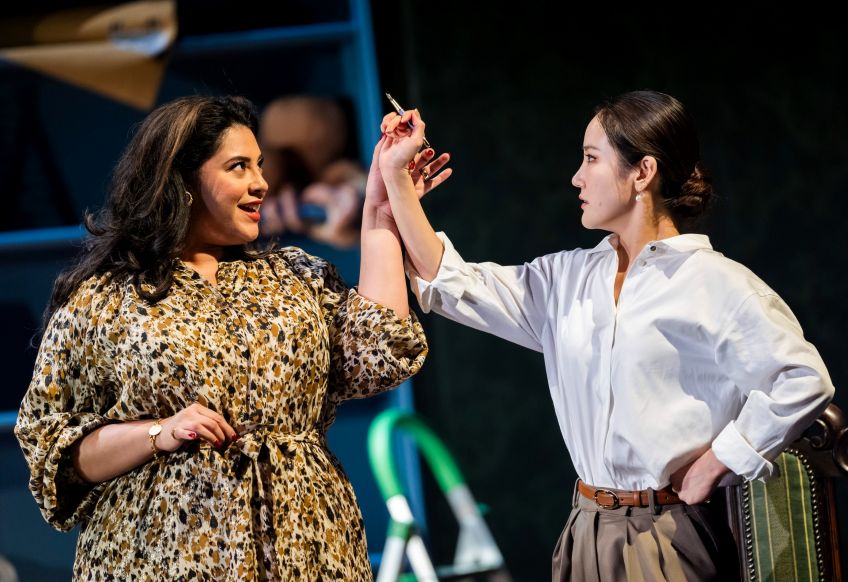
Hera Hyesang Park ‘s Susanna is a clear-headed, well-balanced, self-assured, smart woman, certainly no scampering skivvy, also beautifully sung, ensuring the sublimely composed Sull’ Aria duettino with the Countess holds us spellbound, just as it did the fictional inmates of Shawshank prison. As “brat”, Cherubino, Hongni Wu is endearing both for her lovely soprano singing as in her aria on the agonies and ecstasies of love, Voi Che Sapete, and for the gentle-touch comedy she creates, giving Cherubino an adolescent slouching petulance that counterbalances his cheeky, rampant lust. There’s fine soprano singing from Charlotte Bowden, too, as Barbarina, while Katherine Broderick brings sturdy fun to the role of Marcellina and Daniel Norman makes for a lively, engaging Basilio. Liam James Karai is the titular Figaro, still at the ready with barber’s scissors and cut-throat razor, his firm bass-baritone conveying fun and cunning as he calls the tune in the catchy, iconic Se Vuol Ballare.
With the continuo bestowing beautiful, light sparkle to the recitative, the flow of music from the Orchestra of Opera North, under the baton of Valentina Peleggi, is done full justice from start to finish, the singers’ voice combinations being particularly pleasing in an opera that combines voices big-time in super-superb ways as the songs drive the story and flesh out the characters. As ever, it’s a real treat when seven fine voices sing so splendidly together at the end of Act II.
The finale has impact too, when all sing heartily of this day of torture and madness we’ve all just witnessed, totally relieved to have it now end in nothing but joy. The expressions and reactions of the characters, though, create a delicious, cliff-hanging ambiguity, a wonderful touch that leaves us with the distinct impression that, more than likely, the madness and torture are far from over. Under Louisa Muller’s direction, there are many added humorous touches. Very enjoyable.
Eileen Caiger Gray