Northern Broadsides, founded in 1992 by the charismatic Barrie Rutter OBE, who stepped down as artistic director in 2018, prides itself on imbuing revered classics with a strong northern voice and down-to-earth excellence to create “bold, accessible” shows. The current bold choice is Fyodor Dostoevsky’s towering 1866 literary masterpiece, Crime and Punishment, adapted by artistic director of Northern Broadsides since 2019, Laurie Sansom. And what a choice!
Thanks to an outstanding, ingenious set, canny music and sound input and inventive lighting, gripping build-ups of tension and a haunting, intimate atmosphere of time and place are wonderfully evoked, making this an impressive, admirable production in spite of the fact that certain aspects work less well and the drama does rather run out of steam as it heads to its very sudden end and quietly fizzles out rather than steeping us, with deep impact, in poignant contemplation.
Central to the story is a brutal murder in hot, humid, grimy St Petersburg – two murders in fact – but there’s no head-scratching about who dunnit nor even why. The infinite intrigue and power of the novel’s drama lie in the twists and turns of what will happen next and how it all will end; some twists and turns stem from the ongoing dramas in the lives of the murderer’s mother, sister and others around him but, primarily, it’s all about the feverish turmoil of tortuous twist and turns that fester and seethe inside the tormented, paranoid mind of murderer, Rodion Romanovich Raskolnikov (23), a ragged, penniless, former law student, a brooding, disgruntled, self-isolating, intellectual thinker.
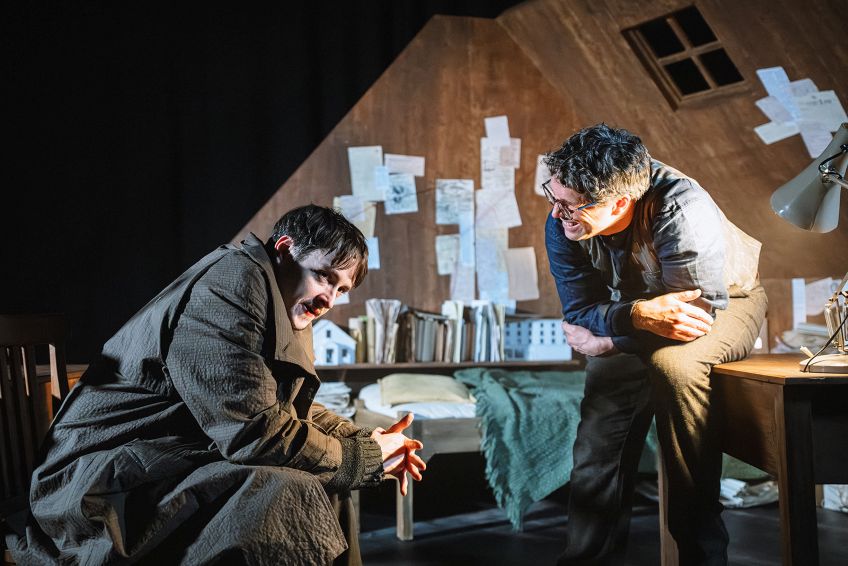
As Rodya picks up an axe to murder in cold blood and rob a nasty, unscrupulous, heartless old pawnbroker woman, he’s convinced he’s doing nothing terrible; indeed, he sees this murder as being for the general good. He believes certain men in the world are so special, so extraordinary, so far above the rest, they’re perfectly entitled to flout the law and reject accepted ideas about what’s moral or immoral. Taking this “cockroach” of a woman out of existence is for the good of all, and once out of poverty himself, he can use her wealth to do philanthropic deeds. The ends justify the means. He fails to take into account, though, the workings of his own human psyche in spite of his calm convictions. As the soul-destroying torment of a guilty conscience kicks in, overwhelming inner turmoil catches him up in an uncontrollable, devastating, self-destructive, psychological spiral to hell. This rationale for Rodya’s thinking and his motivation to murder, though, is revealed to the audience only later in the play during the cat and mouse interplays of Raskolnikov with the patient, wily Inspector Porfiry Petrovich.
Rose Revitt’s ingenious set, designed for smaller venues, is breathtakingly good at conjuring up Rodya’s claustrophobic, cupboard-like, coffin-like garret room. Two wooden walls, with a small window high up, slant inwards over a rudimentary bed, strewn with a mess of blankets, from which the ex-student first emerges. Scraps of paper plaster the walls while tall, ungainly piles of papers and books line the floor and shelves. Simple, old wooden chests, chairs and tables are slotted in, which, along with a wooden washstand that stands apart from the garret area, quickly reconfigure to create police station, tavern, apartments and outside streets.
Fabulous use is made of several fine models of buildings that stand on the shelves in the garret, each representing the location of other scenes, its lights switching on floor by floor as action proceeds. These lights, as with much of the frequently changing lighting, are operated by the three actor/stagehands themselves – lights on tall stands, lanterns, flashlights and angle-poise lamps – all moved extensively to create moody shadows, light and darkness. Sometimes Rodya lights his own face from below or others circle, shining torches on him while Inspector Poriry Petrovich has angle-poises galore at the ready to aim at his quarry in traditional interrogatory style. One divinely atmospheric scene is created by a dancing, carousel mobile and its magical shadows as, with pre-recorded shouts, conversations and whinnies, a flashback outdoor scene is brought poignantly to life as a horse gets beaten to death. Other pre-recorded scenes work splendidly, too, broadening out the onstage space to the streets of St Petersburg with its chaos of rowdy crowds, vagrants and drunks. Music, too, is wonderfully deployed, with careful volumes from music-box and oboe melodies to sounds of tension and echoing voices, well thought out for maximum atmospheric effect.
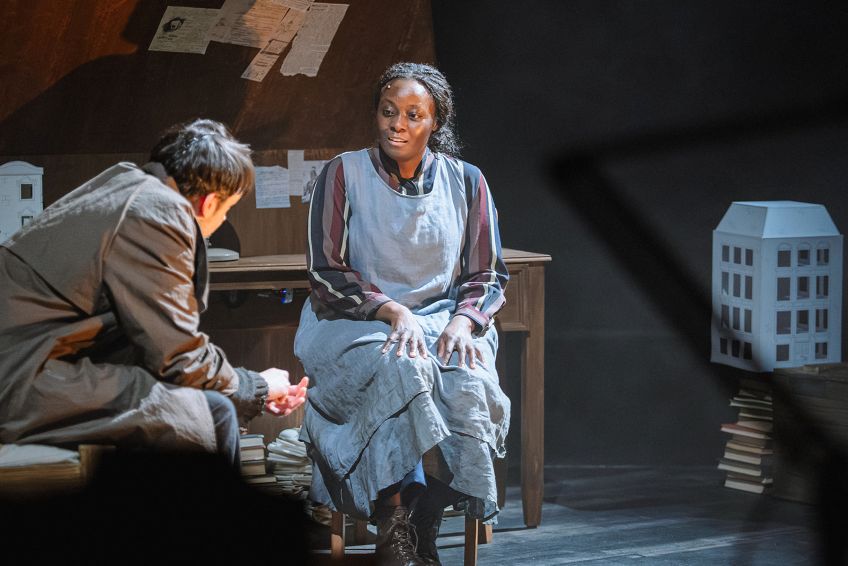
Almost a dozen characters, some just superficially represented, are portrayed by three actors who, at the same time, masterfully incorporate the roles of stagehands and lighting engineers. Some characters (not the central ones) are slightly problematic. When Niall Costigan pops on a coat and headscarf over his grey trousers to become Rodya’s loving, caring mother, our credibility is cruelly tested when his appearance, if not voice or acting, has Monty Python’s Terry Jones spring instantly to mind, creating quite the wrong mood! Trudy Akobeng, too, is visually less credible as Raskolnikov’s loyal, good-hearted, male friend, Razumikhin, while her limping pawnbroker, Alyona, seems softer and more likeable than we might expect a grasping, heartless, worthless, murder-deserving cockroach/vermin hag to be. As bustling, personable housekeeper, Nastasya, and in the smaller role of Rodya’s sister, Dunya, she’s engagingly warm, while she projects well in the meatier roles as Katerina Ivanovna, long-suffering, hard-working, terminally ill wife of drunken Marmeladov and in the crucial role of Marmeladov’s daughter, Sonya. She presents a beautifully gentle, caring, modest, cross-bearing Sonya, full of love, religious faith and moral good, quietly courageous in spite of having to turn to prostitution to support her siblings, ailing mother and wastrel of a father. If anyone can save Raskolnikov from himself it’s her.
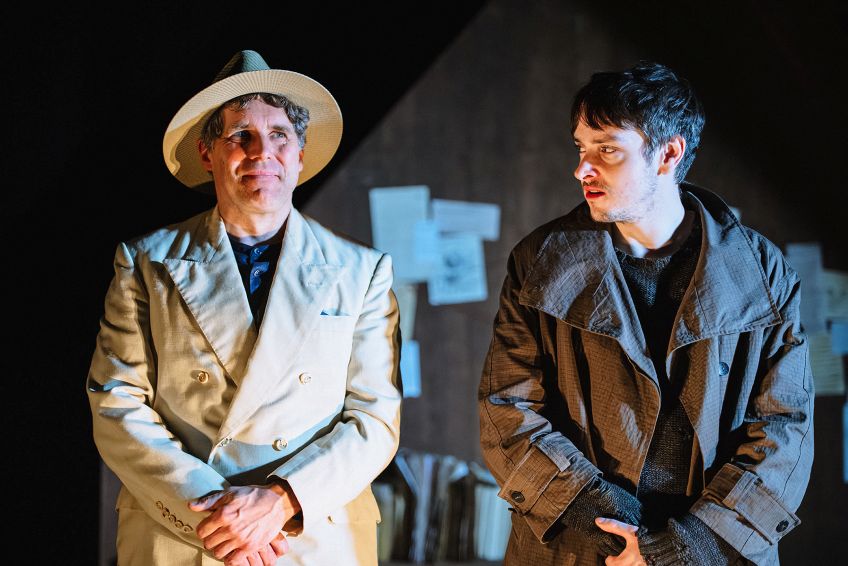
Niall Costigan engages warmly, retaining likeability as the inebriated, irresponsible waster, Marmeladov, who ends up crushed by a horse and carriage (ie a pile of upturned chairs). As despicable, depraved, amoral predator and conman, Svidrigailov, in cream jacket and panama hat, Costigan ditches the Northern accent to become colder and more detached. Rodya’s sister Dunya may have escaped him but he’s persistent. Unlike in the book, though, he stays alive rather than eventually committing suicide.
With so many characters, some appearing but briefly, who’s who might prove confusing to some, but the crucial focus is on the two main characters and their reactions and interactions, which are well drawn and gripping. Scottish accented Connor Curren is the distressed Raskolnikov, tortured by his own mind, swinging through nightmares, hallucinations, paranoia, delirium and calmer moments. With internal monologues and self-rebuke spoken direct to audience, we perceive he’s a confused bundle of emotions, though he does largely present as pretty detached. Meanwhile, Niall Costigan’s Inspector Porfiry is engagingly brought to life as a particularly (apparently) laid-back character, with sparkle in his warm Northern accent as, patient and wily, he joshes playfully in working to entrap the murderer.
It’s nigh on impossible to put on stage a timeless masterpiece that’s filled with so many colourful characters yet primarily set in the suffocating torment and brooding disquiet of a person’s mind, but this production has an admirable, haunting atmosphere and gripping tension. And to ensure the language is accessible to all us modern folk, updates include words like “tosser” and “spoiler alert”.
Eileen Caiger Gray