

Joyce Glasser reviews Ray & Liz (March 8, 2019), Cert. 15, 108 min.
Back in 1996, photographer, painter, art teacher and filmmaker Richard Billingham’s photography book Ray’s a Laugh laid the foundations for what would become two short films, entitled Fish Tank and Ray respectively and, twenty-two years later, his riveting first feature film, Ray & Liz.
The inspiration for the book itself was Billingham’s childhood in Cradley Heath in the Midlands. The title Ray’s a Laugh is deeply ironic as anyone subjected to the opening five minutes of this very dark, grotesque yet compassionate, subtly political British comedy film will realise.
Shot on 16mm film by cinematographer Daniel Landin, the gorgeous images belie the unpleasant and sometimes terrifyingly ugly subject matter. If anything, each shot is painstakingly staged to a fault, but Billingham frames with a photographer’s eye and the décor and costumes are extensions of the characters and expressive of their lives.
An unshaved, pale man who might be in his fifties, Ray, (Patrick Romer) wakes up in a squalid bedroom and immediately reaches for a cigarette. Simultaneously he reaches for the first of many glasses of a dark liquid lined up in plastic litre bottles on a table. Billingham treats us to a stomach-turning close-up of the man downing an entire glass of this home-made brew in one go before reaching for another.
This man with dead eyes then goes back to bed, only to be awoken by a neighbour: a hirsute, 30-something man putting refills of the sickly liquid on a woman’s dressing table. He sees a photo – the only decoration in the room – and, mumbling a swear word, throws it out the window.
It seems Ray is a prisoner in his room and the connection with his previous life is not yet apparent. This unprepossessing vignette has more of Samuel Beckett’s Malone Dies in it than of Terence Davies’ Distant Voices, Still Lives. The image of older Ray in his bedroom fades out with him looking out the rain-streaked window from an upper storey. It is linked in a kind of flashback with younger Ray (Justin Salinger) staring out the window of his neglected, seedy, and dreary council house in the 1970s.
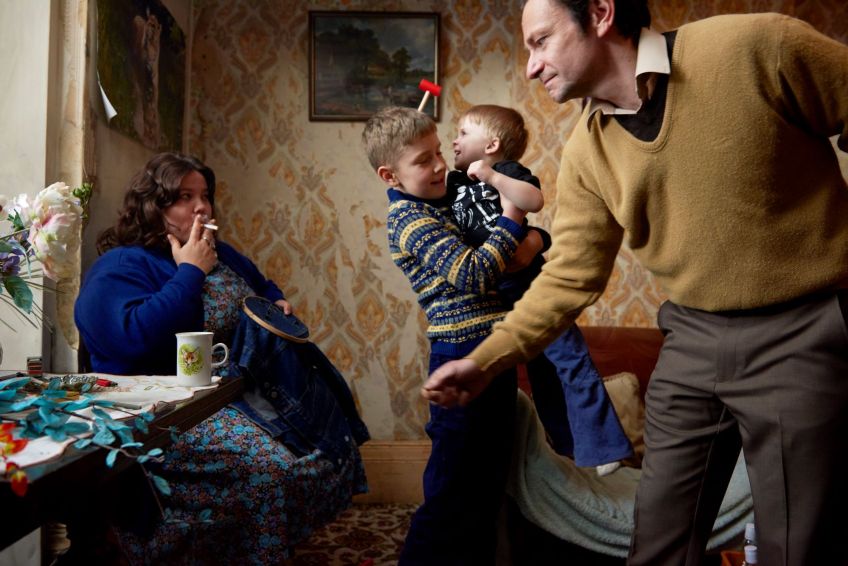
Liz (Ella Smith and Deirdre Kelly), an obese and chain-smoking crossword puzzle fanatic, sits at a table arranging flowers, doing embroidery, or putting together puzzles of jungle scenes. Somewhere under all that flesh and self-abuse is a pretty face. It is perhaps that Liz – from happier times – who is served endless cups (with fox heads painted on them) of tea by Ray, her doting, recently unemployed husband. Liz is surrounded by her own real-life jungle, complete with a menagerie of animals including a dog, cat, hamster, birds and fish. These are just the germ-carrying accoutrements you do not need in a house that looks like it has never been cleaned.
Two-year-old Jason (Callum Slater) is banging away on a hand-eye coordination toy in the living room while his ten-year-old brother Richard (Jacob Tuton) is sent off to get Ray’s mentally-challenged brother Lol (Tony Way) to come over to child-mind. Liz, Ray and Richard are going off to buy new shoes with Ray’s redundancy money. Lol’s mother (who has a broken arm) does not want him to go to Liz and Ray’s home, alert to Lol’s vulnerability and Liz’s intolerance of Lol’s disability. Lol himself is wary, asking several times if Will (a terrifying Sam Gittins), Ray and Liz’s sociopathic lodger, will be home.
Here, the audience feels the tension crank up. And sure enough, the long, ensuing scene with Will and Lol is one of the most intense and horrific you will see all year. It has all the elements of a home invasion film, like Michael Haneke’s Funny Games, but even more chilling in its authenticity.
The plot of Ray & Liz is the destruction of a working-class family where aspiration is an unknown commodity. This family is surviving in a cycle of unemployment, neglect and helplessness. The story is structured around a series of vignettes in different time periods that, in the end, paint a picture in which little Jason becomes increasingly important.
We are fast forwarded in time when teenage Richard (Sam Plant, who also gets a music credit), now with glasses, seems to be doing well in school. Jason (Joshua Millard-Lloyd), however, who has grown pudgy from feeding himself carbohydrates and sugar, is foundering and up to no good. Putting chilli powder down his sleeping father’s open mouth might be an innocent practical joke, but Jason is heading nowhere fast.
There is great tenderness in how Billingham looks back at his dysfunctional family. When Jason is invited over by a friend’s kindly mother, he samples a normal, if modest, family’s warmth and comfort. After this experience Jason becomes prone, like the boy in the recent, Oscar nominated film Shoplifters, to commit an act that is a subconscious cry for help.
The casting is superb, right down to the characters’ authentic Midland’s accents and the performances are so natural it is hard to believe we are watching actors. But Ray & Liz is far from a documentary and Billingham’s artistry is always evident, even, at times, self-consciously so. It is not an easy film to sit through but is so engrossing you won’t want to leave. It will stick with you long after other films are forgotten.