Ever popular at Christmastime (and as a GCSE text) is the thoroughly uplifting, so, so familiar story of greedy, grasping, cold-hearted Scrooge and his sudden, spirited overnight transformation into the utmost of joyful, generous, caring souls. Adapted by Aisha Khan, this production may not be the most dynamic and gripping re-telling of Dickens’ 1843 Gothic tale but, with handsome period set and costumes, gathering involvement, special harmonies, some pleasing performances, plus ghosts, snow, a tear-jerking ending and a rousing finale, it’s a hit with the audience.
Evoking Dickensian drab are pavings of dark grey slate, dark-wood constructions on two levels with orange-lit windows and lamps and hints of mist and dark corners, while spotlights beautifully conjure up a debtor’s prison. Props and set components are kept to useful basics: chimney-place, grandfather clock, tables, chairs, a roll-on bed, a Cratchitt table that rises up from the dark slate floor, chandelier and green decorations that descend from on high as required, portable baskets of goods, a truly gigantic turkey and so forth. Performances, too, even the ghosts, are never elaborate or over-the-top, avoiding melodrama, caricature and sickly sentimentality in favour of a more natural feel so that even the supernatural comes over as pretty natural – apart from scary moments when Marley’s ghost looms out of the very fabric of the front door or when the faceless, voiceless, sinister non-human Ghost of Christmas Yet To Come points and prowls darkly, darkly in black cloak and hat.
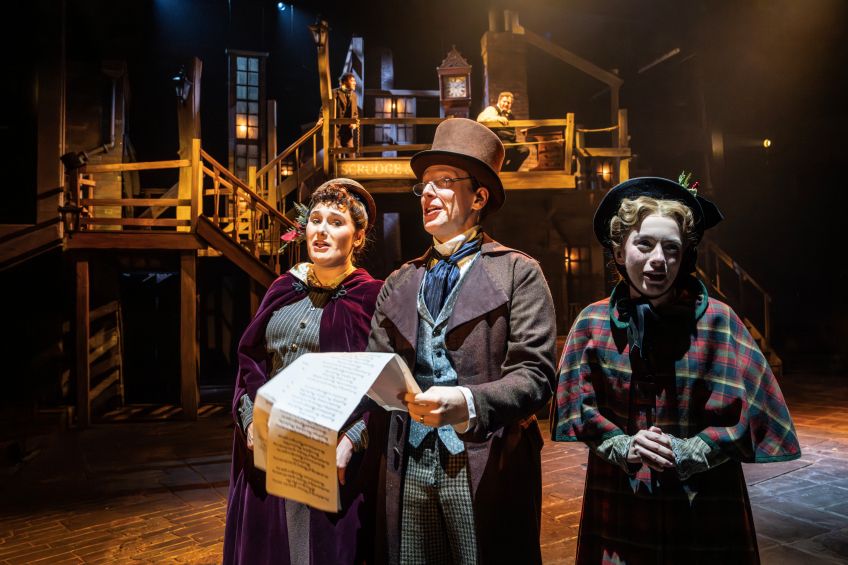
The incorporation of children (local 10-16 year olds) as a frame for narration proves a bit jarring at times in interrupting dramatic flow, talented though they are, but they do serve to bring the city to life. It’s not London, though, for accents are mainly Northern and The Sheffield Carols, passed down via pubs through the generations, are a main feature in this production, all sung a capella with nary an instrument or soundscape. Traditional carols like The Holly and The Ivy and We Wish You a Merry Christmas are sung heartily, at times partly from the aisles, along with village carols such as Sweet Chiming Bells – appropriate in tolling the hour for ghostly visitations. Harmonious dum-dum-dah-dooby-dos get sung during scene changes while Fezziwig guests dance not to a fiddle but to a folky, a capella rendition of Six Jolly Miners. Big song and dance routines are not in the mix, though, even in the busy, Oliver-style opening scene in which children, chimney-sweep and vendors of bread, fishes, flowers and veg mill about far and wide.
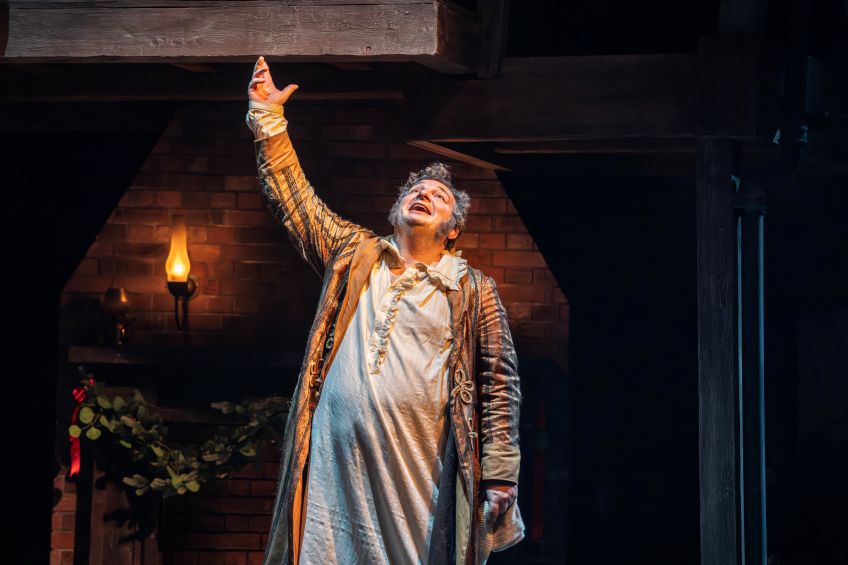
All animated anger, agitated irritation and misery-inflicting cruelty, Ian Midlane’s Scrooge argues vehemently with the spectres to justify his despicable actions, but eventually, as the blatant, moral message gets spelt out ultra-loud and clear and strikes home, his conscience, empathy and a sense of responsibility and justice kick in and Scrooge is joyfully transformed in time to save him from the eternal, infernal chains that are lugged around by dead partner, Marley. Actually, these really don’t look too heavy or cumbersome, nor does he have a bandaged, gaping jaw, but, as a formerly crueller, even more heartless version of Scrooge himself, Anthony Ofoegbu’s Marley comes over well in his silver-grey, glossy-coat ghostliness.
Nitai Levi’s Ghost of Christmas Past, a Scot who sports a miner’s head-lamp, is also robust in his willingness to be as stroppy with Scrooge as Scrooge is with him as he shows him scenes from his past, scenes that help explain how early blows to Scrooge’s psyche from parents, teachers, peers and his sister’s untimely death set him on a path of bitterness. Big-bearded, in dark pink trousers, Christmas wreath and fine, glittery coat, Adam Price’s Ghost of Christmas Present is a sturdy, pleasing presence and Price cuts a fine figure, too, as the festively jolly Fezziwig, a man subsequently broken to a wretched wreck as a result of the misery and destitution caused by Scrooge’s cruel inflexibility over his debts. Striking, too, as Old Joe, a heartless Eastender pawnbroker who buys dead men’s effects, Price shows he has further strings to his bow.
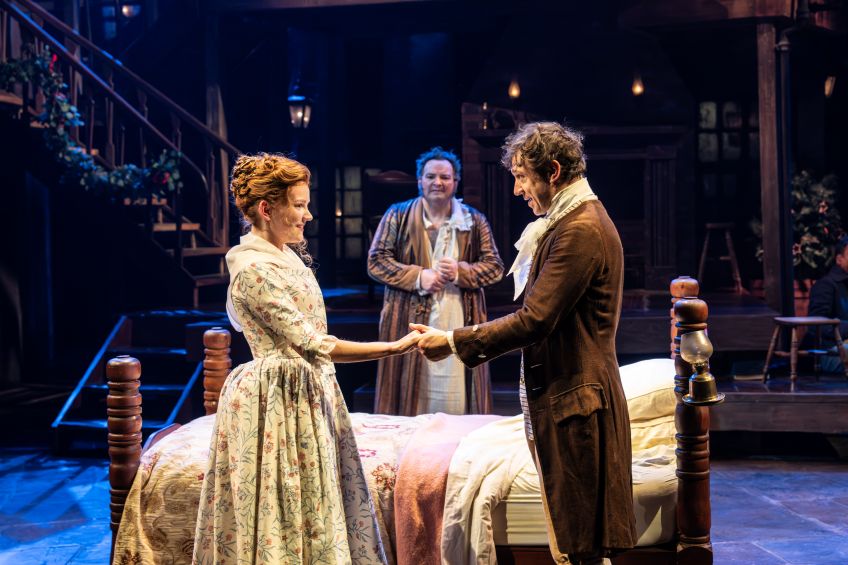
Ryan O’Donnell plays a creditable younger Ebenezer Scrooge, for whom love and romance are quickly subsumed by a lust for money, and he’s a credible, likeable Bob Cratchitt, too, again without exaggerating emotions, qualities and characteristics. It’s to be hoped, though, that Bob’s Christmas presents include a huge furnace of an oven and a time machine for his wife because otherwise that massively gigantic turkey will never get properly cooked in time for dinner and the Cratchitts will all die of salmonella poisoning. But never mind that, for now comes a fine, rousing chorus finale from the large and lively cast with lots and lots of applause, and all ends well – for now.
Eileen Caiger Gray