
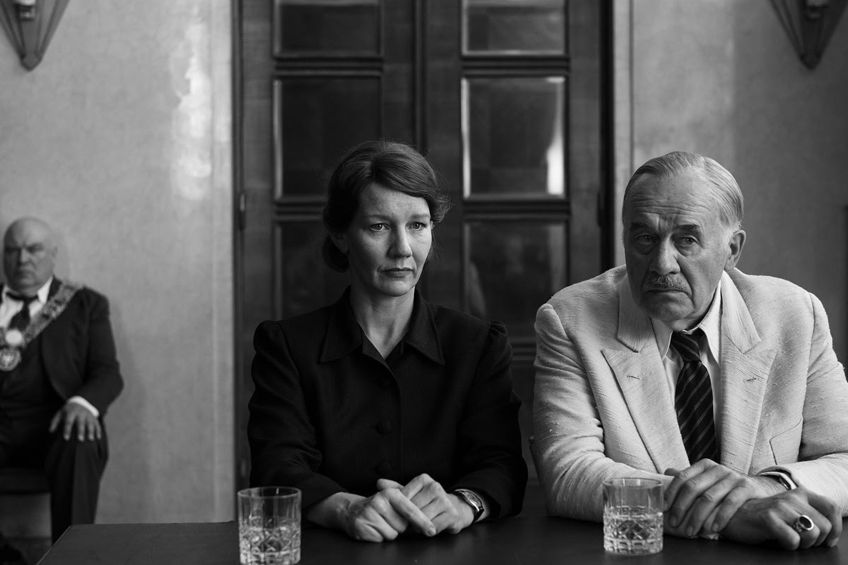
Joyce Glasser reviews Fatherland (October 23, 2026) cert 12A, 82 mins.
Fatherland is the third film from Polish-British filmmaker Pawel Pawlikowski that is under 90-minutes; that is shot in monochrome by cinematographer Lukasz Zal (Zone of Interest, Loving Vincent); and that is set between the shifting borders of eastern Europe post WWII. The previous films are the Oscar winning semi-autobiographical Ida (2014), and the three-time Academy Award nominated Cold War (2018), inspired by the turbulent and peripatetic relationship of Pawlikowski’s late parents.
Fatherland again explores the notion of homeland for characters coming to terms with a political past that has tainted the present. In 1949, the 200th birthday of Johann Wolfgang von Goethe, the Nobel Prize winning author Thomas Mann agreed to attend celebrations in Frankfurt am Main (West Germany), Goethe’s birthplace, and Weimar (then East Germany), where he is photographed visiting the home in which Goethe died. Mann will be presented with the Goethe Prize for Literature.
The charismatic actor Hanns Zischler, an intellectual in his own right, and dead ringer for Mann packs his portrayal with layers of complexity. Mann is accompanied by his daughter Erika (East German actress extraordinaire Sandra Hüller, who played Rudolf Höss’s wife in The Zone of Interest). In reality it was Mann’s Jewish wife Katia who accompanies him but the substitution enriches the film dramatically.
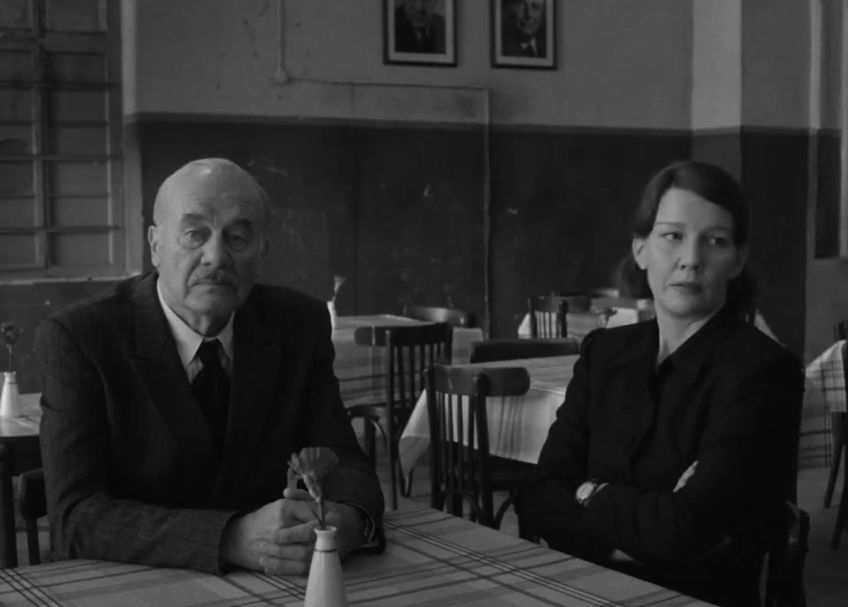
In a press conference, a reporter asks Mann where home is. After a pause, he says, “My home now is California, but where my “Heimat” is, where I belong, is a much more difficult question.” This reply forms the core of the film and of the trilogy.
Pawlikowski, who directs, co-writes and co-edits the film, speaks six languages and is no stranger to crossing boarders. He was born in 1957 in cold war Poland, moved to the UK to study when he was 14, then moved to Italy and Germany and back to the UK (where he made documentaries for the BBC before making his first feature, The Last Resort in 2000). He now resides in Warsaw and Hydra, Greece.
Fatherland opens in a dingy bedroom in Cannes, France where Mann’s eldest son Klaus (a haunting performance from August Diehl), naked and chain smoking, is talking with Erika. She is speaking from Pacific Palisades, L.A. where she is an assistant to their 74-year-old father. Erika is trying to convince Klaus, who has vowed to never to return to Germany, and is estranged from their father, to join them on this trip. As Klaus mumbles that they should just top themselves as there’s nothing to believe in anymore, he ignores a young man who dresses and leaves the flat silently.
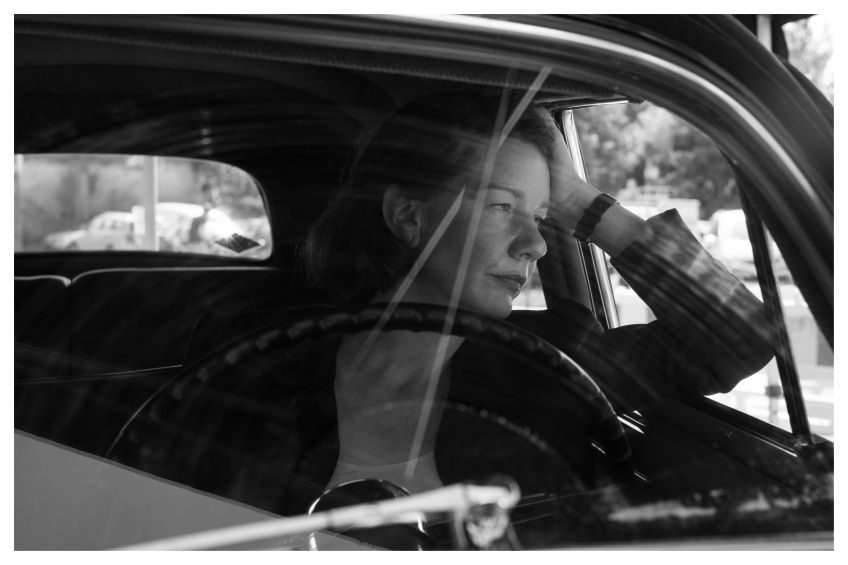
After this scene, Klaus’s absence hovers over the film, as Erika optimistically calls to see whether Klaus has checked in to the hotel. The camera fixes on Erika’s face in a scene that eventually leads to one of the most poignant endings in any film this year. Erika has recalled Klaus saying that ‘hearing Bach makes me almost believe in God.’ In the final scene, an organist is playing Bach in the ruins of a chapel that father and daughter visit on their return road trip. Those who have seen the film Cold War will be reminded of that film’s tragic ending in a cold, war torn chapel.
Fatherland chronicles Erika’s discomfort at how her father is being both honoured and used for propaganda by both sides. But he goes forward, delivering his speeches because he truly believes that Goethe represented love, not death and that literature knows no borders. He does not hide his record of speaking out against tyranny and censorship in Germany, the Soviet Union and in America during McCarthyism – which hastened Mann’s resolve to leave California in the early 50’s.
At a press conference he is accused of fleeing Germany in 1933 instead of “suffering like the rest”. A target of the Nazi regime that confiscated Mann’s Munich home and bank accounts, Mann replies, ‘If I had stayed, I wouldn’t be talking with you now.’
Erika is her father’s chauffeur, valet, manager, carer, (French) translator, and also edits his speeches until, fed up with her father delivering speeches by rote while avoiding Klaus, she accuses him of political naivety. She calls him a narcissist. When he, in turn, calls Klaus, ‘a spoilt attention seeker’, she snaps, ‘I wonder why.’
But Mann, who shares Erika’s increasing unease with the pomp and ceremony of the lunches with, on one occasion, a male military chorus, is no hypocrite.
At a reception at the Metropol Hotel in Frankfurt, Wieland and Wolfgang Wagner (Enno and Theo Trebbs) cosy up to the opera-loving guest of honour, asking him to support the reopening of Bayreuth. In a powerful scene Mann tells them: ‘your grandfather’s music should live on, but Bayreuth should be razed to the ground and your mother [Hitler’s friend Winifred] put on trial.’ Similarly, when the writer and future East German Minister of Culture Johannes R. Becher (Devid Striesow), offers him the “figurehead” post of President of the first Academy of Arts, he declines.
Pawlikowski, careful to avoid expository writing while condensing and eliminating much – perhaps too much – context and background – dramatises the Metropol reception to tell us more about Erika and Klaus, too.
Born just a year apart, the two eldest of Mann’s six children share a bond that extends to their early life in theatre (Erika was an actress before becoming a war correspondent) and their book about German intellectual exiles, Escape to Life. If you’re paying close attention to the rapid dialogue, you’ll hear a quick reference to W.H. Auden who helped Erika get a UK passport by marrying her in 1939.
And from an encounter with Erika’s husband of three years, Gustaf Gründgens (Joachim Meyerhoff), a German actor, closet homosexual and Nazi sympathiser, we learn that Klaus, too, knew Gründgens, only too well. His novel Mephisto banned by the Nazi’s, is based on Gründgens’ self-serving career. In a satisfying denouement, Erika uses Mann’s visit to ensure that the novel will, at last, be published in Germany.