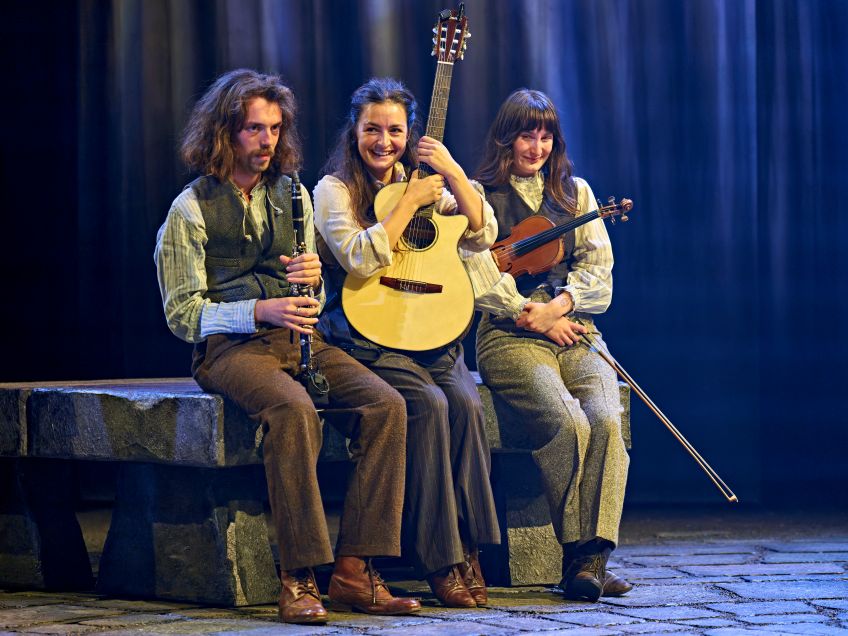
Hot on the heels of The Crucible’s triumphant, smouldering tragedy, King Lear, comes a triumphant Twelfth Night, many of the same cast now taking very different roles to deliver a romping rom-com, tinged with pathos and choc-a-bloc with mistaken identities, deceptions and farcical confusions. Thanks to outstanding, tip-top comedy performances we’re treated to constant, warm waves of uplifting belly-laugh humour that bubble along throughout, even if the far-fetched romances of the swooning love triangle don’t always strike the right note. Superb set and lighting and wonderful arrays of glorious, well-fitting, non-Shakespearean outfits please the eye to greatly enhance enjoyment while three musicians perform, onstage and off, on guitar, fiddle, clarinet and bass clarinet, adding to mood and atmosphere.
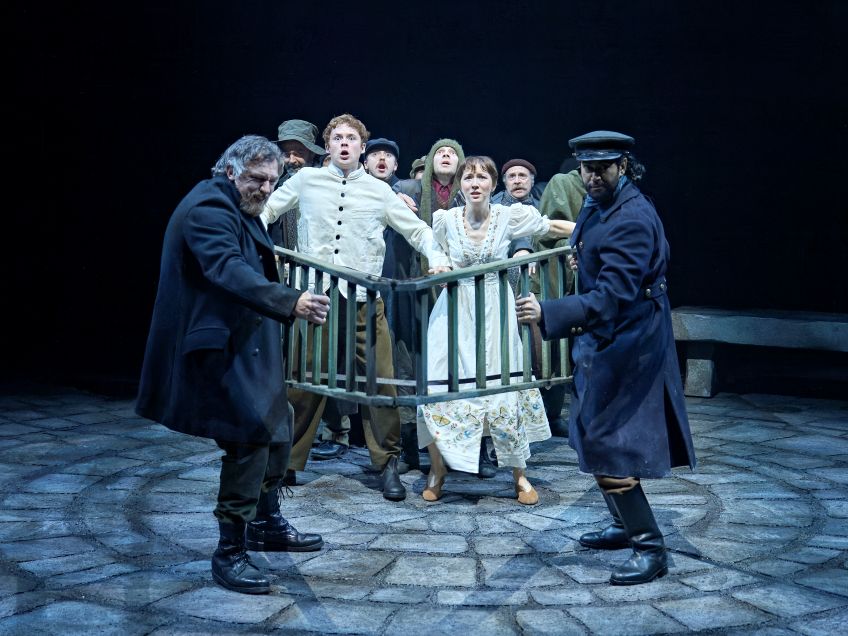
Initially, an orange sun sits, huge and round, at the back of the stage, where the floor is set with large, handsome, grey cobbled stones, atop which three chunky, Stonehenge-style stone benches grace the stage’s revolving rim, keen to travel to new locations. Just like the sun, layers of lightweight, beautifully lit curtains also come and go, appearing in soft, inviting folds of grey, brown or blue-grey and providing effective hiding places for farcical goings-on. Since interest stems from words and action, few props are needed.
It’s Feste, the singing fool, who opens the show, just as he ends it – with a hey-nonny-no and an umbrella – before we’re instantly tossed about in a tempestuous, ship-wrecking sea-storm, well and truly evoked through superb lighting effects and two tall, light stepladders, wielded by multiple cast members. These lurch and tumble in all directions over stage and stone benches as the ladders break away from forming a ship’s bow to perform swaying lurches and tumbles with them. In the stormy sea the twins, Viola and Sebastian, cling to each other until torn apart, each fearing the other is drowned.
Splendid as Viola, Bebe Sanders is soon dressed as a chap once cast upon the shores of Illyria to become a splendid Cesario, servant to Duke Orsino. Addressing the audience with earnest warmth and sincerity, Sanders carries the story magnificently, and when strong, sturdy, caring brother Sebastian (Harry Redding) eventually turns up, dressed in identical uni-sex trousers and top, their reunion is quite touching, and since the pair are not wildly dissimilar, the twin story even maintains sufficient feasibility through all the farcical and romantic twists and turns.
Justina Kehinde’s Olivia, dejected at first in smart black dress as she mourns her father and brother whilst rebuffing all romantic proposals sent by Duke Orsino, instantly falls for the duke’s messenger, Cesario, never suspecting he’s really a she. Her whole being infused with rapturous enthusiasm and flirtatious insistence, she now blossoms and blooms in flowing, green dress. Meanwhile, Cesario (aka Viola) has fallen head over heels for the duke, her master, who also doesn’t suspect he’s really a she. Why she falls for him is a mystery, given that Fode Simbo’s Orsino is an uncontrollably loud, angry, pained, scarily emotional chap. However, in the end she gets her man and we must assume all’s well that ends well.
It’s the comic sub-plot, though, that reigns supreme: the double act of Milo Twomey as Olivia’s uncle, Sir Toby Belch (or Sir Toby Fart?) with James Chetwood as Sir Andrew Aguecheek is magnificent, their vibrant comic timing, delivery and interactions spot-on, both physically and verbally, creating an immense, intense sense of fun and mischief. Twomey’s drunken revels hit the mark without becoming over-the-top boorish, while Chetwood’s warm, loveable Sir Andrew is affable, full of sunny, childlike enthusiasm and dim-witted enough to be easily led astray. Jay Saighal works well with the pair as Fabian, while scenes like the ludicrous duel/fight glory to the utmost in fun and humour. With assortments of pleasing velvet jackets, country-squire elbow patches and check trousers, bright but not gaudy shirts and neat shoes, the outfits all work wonderfully with the characters, right down to the servant girls’ neat, black pinafore dresses.
In smart attire, too, as a sturdy, long-haired Feste is David Birrell, a smart-witted fool – as Shakespeare’s fools tend to be – in dark great-coat, set with tasteful sparkle and colourful streams of narrow ribbons, and handsome waistcoat. Music being the food of love, Birrell’s great singing voice, impressive vocal range and stage presence are well catered for in a variety of musical interludes, some sung with others, many as solos. Folk-style songs like Three Merry Men Be We nicely enhance the revelries of Twelfth Night carousing, while longer, less catchy compositions reflect the melancholier aspects of the play.
In black and white, Katie Wimpenny’s Northern lass, Maria, is another real hoot of a stage presence, her many comic touches adding further energetic sparkle and irrepressible mirth. Bold and effusive, she jumps up and down with explosive joy and uncontrolled eruptions of hilarity as she helps Toby devise their terrible prank on Malvolio and watches the mind-boggling results.
Meanwhile, in the crucial role of Malvolio, steward to Olivia, it’s Mathew Horne, recognised far and wide (especially in Barry and Billericay) as Gavin of Gavin and Stacey or from Drury Lane’s The Tempest where he injected some brightness into a gloomy moonscape set when, as Trinculo, jester to Sigourney Weaver’s immobile Prospero, he wrestled with Caliban.
Malvolio first appears in a dark suit with wide, wide shoulders, walking with repressed, stiff-necked bearing, fingertips drawn together across his body, self-righteous, well-spoken, words carefully placed, and utterly humourless. Shakespeare’s embodiment of a pompous, killjoy Puritan, Malvolio keeps everyone in their place, tolerating no revelries even on Twelfth Night – indeed, tolerating little of anything at any time – which is why Maria, Sir Toby and co plot to bring him down and punish him for his self-righteous, pompous interference.
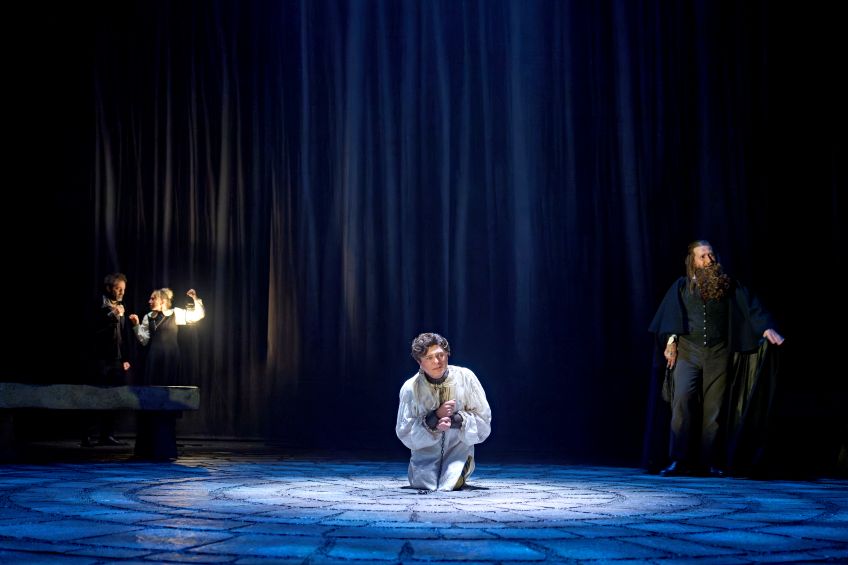
Horne’s Malvolio works well. Staid, distasteful and intolerant at the start, he’s thoroughly ridiculous when roused by the night-time revellers, storming out, indignant, in chunky, check dressing-gown, his wavy-haired, dark wig, hastily donned, riding about his head. When it comes to comic touches and timing Horne also knows what’s what. Amusement grows as, whilst eating a banana, he reads aloud the letter Maria has forged, purporting to be from Lady Olivia, his ego allowing him to believe his Lady is actually in love with him. Then, lo and behold! On his next grand entrance, there he stands dressed like an elaborate Morris man, yet displaying, into the bargain, the longest, yellowest stockings ever seen, thickly cross-gartered for miles – and with pom-poms and bells on to boot. Massive laughter erupts, repeatedly renewed as, smiling madly, he cavorts and capers about stage and benches, showing off his yellow legs from every location and every possible, hideous angle, causing Olivia to flee, fearing she’s about to have greatness thrust upon her! In contrast, though, things take a dark turn when Malvolio’s cruelly cast into a harsh, dark prison (the centre of the stone floor) and further mentally tortured. Horne’s pathetic, cowed demeanour, soiled, bedraggled appearance, distressed weeping and crushed, humiliated spirit make us genuinely sorry for him – until he later swears bitter vengeance on all.
Directed by Jamie Glover, this is super entertainment, the performers injecting boundless fizz and sparkle into a very silly story, borrowed, like most of Shakespeare’s plots, from various sources, then woven and embroidered into…well… What You Will. It’s the way he tells ’em!
Eileen Caiger Gray