
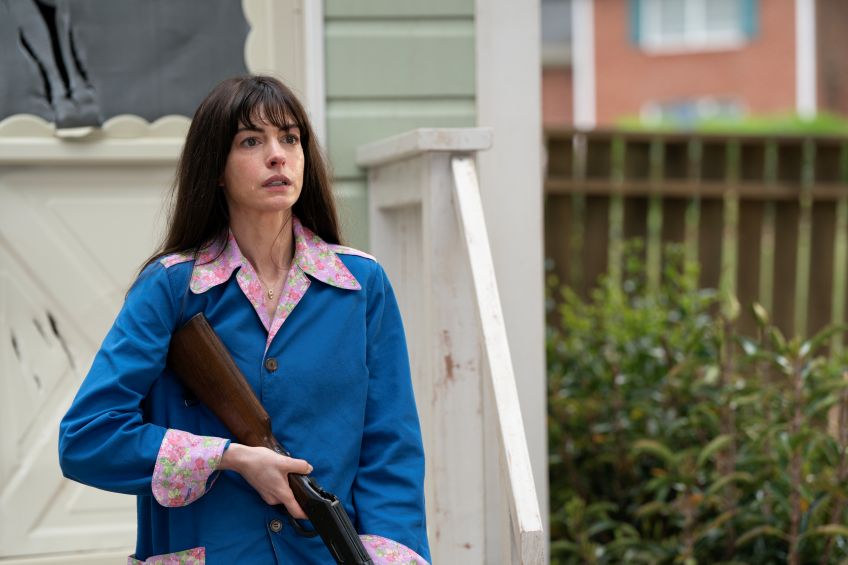
If you see the trailers, ads or hear any quick summary of The End of Oak Street, you could be forgiven for thinking the film is yet another rehash of the Jurassic Park franchise created in the 1990s when Stephen Spielberg directed the first two films. Unapologetically, David Robert Mitchell (Under Silver Lake), backed by Cloverfield director JJ Abrams, adds a touch of Back to the Future to his 80’s suburban setting when a middle-class Michigan neighbourhood is sucked through a worm hole back 200 million years.
Yet, for all that, there is no ET moment when one of the teenage co-stars’ bonds with a dinosaur. These creatures are out for blood. And The End of Oak Street feels a bit off-kilter for a nostalgic throw-back or even a parody. And that’s where it gets intriguing as well as fun. For this film holds your attention and doesn’t overstay its welcome. If only Mitchell had gone further.
The set up here is all important and what better way to meet the Platt family than at a community barbeque. The sun is out, the hot-dogs are cooking and the pre-mobile phoned families are playing traditional games. But all is not what it seems.
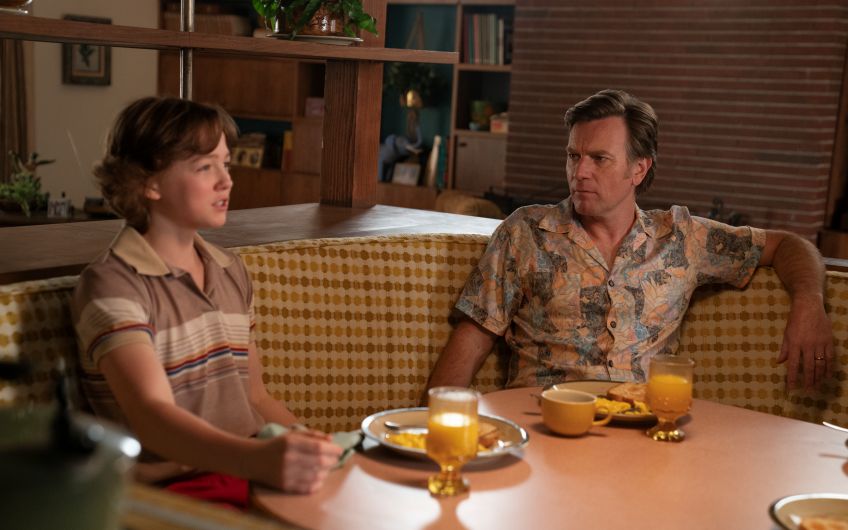
Denise (Anne Hathaway) would rather be in the basement writing her novel, a pursuit she keeps secret from husband Greg (Ewan McGregor) who “wouldn’t approve.” Greg doesn’t want to be there either. He’s going off to do some pizza deliveries. The couple argue because Denise questions why, with his new job, Greg needs the money. Greg, too, has a secret: he lost that job.
The two teenage children, Brian Platt (Christian Convery) and Audrey (Maisy Stella), pick up on the vibes and worry about divorce.
Yet when he brings back a pizza for dinner, there is laughter as the family sit around the dining room table to share the food – oddly, without so much as a side salad or a bottle of wine or lemonade. Clearly Denise, despite her height, long black hair and good looks, is no Nigella Lawson.
At the barbeque young Brian is playing with the family dog Starbuck, his eye on a new girl in town Jeanette (Jordan Alexa Davis) unaware she prefers girls. Brian’s older sister Audrey, uninterested in the boys who ignore her, would rather be on the roof star gazing and reading astrology books.
Denise, whose attention is drawn to a strange plant rapidly growing in her neighbour’s garden, consults the local librarian, Mrs. Valcourt in the days when Librarians knew things like that. She can even identify the plant as a species that went extinct 200 millions of years ago. Then there’s the giant poo. And then the lights go out.
Against this setting of a looming family and community crisis, the sizeable houses on Oak Street are being surrounded by tropical marshland. The water is flooding the Platt’s basement, leaving the Platt’s with no bunker when the first dinosaurs come.
The middle section of the film resembles a zombie movie, where people are running away from groups of mindless aggressive animals, trying to escape in homes and cars, but of course, it’s made more interesting by the dinosaurs.
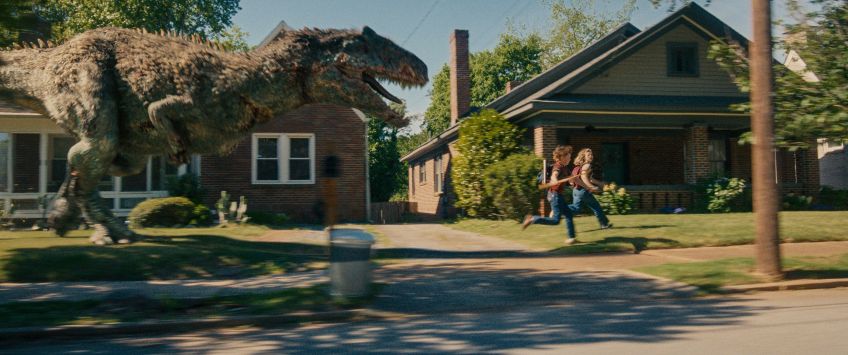
Mitchell, who directed the 2014 hit psychological horror film It Follows on a budget of $1.3 million spends a lot of his $80 million budget on the visual effects that, like the Jurassic Park films, were created by George Lucas’s Industrial Light and Magic. The estimated extinction of the mysterious palm tree-like plant being 200 million years ago, allows Mitchell to use a variety of dinosaurs as we are on the crossover of the Triassic and Jurassic eras. Children will love it.
If there’s no problem with the authenticity of the creatures, there is with the human reactions. When Starbucks goes missing, Brian goes out at night looking for him. His sister follows, both wandering around the neighbourhood virtually unarmed. Brian conspicuously yells out the dog’s name. Most people over the age of 8 would be frozen with fear, crouching in tears in the most secure corner of their homes or at least wondering if their food and water will run out before help comes.
Lots of loose ends are wound up in the epilogue but a bit too conveniently. If you remember True Lies bored housewife Jamie Lee Curtis learns that her boring husband (Arnold Schwarzenegger) is a secret agent, he learns his wife is an adventure-seeking knock-out and their married lives are transformed. A similar scenario is suggested here, when, after surviving such an ordeal you look at yourselves and others differently.
In this film, what we are missing is the metaphor, that extra layer or the twist.