
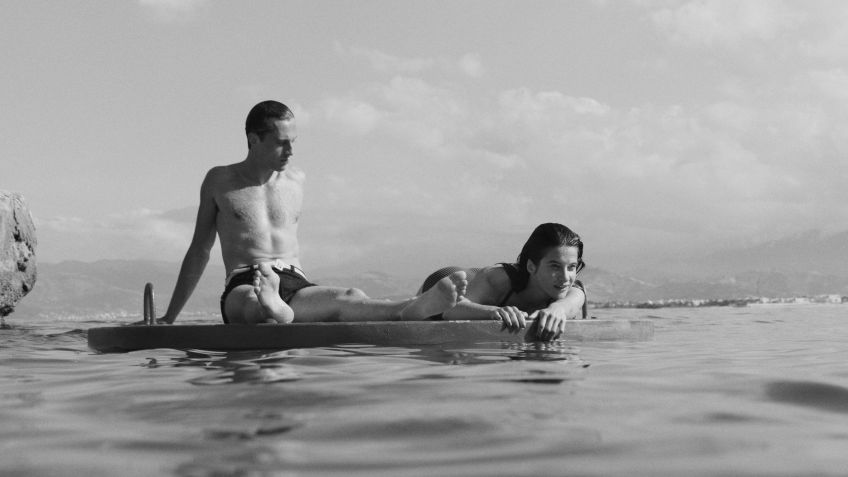
Joyce Glasser reviews The Stranger (April 10, 2026) Cert. 15, 121 mins. In UK and Irish cinemas
François Ozon (8 Women) is one of France’s greatest, and certainly most prolific, directors and scriptwriters of original and adapted screenplays. Ozon could rest on his laurels for his brilliant adaptations of Everything Went Fine (2021) and In the House (2012), but at 58, he has tackled the mother of all French adaptations, The Stranger.
The novel is presented in two parts (although part two is subdivided into the trial and prison) as a personal chronicle beginning, in Part I, with the daily activities of a diligent clerk of around 30 called Meursault (Benjamin Voisin, who starred in Ozon’s Summer of ’85). Part I is characterised by an obsession with time with days and hours noted.
In Part I, Meursault’s mundane routine is annoyingly interrupted by the news of his mother’s death. He passively attends the wake and funeral, but smokes, declines to pray, and, fatally as it turns out, does not shed a tear. His conduct is noted.
The day after the burial, Saturday, Meursault meets the beautiful, fun-loving, caring Marie (Rebecca Marder) at the beach and they spend the night together. This, too, is noted at his trial.
The following weekend Meursault becomes further drawn into the sordid affairs of his friend Raymond Sintès (Pierre Lottin) when he and Marie join Raymond for lunch at his friends’ beach house. Raymond has cruelly humiliated his Arab girlfriend, Djemila, (Hajar Bouzaouit) and her revenge-seeking brother shows up at the beach. After an early lunch, at high noon, Meursault walks on the sweltering beach towards his own undoing.
The famous final paragraph of Part I stands out for its profundity and poetic lyricism, in contrast to the previous unadorned prose. Ozon marks it by using stream of consciousness to Meursault’s awareness that he has destroyed the day’s equilibrium.
In Part II (the trial), time, so precise in Part I, begins to disintegrate as Meursault is condemned, not for murder, but for not conforming to society’s expected conduct. In Part II (prison) time disappears and, rejecting a priest and his god, he confronts death.
Throughout the novel, Meursault is indifferent to everything, from an exciting promotion at work to a proposal from Marie. “I said I didn’t mind; if she was keen on it, we’d get married.” Camus never explains why such an indifferent man would share a chronicle of his attitudes as though showing them off or trying to shock us with his irrationality. One plausible explanation is that Meursault is a thinly veiled mouthpiece for the author.
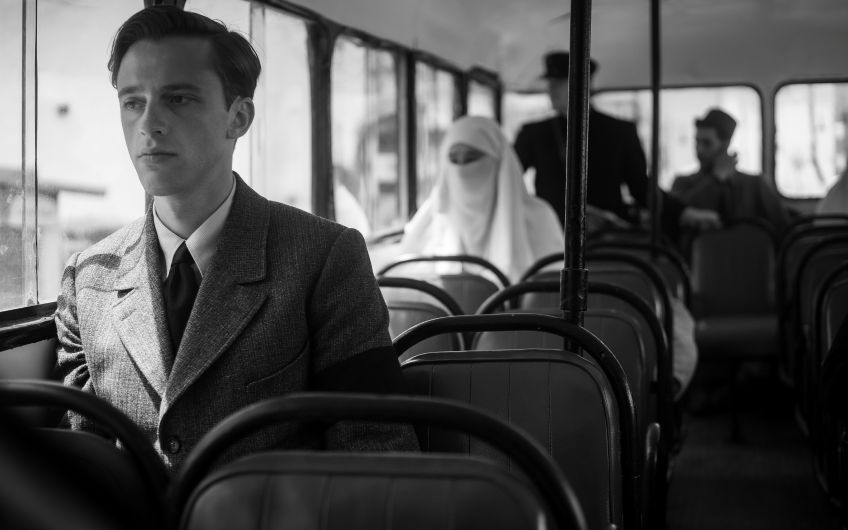
To its credit, Ozon’s faithful adaptation largely eschews narration while capturing in editing and by other techniques, the flat, detached and minimalist rhythm and cadence of the Hemingway-influenced narrative and dialogue. It is atmospherically shot in black and white by Ozon’s regular cinematographer Manu Dacosse to blend into the newsreel footage Ozon inserts early on, situating the action in 1938 when Camus’s native Algiers ( the film was shot in Morrocco) was under French colonial rule.
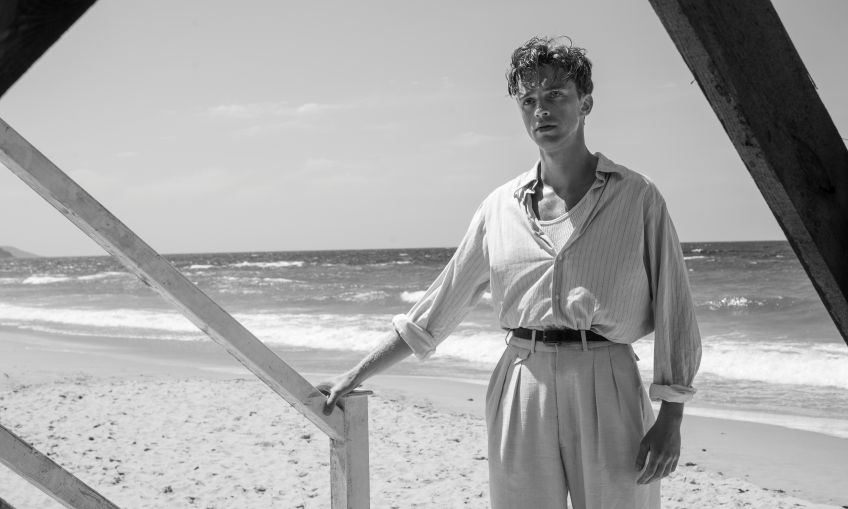
Dacosse is also responsible for making the sweltering (symbolic) sun, which shatters the protagonist’s life, a central, malevolent character by saturating the screen at key death-related plot points, including the funeral, the beach walk, and the trial. This is key, since Meursault blames the sun for a murder as inexplicable as is his life.
Ozon skilfully substitutes visual equivalents of Camus’s loaded text which, in the film, would be too insistent, amounting to foreshadowing. This is the case with the walk to the burial when a nurse points out the risk of heat-stroke outside or a chill from the cool Church. Meursault adds, “I saw her point; either way there was no escape.”
But while Ozon’s adaptation cannot be faulted, it’s hard to be emotionally involved in what is essentially a parable with one dimensional character types designed to express the twenty-something-year-old author’s absurdist view of the world. Even Ozon’s addition of an expanded role for Djemila – representing the female and the Arab voice that is ignored in the novel – seems superfluous. No one but the society Camus is criticising can forget that blond, fair Meursault has shot dead an unarmed Arab.
L’Étranger, the slim novel on which The Stranger is based, was published in Paris under Nazi occupation in May, 1942, a year before Camus became editor of the underground French Resistance publication Combat. The copy passed Nazi censorship which judged it “asocial” and “apolitical.” Anti-Nazi factions, however, rallied behind the book, identifying a subversive and anti-authoritarian subtext.
This paradox is just the beginning of the puzzling qualities and anomalies that make L’Etranger an inexhaustible classroom favourite. Such is its novel appeal that the book has been translated into some 60 languages and has not been out of print since it was first published. And yet, there has only been only one significant adaptation (Visconti’s 1967 version shot in Algeria). This is perhaps because no one can agree on what the novella means.
In 1956 Carl A Viggiani wrote that “the novel ‘is incomprehensible except in the context of all [Camus’s] works”, and points to the novel’s use of myth, symbols, thematic devices and “undiscovered meanings…” Even Camus felt the book needed a philosophical framework, and that same year, wrote Le Mythe de Sisyphe expounding on the role of this myth (Meursault as Sisyphus), death, suicide and the absurd.
Shortly thereafter, none other than Jean Paul Sartre felt his colleague’s book required an explanation and published his Explanation of the Stranger in Cahiers du Sud. Since then, dozens of academic articles have analysed the work – some desperately.
Viewers of the film will join countless readers, ruminating over what Camus himself called an incarnation of “a drama of the intelligence”; intent on unlocking its mystery.