How might you feel if you sat down for the 1969 moon landing and then had 55 years of life flash before your eyes in just three hours (with a 20-minute breather in 2005?) Ecstatically nostalgic, uplifted, exhilarated, overwhelmed, amazed, bewildered, pummelled and exhausted? Dejected, perhaps, sad and sorrowful? Well, you may feel all that and more, but above all, this production’s superb acting and breathtakingly innovative stagecraft prompt powerful wows of admiration.
Award-winning Sheffield playwright Leo Butler’s Living, directed by Abigail Graham, is an ambitious, riveting drama, in which eight performers bring to life more than thirty characters in Pitsmoor, Sheffield, where the writer grew up. Set almost exclusively in their front room, the personal lives and whirlwind stories of main characters, Kathy and Brian, and their family and friends unfold through five decades of eventful social and global history.
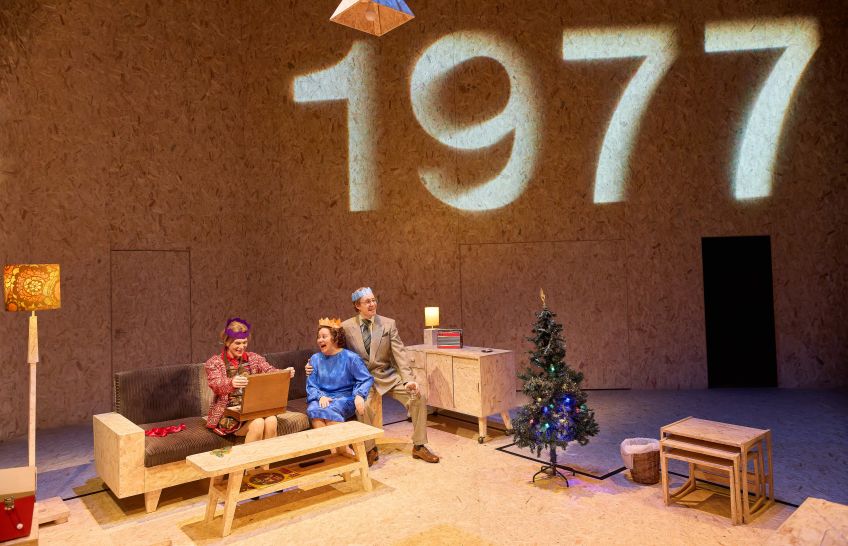
Bounce, speed, humour and tireless, forward impetus fill the stage in the first act as scene after scene powers on, each morphing in a split second into the next, a sentence from one scene often seamlessly completed by a character in the next, as the date, writ large on the chipboard walls, takes us on, often a whole year at a time. In the blink of an eye Kathy, Brian and the people in their lives pass through life’s different stages, a big belly becoming a crying baby in an instant, while clothing and set components subtly change almost as if by magic as eight vibrant actors come and go with super precision timing, morphing characters from one age group to another.
As we witness the entire lifespan of Brian, Kathy and best friends, Sean and Jules, the next two generations grow up and evolve before our eyes with their own personal stories, their good times and bad shaped, like those of their parents, not just by the people in their lives and by their own choices but also by historical and political events. So it is that as act two travels forward in the direction of 2024, the mood, tone and pace change dramatically. As we head into pandemic and beyond, the formerly warm, communal hub of interactive family and friends, filled with guitars and music, heated but good-hearted discussions and shared worries has gone: life is more disparate now, disjointed, unsettling, disturbing; family members are more distant in miles and also in their relationships; disagreements, confrontations and misunderstandings are more fraught and hostile than before. As they make faltering connections, both technologically and personally, the chipboard walls fill with videos of absent talking heads.
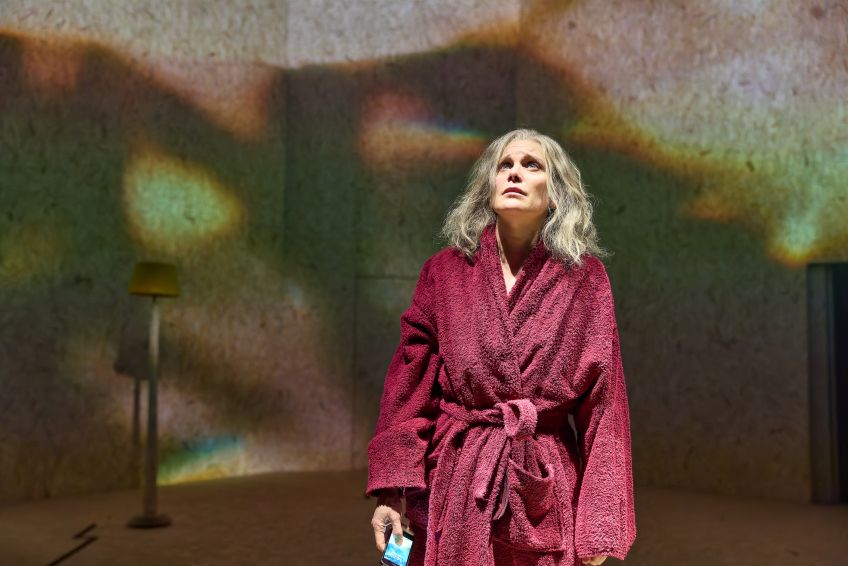
Hard-working NHS nurse Kathy and less reliable, not-always-working Brian are a bubbling, lively young couple when they move into their new home to start a family, full of excitement and joie de vivre. Sensitive, realistic portrayals from Liz White and Kenny Doughty bring the pair engagingly to life through all the ups, downs, changes, fluctuations and transformations, brought about by child rearing, strikes, unemployment and depression, materialism, job successes, market crashes, overwork, ageing and illness. Liz White’s journey from nimble nurse, wife and parent to shuffling, grey haired, cloudy-brained dementia sufferer is very moving, the lighting dimming as dark shadows loom large and the dates on the wall become a blur, then disappear.
Samuel Creasey and Abby Vicky-Russell are brilliant as the children, Michael and Rebecca, played from comical toddler-hood and playschool days through riotous, rebellious teenage goings-on with friends, and on into subsequent decades of their own ups and downs. Kathy and Brian’s likeable lifelong friends, Sean and Jules, and Brian’s brother Jeff, are likewise engagingly portrayed by Andrew Macklin and Michelle Bonnard, while Hadri Bhambra and Melina Sinadinou inhabit hosts of other characters, sparkling as young school-kids, as rowdy, sex-crazed teenagers and as neighbours, lovers or workmen.
Sarah Beaton’s set and excellent costume choices give a wonderful feel for the atmosphere of each era as the audience looks down from two sides on a living room, where pale brown chipboard walls predominate and the floor is set with pale, stylised settee, lamp-stand, table, transistor radio, TV and record-player with records. Subtle changes affect lampshade and cushions as the years roll by, and in come a video-player, remote-controls, CDs, early computer, then mobile phones. Music and singing from appropriate eras, plus TV and radio news snippets from the likes of B. Johnson, Trump and Obama feature as we travel on from Beatlemania, Lennon, landlines, flared, cord trousers, big-collared, patterned shirts and Flower Power, from burning bras and Germaine Greer and on through changing prime ministers and Nick Clegg, through conflicts in Bosnia, the Falklands and Iraq, through decimalisation, power cuts, three-day weeks, strikes, Orgreave, Live Aid, from the joining of the Common Market to the Brexiting of it and from 9/11 and the financial crash to the pandemic and beyond. In this race through time, so much is telescoped and shoehorned in – cigarette smoking, chemotherapy, bullying, college, backpacking, partying, drugs, class mobility, lesbian mums, feminism, immigrants, Barbie, Arctic Monkeys, dementia, a distracted, impersonal estate-agent. Some speeches are frustratingly muffled or lost in hubbub but, fortunately, not often, while it can feel overwhelming at times and somewhat protracted in the second act, but overall, the impact is splendid.
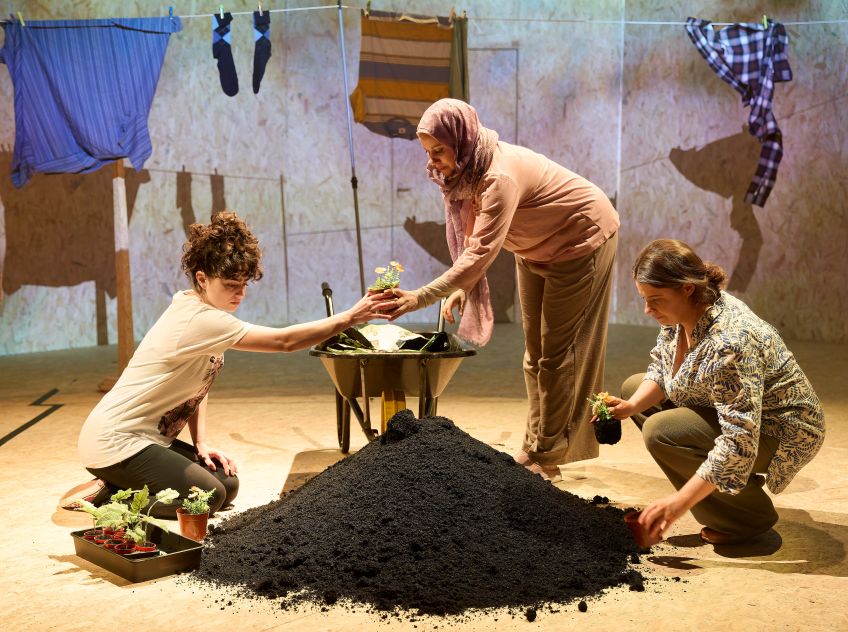
Carried along on bouncy, buoyant tidal waves of history and politics that contribute in shaping family fortunes and interactions, each scene puts us in a new moment in time, until eventually, a pile of soil is wheel-barrowed into the garden to plant new life and we come full circle (sort of) as previous generations move on and a new, enthusiastic couple buys the property.
This special play has so much on offer there must be something to amaze, delight and/or depress anyone who’s lived through any of the past fifty-five years or so, whether in Sheffield or not.
Eileen Caiger Gray