

John Godber’s comedy Teechers, with its light laughter and heavy, heartfelt messages serves as an enjoyable, thought-provoking eye-opener for anyone who has no insights into our schools and education system. For anyone who’s taught, though – or been a parent – or even for some who merely went to school – there should, perhaps, be a tongue-in-cheek trauma-trigger alert!
Set in a “requires improvement” comprehensive school, Whitewall (no, not Whitehall) Academy, teenagers with Hull accents feel written off from the word go by a system skewed against them, their goings-on eliciting laughter throughout. The clowning, though, is wrapped around, and wrapped up in, sad and serious issues and the youngsters have a heavy, albeit humorous, tale to tell. Widely enjoyed, performed and studied since Hull Truck Theatre Company first staged it in 1987, the play has undergone updates more recently, and Whitewall (no, not Whitewash) has now moved on forty years – moved on in time, that is. Alas, the sad, serious issues, far from moving on, have deepened, multiplied and rolled backwards since forty years ago. Back in the 80s, Godber was bewailing the low status of drama and performing arts in our schools while pinpointing how absolutely essential they are. Now the situation’s worse still so there’s even more bewailing and pinpointing to do.
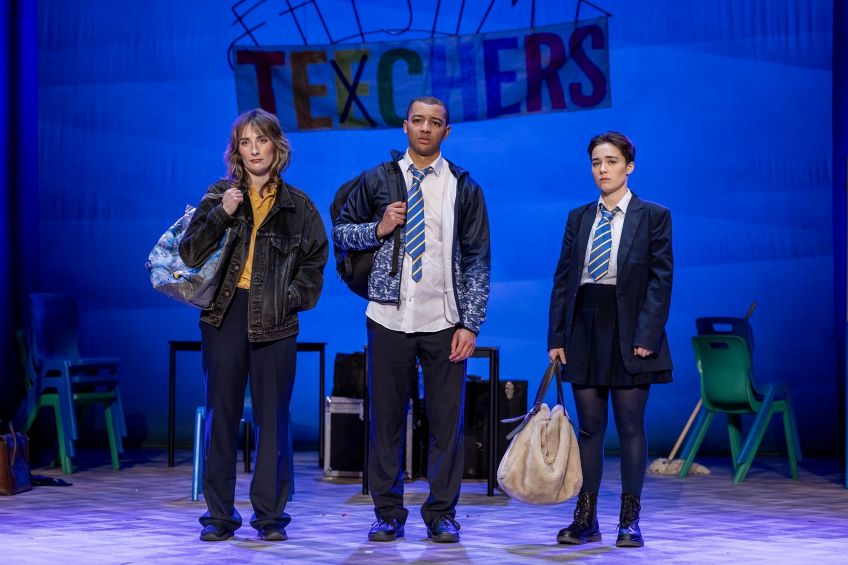
Godber’s play has the feel of a lively, good-hearted, slick, no-budget school production, in which students want to both have a laugh and vent their (i.e. Godber’s) spleen. That’s just as it should be since the play that’s being extensively enacted within Godber’s play is, in fact, a school production. Hobby, Salty and Gail, three Year 11 teenagers, soon to leave school, are performing their final BTech drama piece. In school uniforms with stripy ties and a hanging-out shirt for Salty, Sophie Suddaby, Levi Payne and Jo Patmore inhabit their teenage personas brilliantly. Addressing the audience directly as if it were the school audience, the three embark, full of breezy life and freshness, on strings of rapid verbal interchanges and fast-paced, rhythmic patter, often humorous, sometimes bitter and heated. As often as not the narrated snippets, asides and interchanges come not just from the lips of the three teenagers but from those of hosts of teachers and classmates, all embodied by the same three as they slip constantly in and out of impersonations, building a bigger picture of the life and characters of Whitewall Academy.
The set and props are appropriate to a cashed strapped school – roughly improvised. By donning a check jacket “borrowed” from her real drama teacher, Sophie Suddaby becomes the put-upon novice drama teacher and main character, Sharn Nixon (Jeff Nixon in the original), naively hopeful and full of enthusiasm at first that she can connect with and inspire these underprivileged kids and thereby improve their lives and future prospects. She succeeds to some extent but, what with undermining from, and confrontations with, pupils and staff alike, she gets ground down by the endless, insurmountable obstacles and impossible workload. As the going proves too tough even for her, the allure of working in a posh, well-funded school with tailor-made facilities and exciting prospects overwhelms her former egalitarian principles and hostility to elitism.
Draping a pink scarf about him in the manner of a female impersonator or an over the top Frances de la Tour, Levi Payne becomes larger than life Executive Head, Mrs Parry, while whoever pops on the Groucho Marx glasses and nose conjures up authoritarian, disciplinarian, selfish Deputy Head and maths teacher Mr Basford – he who puts difficult kids in new teachers’ classes and keeps easier ones for himself. Bouncy, full-of-herself, leg-kicking sports teacher, Miss Prime, appears whenever Gail picks up a racquet while bully Oggy Moxon is the one sporting the back-to-front baseball cap and grumpy, narrow-minded site manager/caretaker Doug has a tatty high-vis waistcoat and a big broom … and so on. Those at the well-equipped, well-funded, smug private school, St George’s, speak in posher accents, of course, in a play that does indulge in a bit of stereotyping and black and white contrasts.
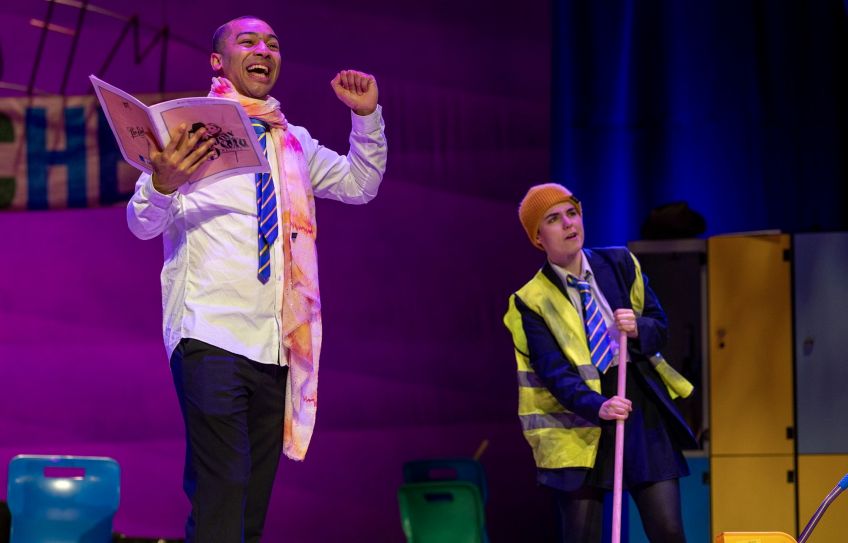
The play still retains some of its 1970’s/80’s feel, too, in spite of updates that cover vaping, references to Covid, Lockdown, mental health, Ofsted, ID lanyards, modern tech and social media like Tik-Tok. Of course, it’s not just pens, books and PE kit that poorer kids might lack these days: with schoolwork and homework now largely done online, it’s a tablet or computer that each child needs and they can’t even be shared like books can. At Whitewall, those with no such devices are trying to work on small phone screens. No wonder staff and pupil morale is low. New problems and pressures are created by regimented tick-boxes, demanding, unthinking diktats, targets and risk assessments, all compounding longer-standing stresses like unfathomable timetables, labyrinthine schools that involve travelling to split sites, stroppy confrontations of teachers with frightening children, stroppy confrontations of teachers with frighteningly inflexible senior management, endless cover lessons, lack of allocated spaces to teach in, impossible workloads, truanting, teacher burn-out that leads to poor staff retention, and leaky roofs. (Etcetera.)
Wonderful music interludes bring welcome breaks as, in beautifully choreographed routines, the three dance simple desks, plastic chairs, a chest on wheels, a rail of clothes, lockers, mops, broom and bucket to new locations for different scenes. Handsome, blue curtains and a mainly blue backdrop frame the stage, clouds sometimes scudding across, while a sign hangs above for Fat Sam’s in the current Bugsy Malone production. (It’s puzzling, though, that the list of school productions, performed pre-Nixon and quoted by Salty, is so long and impressive, and it’s obvious Brecht has already made a big impression on him. Why Miss Nixon thinks Marat Sade will rock all their boats infinitely more than those isn’t quite clear.)
So it is that, through laughter and silliness, tied in with soap-box proclamations, bitter resentment, frustration and outrage, the teenagers pinpoint how our education system is failing them. They underpin, too, how valuable and essential drama and the creative arts are in providing outlets, especially those who struggle elsewhere, allowing youngsters to find a voice and both show and feel their worth. As they enjoy real-time connections and relationships with people in the real world, they broaden their imagination and aspirations and develop cooperation, understanding and empathy. The performers demonstrate how having the opportunity to indulge a real love and shared passion for a subject is generally far more valuable than slogging without any love and passion towards some ultimately meaningless target. Yet these under-funded subjects are increasingly neglected to the point of disappearing altogether from the curriculum in many schools.
Yes, the messages come over loud and clear, that’s for sure, but so do the laughter and the liveliness of the storytelling, ensuring enjoyment all the way. (Well, almost.)
Eileen Caiger Gray