It’s intensely gripping, it’s challenging, it’s exhausting, it’s sometimes bewildering, and liberties galore have been taken with HG Wells’ story, but surely no-one can fail to be filled with utmost admiration and amazement at what this close-knit team of four actor-performer-film-makers achieve onstage. Expressive acting is just the start for this is a company renowned as “multimedia daredevils” who go big, big, BIG on incorporating audio-visual technology. And it’s that aspect that sends admiration and amazement into orbit.
HG Wells’ ground-breaking War of The Worlds, a gripping sci-fi tale of terror, is a classic masterpiece of literature still studied in schools far and wide. The first readers, though, in 1895 to 1897, got their chills and horrified thrills from cliff-hanging magazine episodes before the book came out in 1898. The icy, cautionary tale tells of extra-terrestrials of immense intelligence and superior weaponry who have wrecked and exhausted the resources on Mars, so now invade Earth, brutally and systematically eradicating mankind to take the planet for themselves. How do the humans react? Can the aliens be stopped? Wells drew strong parallels, too, with how the human race likewise brutally eradicates indigenous peoples to colonise land for themselves.
Stage and screen adaptations a-plenty and music, too, have changed and re-shaped the tale but it was Orson Welles’ 1938 radio broadcast that caused the greatest shock and sensation and created genuine panic in the population. HG’s writing style is so authentically journalistic and so vividly descriptive that listeners actually thought they were hearing, not a dramatised story, but a live news report. They actually believed Martians had landed and they were as panic-stricken as the fictional folk in the story, demonstrating, just as Wells did, how quickly order, rationality and common sense break down when chaos breaks out.
Imitating The Dog ‘s very free adaptation, though, diverges massively from the original. HG’s style, tone and language are gone – with even a couple of “f” words thrown into the mix. No longer is our main character an unnamed man reporting in detached, journalistic style on what he witnesses: instead we have the highly emotional, viscerally reactive William Travers, confused, paranoid, fearful, frenetic and increasingly inhuman. The events and outcome of the story are very different, too, as we travel from a hospital to end up, via Mornington Crescent and Epsom, on a long, desolate car journey to Dover. As we follow William’s journey, though, as with Wells, there’s a strong focus on how humans react, behave and completely fall apart in the desperate struggle to survive under extreme stress and danger. William’s terror, paranoia, abandonment of morality and decency and mental breakdown are intensely enacted and also echoed in other characters. Right from the first moment, this tale is less about alien encounters and subtle, gradual build-ups of tension and far more about intense human emotions and interactions, and it’s also very much about the spectacular, nightmarish, visual impact of post-apocalyptic landscapes, evoked through technological audio-visual innovations.
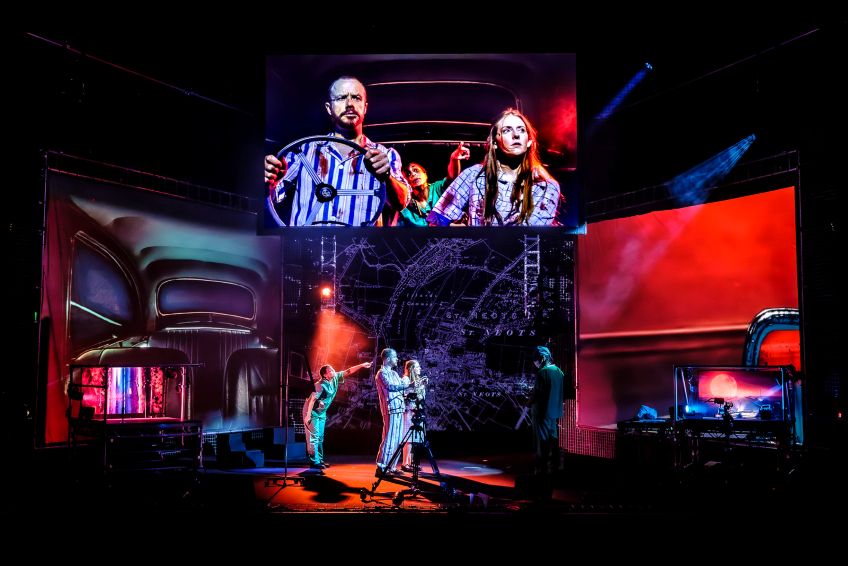
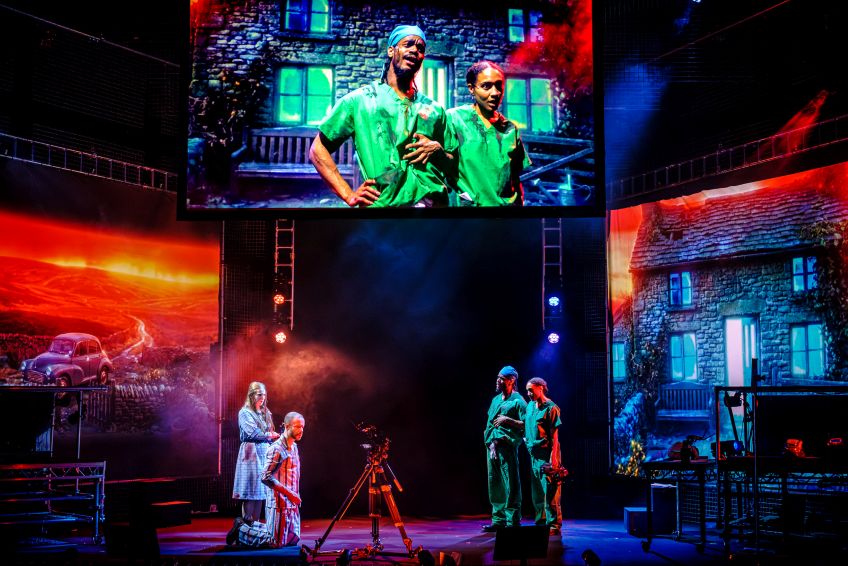
Amidst smoky mists, we open with a bang in a hospital where three medical staff in green scrubs are fighting to save a patient in blood-smeared, striped pyjamas who’s in cardiac arrest. Above the stage is a large screen, to the sides two smaller screens on moveable trolleys. Throughout the entire piece the four remain dressed exactly as now, no matter what characters they play, no matter what they’re doing. And what they’re mainly doing is filming the story that they’re enacting while they’re enacting it, and all is relayed onto the main screen. Presumably, we could watch the story unfold purely on the overhead screen as a film with the wonderfully expressive faces in close-up (though lip-synch does goes awry and there are odd glitches) but it’s the onstage choreography of logistics that holds the greatest fascination, that impresses most and compels us to closely follow this extra layer of entertainment, taking place onstage in the semi-darkness.
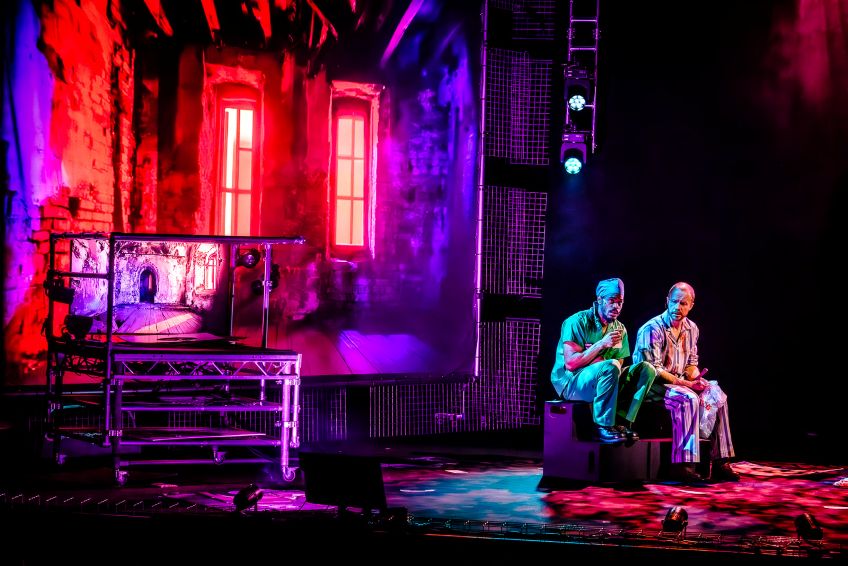
William, a bundle of explosive emotions, is played engrossingly well by Gareth Cassidy. He has no camera and does no filming; the other three film extensively, while all four must master ongoing, slick, efficient, multi-tasking choreographies. For not only do they all play characters and deliver lines, but at almost every moment they’re taking up, putting down or handing over cameras whilst rearranging props, standing cut-out shapes in front of video-scene backdrops on the side-screens or holding up cut-outs to be filmed from various angles. At times, characters are still speaking lines as they perform these activities and, so that each is looking into camera, they often face in opposite directions as they address each other. It works marvellously. A square board of brick-wall pattern, held by William’s face, has him peering round an entire wall on the screen overhead. Similar use is made of car windscreen, windows or a stonework gap for peering through, while model cars are moved, too, in Thunderbirds style, to look as though they’re travelling along devastated roads as apocalyptic backdrops transfer from small screens to large and the action is overlaid.
2D props of items such as a gun, newspaper headlines, drinking bottles and steering wheel contribute to the surreal feel of the action and to the nightmarish, raw quality of the overhead images as stylised cities, engulfed in red, flaming infernos and endless, desolate devastations of rubble and ruin appear on the screens, Big Ben disappearing before our eyes. Distant tripods and metal tripod legs put in odd video appearances and tentacles briefly turn up in church as ongoing soundscapes blend in non-stop to reinforce the all-pervading sense of desolation, devastation and hopelessness with huge varieties of rhythmic clinks and pulses, wailing tones and electronic tensions, leaving just odd moments for silence or more tender tones, plus flash-bang moments when red searchlights roam and electrical whiteness fizzes as scenes move on.
Morgan Bailey gives a vibrant portrayal of a loud Scouser artilleryman, cackling with superficial cheer and glee while sounding close to cracking; he also plays well the doomed curate preaching to the dead. Bonnie Baddoo is splendid, too, as a desperate West Country woman in the Underground, surviving on dangling meat supplies she’s butchered from passers-by while quoting Dickens and Milton and singing “Kiss Me Goodnight, Sergeant-Major”. Suicides, madness, murder and shooting all feed into the carnage, an onstage hanging having particular impact.
Act one engages very well indeed as the confused, desperate William roams chaotic, deserted NHS corridors (walking on the spot in actuality), piecing together what’s happened while he was unconscious and bandaged, before emerging to meet those disquieting individuals. Each one, even his own wife, tells William, in turn, to his face that it’s he who is responsible for the destruction of the world because he’s so full of hatred. B/W footage of Enoch Powell and right-wing racist rallies suggest William’s sympathies may lie that way, too, and explain how he ended up trampled by a horse. The frictional relationship with wife Evie (nicely portrayed by Amy Dunn as sympathetic and humane as she sweetly sings “Nothing’s Gonna Change My Life”) is new to the story as is the pair’s long drive by car to Dover as William becomes increasingly cruel and murderous. With more sameness, though, act two gels less well than act one.
It’s exhilarating to witness such expressive acting and such slick, clever deployment of technological expertise; there’s less exhilaration, perhaps, in the trajectory of the story or in the clarity of Wells’ broader, cautionary warnings. Only a narrow part of Wells’ story is closely reflected in this adaptation and, as we come full circle back to cardiac arrest, the sudden end might possibly leave us a bit flat. So, what happened to the aliens in the end? Or do we assume they didn’t actually exist and it was all a dream, just one big, hallucinated nightmare?
Eileen Caiger Gray