
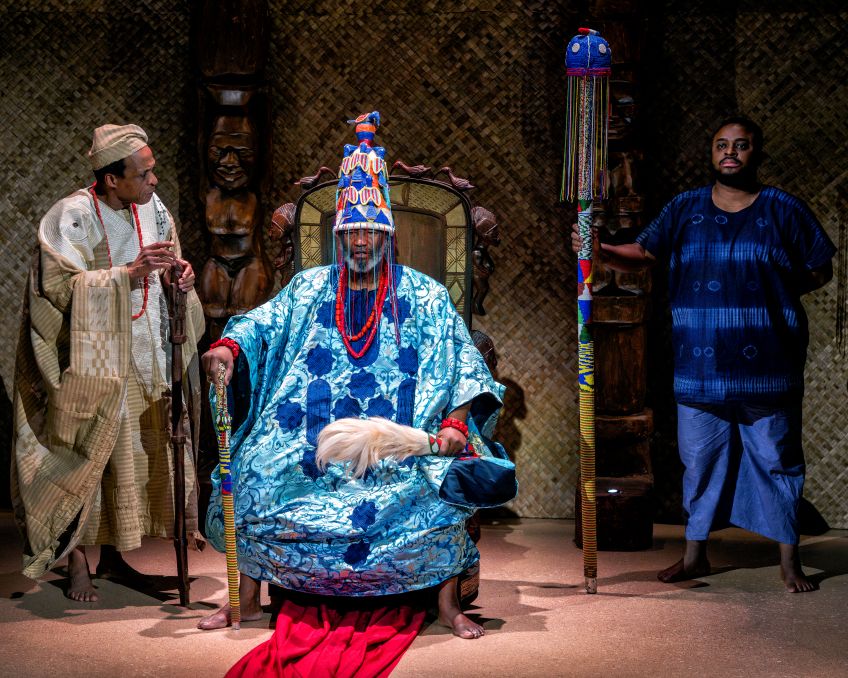
Crown of Blood is an arresting title for a play, full of intrigue and gore. Shakespeare might have chosen it for his Macbeth. In fact, it’s the title chosen by Hackney-born playwright Oladipo Agboluaje for his African Yoruba drama, ostensibly an adaptation of the Bard’s Scottish play but rather, perhaps, a Yoruban drama that runs strongly in parallel with Macbeth’s characters, plot and events but also diverges from Shakespeare to fit more appropriately with Yorubaland’s own history, culture and traditions. There’s also a narrator, Arokin, a court historian, who fills in a little history and background in traditional storyteller style. Either way it’s an intensely gripping story.
Following the success of the phenomenally powerful production of Death and The King’s Horseman, staged at The Crucible a year ago, this play is another collaboration of Utopia and Sheffield Theatres that features revered Nigerian “Nollywood” stars of stage and screen while incorporating exciting aspects of Yoruban history, culture and some fantastically vibrant music and rhythmic movement. Fact, fiction and myth blend as the story unfolds, exploring huge, universal themes, ongoing the world over as throughout all history – why and how power corrupts, especially amongst leaders, and how flawed humans can so easily be completely taken over by brutal, selfish ambition and an irrational belief in the role of destiny, leading to widespread conflict, ruthless betrayals of friends, kin, king and country, and the slaughter of innocent people.
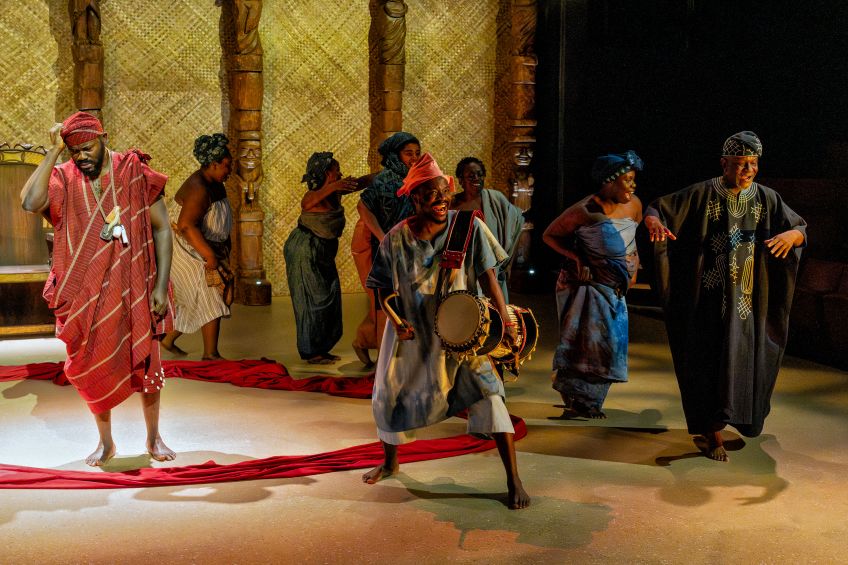
Set now in the nineteenth century in the tumultuous civil wars in West Africa with its many rival factions, brave soldier and blacksmith’s son, General Aderemi, saves his kingdom from invaders and – lo and behold, just as prophesied by the oracle, he’s promoted. Might, then, the oracle’s other prophecies also become reality? Is he also destined for the throne? So far, he’s been entirely contented with the life he already has with his loving wife, Oyebisi. She, though, is not. She was once in line for a throne herself but saw her parents brutally murdered when she was stolen away into slavery. Her steely, unbending determination to sit on a throne at any cost and regain what is her right spurs her on to murder, lie and deceive and to turn her husband into a murderer.
Oyebisi’s character, actions and eventual fate are notably different from Lady Macbeth’s in that she’s much more hands-on and instrumental in pulling strings from the very start to the very finish. Instead of cackling, supernatural witches who appear out of thin air, we’ve an all-too-human, spiritual soothsayer who’s easily bribed with money by Oyebisi to deliver the prophecies she dictates – until she later stabs him in the guts with a knife before pushing her husband into murdering the king. Award-winning actress Kehinde Bankole plays Oyebisi outstandingly strong and determined. Unlike Lady M she doesn’t break down and go mad. She’s taken aback when her husband’s brutality goes beyond even what she’d envisaged, but she recovers. In a world run by men, she stands firm. Husband Aderemi, played wonderfully by Deyemi Okanlawon, starts out as a brave soldier, an affable, contented man, who becomes increasingly crazed with power, out of control and out of touch with reality, ordering even his friends’ wives and children’s to be slaughtered. The pair play convincingly well together as they move from loving couple to conflicting, conflicted souls.
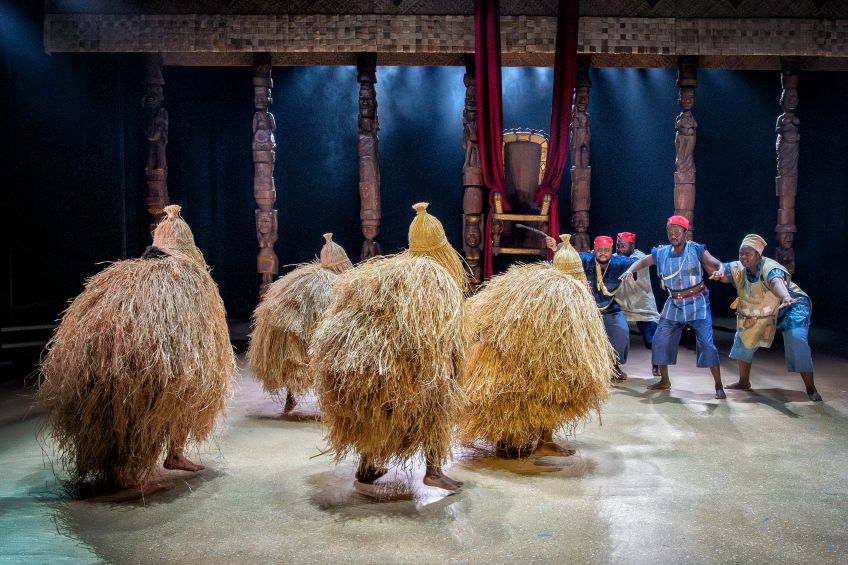
A handsome, simple set, wonderful array of costumes, vibrant music and movement, and subtle sounds of tension and lightning cracks combine well in the impressive spectacle of this piece. A wooden throne sits at the back with carved wooden columns and panels of woven, patterned rush, which lift to reveal dark spaces. Attractive, evocative red lighting, white mists and long ribbons of red fabric that unfurl like rivers of blood are used to great effect, the ribbons even lifting the throne to suspend it in mid-air at one point. The colourful costumes and headwear, from simple, plain or striped fabrics to regal fabrics woven with sparkle, are glorious, with those of the masqueraders at the ominous Festival of Death and of the crooked-hatted god particularly striking. Exhilarating, too, are the traditional drumming, chanting, calling and singing of all those wearing them, led by charismatic actor, MD, co-composer and award-winning singer, Kayefi Osha. Besides providing historical and cultural context, the music serves as light relief after scenes of tension, while humour sometimes pops up, too, as when councillors and statesmen (who have quite a say on who should be king) argue and bicker, or when a man is briefly turned into a chicken.
Act One builds tension very nicely, although, for timing purposes, it goes a bit beyond its natural stopping point. The shorter second act rattles through a lot of events but does seem to lose a little in impact, what with all the deliberations, offstage killings, insurrections, the cunning advance of an opposing army (clad in rafia like walking haystacks and protected from Aderemi’s proposed flaming arrows by out of season rain) and then the final sword-fight that ends Aderemi’s life, leaving his dead body to be dragged to the empty throne by his wife. But it all works splendidly overall.
Knowing anything at all about Macbeth is not in the slightest bit necessary for anyone who hopes to enjoy the drama and spectacle of Crown of Blood; it might even be for the better! The names are a little hard to grasp at times, perhaps, but the language, apart from liberal sprinklings of elephant metaphors, has a direct and practical fluency of meaning rather than being couched so much in poetical turns of phrase. This Crucible World Premiere travels next to The Belgrade Theatre in Coventry.
Eileen Caiger Gray