
It was in the 1870s that Pyotr Ilyich Tchaikovsky poured his glorious, emotionally charged music into the drama of Eugene Onegin and his world of thwarted romance, the opera was first performed in Moscow in 1879. Taking the story from Pushkin’s novel of 1825-1832, written in verse and set in an 1820’s era of tsars and aristocratic splendour, Tchaikovsky closely shaped his heartfelt orchestrations round actual passages from Pushkin’s verse so that text and music worked hand in hand. Timeless, dramatic themes of thwarted love, longing, rejection, dejection, regret, devastation, irreversible decisions and the role of Fate were ideal for an emotional, troubled composer like him. And there’s a tense, fatal duel into the bargain.
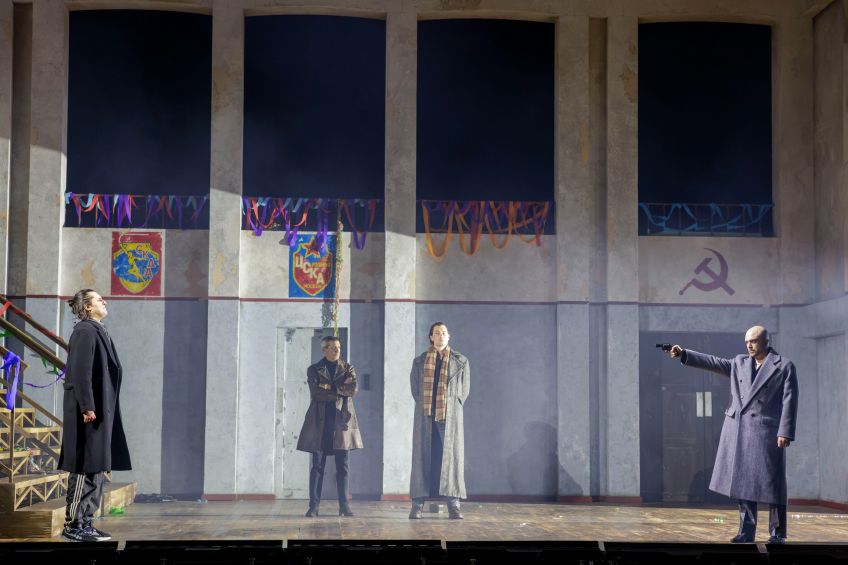
Retaining the poetic Russian libretto (with English titles), Opera North’s 2026 innovative co-production with Irish National Opera and Opera Queensland, directed by Patrick Nolan, is sung magnificently all the way, while the score, played by The Orchestra of Opera North under Garry Walker, captivates, impassions, devastates and enthrals just as it should as Tchaikovsky travels the gamut of emotions. When it comes to setting and costumes, though, forget nineteenth-century Imperial Russia with the formal lifestyle and genteel conventions of its upper echelons, and move forward in time… and further forward. Onstage the same episodes now unfold in 1980’s USSR. This may sound like a terrible idea on paper, but in actuality… it’s even worse! Distracting, annoying, bewildering, the brutally ugly set is beset far too often with extraneous, overly busy people, costumes and goings-on, irrelevant to, and/or at odds with, the characters, events and society that Pushkin, Tchaikovsky and co-librettist Shilovski were depicting.
From the start, instead of sitting back to bask in the rich orchestral overtures, we’re visually bombarded by masses of busy onstage bustle in the manner of a Cookie-ridden webpage, the distractions driving on through a good deal of the long first scene, sometimes spoiling focus on duet or solo. Luckily, the add-on extras do subsequently quieten down a good deal as the story unfolds, allowing fuller focus on the fine singing and words, so, miraculously, thanks to the enthralling excellence of the music, musicianship and singing, this 3-act production still very much delights.
Throughout, our eyes are massively assaulted by the huge, heavy presence of grey/fawn concrete, shabby, crumbling, stained and bedecked with old Soviet symbols. At either side stands a big, slatty, stadium-style bleacher, later turned round. As we try to enjoy the orchestral manoeuvres, character interactions and fine singing whilst glancing at the translations, information overload kicks in. Pouring in and out to attack a rail of clothing with jumble sale vigour come men and women in endless, motley arrays of patterned frocks, headscarves, shirts, trousers and footwear. Soon flags of Lenin march into place along the bench slats, before Olympians in red and white tracksuits turn up to click on torches, and Ukrainian colours are displayed, with others, by dozens of hands, holding up dozens of square cards. A table to the right is set out for all who fancy a mug of tea from a tatty tea-urn, be they field worker, of higher status or even related to a prince (all dressed much the same). Small groups can now lounge about and/or chat.
Amidst the bustle, Hannah Mason and Claire Pascoe’s splendid duet as Madame Larina and nurse/housekeeper Filipyevna, given half a chance, stands proud as they sing of their experiences of love and marriage. Resigned to the fact that life often doesn’t go the way you might expect, they’re convinced that, if fate doesn’t deliver the right arrangement, then duty and loyalty must kick in – all directly foreshadowing what’s in store for Madame’s Larina’s own daughters, Tatyana and Olga.
Engagingly played and sturdily sung by Jingwen Cai, younger daughter, Olga, is more confident, flamboyant and positive than her shy older sister, her bold, yellow, Spanish-style dress with black polkadots and her tight, short dancing frock offering further proof. Cai’s vibrant enthusiasm lends credibility to her relationships with sister Tatyana and devoted boyfriend, the poet Lensky, their neighbour, sung with amiable presence by Caspar Singh. In denim jacket or great coat, he, too, brings their devotion and passion alive, his strong, lyrical tenor highly pleasing, and his haunting, heartfelt pre-duel aria particularly touching.
For Tatyana’s name-day party, the concrete is nicely wound round with colourful beaded tubes as costumes upgrade from rural mish-mash to a slightly more dressed-up mish-mash of short, tight dresses and skirts, trousers and tops, which upgrade further in the final act to inject glittering shimmers of silver and black silkiness to the Prince’s shabby, concrete ballroom, now bedecked with a set of dullish lights. Here, the deep tones and wonderfully expressive singing of Joshua Blume as Prince Gremin, dressed in smart suit, is another engaging treat.
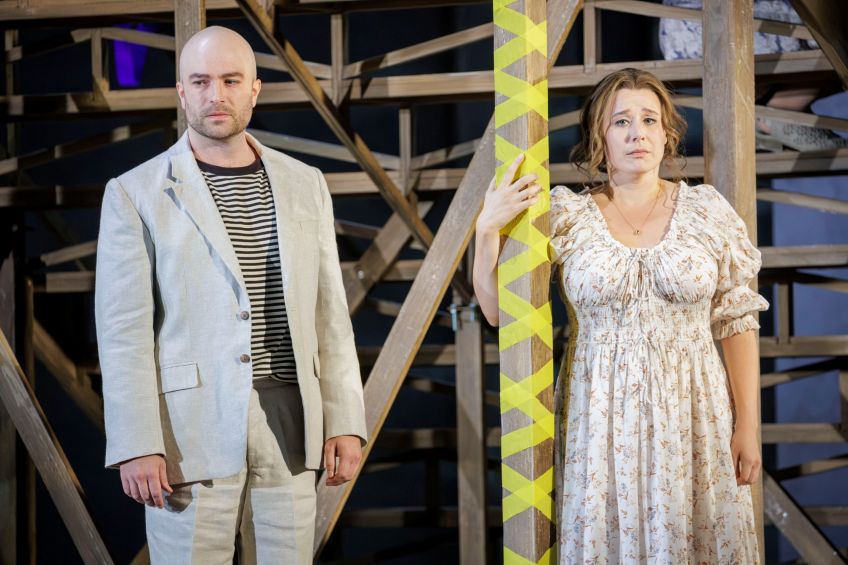
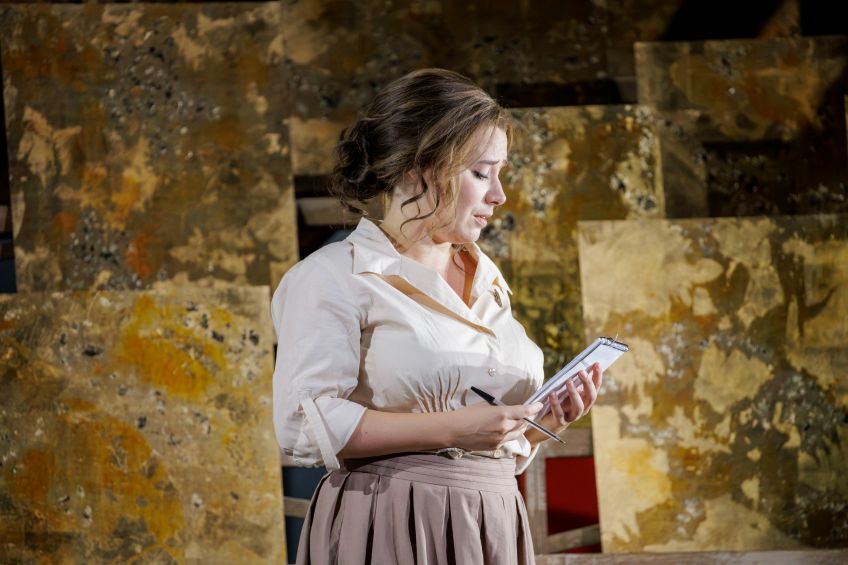
In the role of smooth-headed, broody, moody Eugene Onegin comes John Brancy with another fine, strong voice as his enigmatic mix of off-hand, full-of-himself, hot-and-cold reactions transform him over the years into a pained, passionate, desperate, defeated being. Travelling from shy, dreamy young introvert who suddenly (for no obvious reason) is totally love-struck for the off-hand Onegin, into a princess full of stately self-assurance, is Verity Wingate as Tatyana, singing superbly, her rounded soprano tones much appreciated throughout and bringing fine warmth and delicacy to the long letter scene as she wrestles with her emotions.
At every moment, in characteristic Tchaikovsky style, the orchestra likewise colours every detail of this emotional story of inner conflicts. Warm, soaring melodies take turns with folk, waltz, mazurka and polonaise as we travel from wistful longing and painfully tender beauty to tense build-ups, passionate despair, intense climaxes and explosive, anguished outpourings; from uplifting phrases that curl in magical wisps through woodwind and horn right down to doom-laden lower string growlings. There’s always stalwart singing from the chorus, too, in their various roles and very varied costumes, while their simple, stylised, updated dance moves bring an element of amusement.
In spite of distractions and jarring elements, this simple, complex, ambiguous story of timeless, universal human emotions and interactions still carries us with it, thanks to the excellence of the story-telling libretto, the thoroughly delightful singing and the glorious music.
Eileen Caiger Gray