
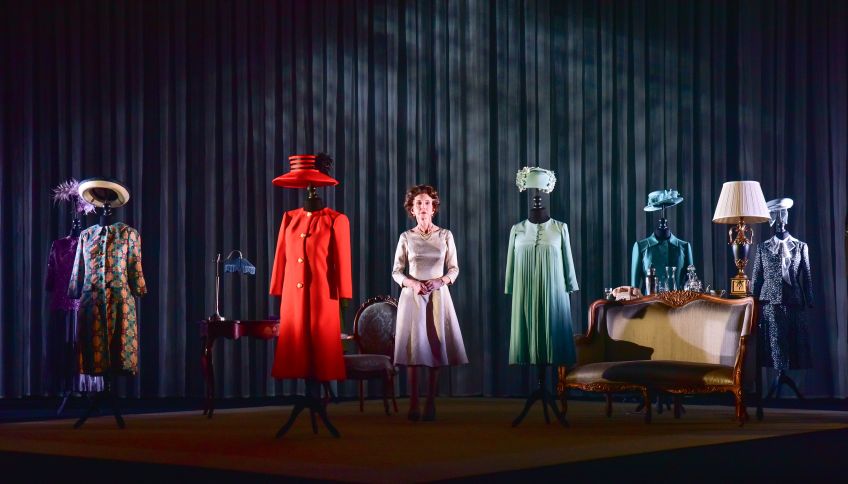
A woman in black coat and hat stands in mournful profile at the side of a dark, ghostly-lit scene as a piper plays a haunting lament. Queen Elizabeth II, who long reigned over us, is dead. As the National Anthem plays some audience members stand.
Daisy Goodman’s By Royal Appointment thus starts with striking visual impact in a drama all about the creation of visual impact. The real drama, though, lies in the imagined interactions and relationships of three intriguing characters, the late Queen’s designer, milliner and dresser, who worked so intimately and tirelessly with her Majesty in creating her unique look and shaping her public image. Their ongoing mission was to enable this woman, compelled to live a dutiful life of “studied neutrality” whilst never directly expressing any substantial opinion verbally, to speak out via her clothing, accessories, jewellery and Queen of Sheba lipstick.
Sparkling with warmth and life, full of humour, poignancy, insight and nostalgia, Goodman’s play is nicely balanced and is acted out with engaging energy and chemistry by a splendid cast. Of course, since no-one actually knows what goes on behind closed palace doors, shows about royal families and households must always embroider and embellish facts with conversations, interactions and goings-on entirely of their own imagining. Accomplished novelist, TV producer and screen writer, Daisy Goodman, creator of Grand Designs and Escape to the Country and writer of the series Victoria, achieves fine, enjoyable feasibility with this, her debut play.
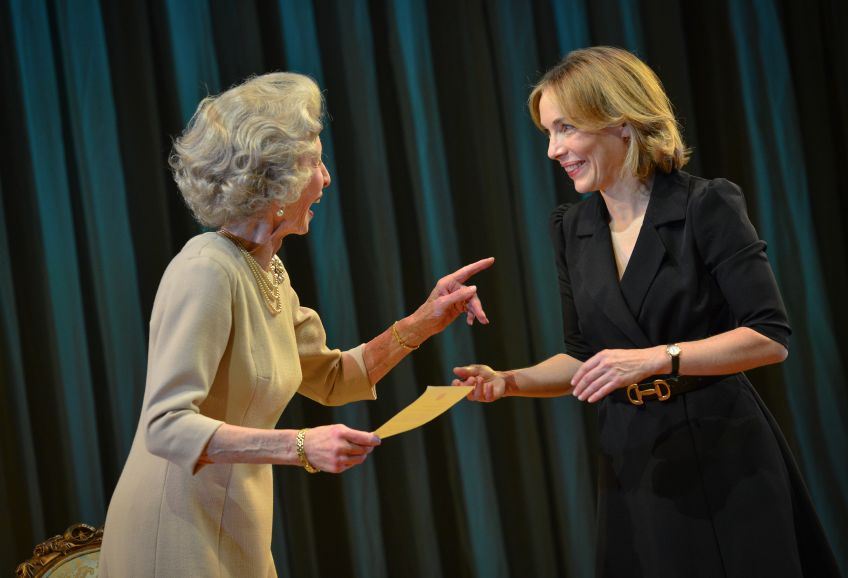
In real life, the late Queen’s designer (after Norman Hartnell) was Hardy Amies, her Australian milliner was Freddie Fox and her dresser was Scouser docker’s daughter, Angela Kelly. Here, though, Goodman’s dresser is a Gigi Gaunt from Wigan while The Milliner and The Designer are not named but, along with Jane Asher’s Queen, all spring vibrantly and credibly to life. Laura Main (predominantly famed for being Sister Bernadette in Call the Midwife) is The Dresser while The Designer is David Robb (predominantly famed for being Dr Clarkson in Downton Abbey) and The Milliner (a flamboyant Australian queen in contrast to Robb’s restrained British one) is Matthew Cottle (also all-round famed, including as Prince Edward in The Windsors). The true fascination of the piece lies in the interactions and relationships between these characters and their Queen, a deeper understanding of each growing little by little as aspects of personal lives are revealed.
From a present-day museum exhibition of the late Queen’s clothes we travel back to the swinging sixties before heading forward in linear mode through decades of episodes and events to finally arrive full circle back at the starting point. With perky freshness and enthusiasm as the young exhibition curator, all in black and sporting a head-set, Laura Matthews announces the date for each scene, rattling off snapshot bursts of pinpointing events, more of which crop up in the scenes themselves – the arrival of colour TV, Eurovision wins, hit songs and films, the Prince of Wales’s investiture, Eastenders, Dolly Birds, Wallis Simpson and Liberace, a Queen Mother, two Beckhams and a Lineker, Ireland’s Troubles, the traumatic death of Earl Mountbatten, AIDS, the miners’ strike, the great fire of Windsor, an unexpected visit from Michael Fagan, mobile phones, British Rail fabrics, Prime Ministers galore, Brexit and the opening of parliament in a blue hat trimmed with yellow flowers, the Pandemic and Prince Philip’s funeral, and so on – for long, indeed, she reigned over us. Some notable events, though, don’t feature at all.
The neat, attractive set is very simple: atop an angled carpet of golden yellow sit elegant, bow-legged chairs and tables, set with silverware and cut-glass. A series of long, elegant curtains that flow in soft folds move for scene changes, steeped beautifully in colours that largely reflect outfits that feature. When picturing outfits worn in public by the late Queen through her long decades of service, colossal arrays of matching coats and dresses spring to mind, of course, in vibrant pinks, greens, lilacs, cream, yellow, silver or shades of blue and turquoise, distinctive but rarely properly fashionable, each topped with a jaunty, often bizarre hat whose colour matched the outfit spot-on, a hat like no-one else sported – anywhere in the universe. Few realise, though, just how much deliberation, discussion and collaboration went into the choice and creation of each ensemble – until now.
Jane Asher’s Queen captivates throughout with restrained charm. Ageing admirably downwards from her own remarkable 80 years, Asher also ages admirably up, adopting a slight stoop and unsteadiness for the queen’s more advanced years. From initial sturdy, Princess Royal-like tones, her voice becomes convincingly hoarse and painful in her annus horribilis. Joyful enthusiasm for horse-racing and for dog-walking in headscarf and tweeds peeps out now and again from that habitual air of restrained, stately, turn-the-other-cheek calmness, and quiet, guarded yet steely firmness, but it’s with her dresser that the Queen relaxes a little more.
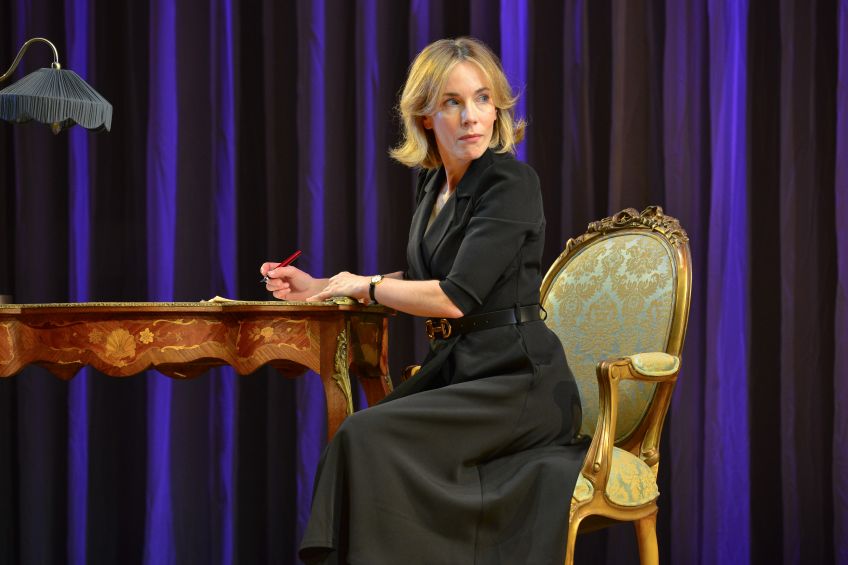
Somewhat in the manner of Anna and Lady Mary in Downton Abbey, constantly in each other’s company, a slightly closer, freer, more intimate relationship emerges, in which advice, empathy and confidences pass both ways. But, whilst loyal, caring and dependable, Laura Main’s Gigi, dressed always in black, is more blatantly forthright, feisty, challenging and outspoken than Anna. For decades this self-assured woman remains at the Queen’s side, pinning up the royal hair-rollers each day and sorting out jewels and accessories, her responsibilities expanding through the years, even into design itself. The relationship between them is gently moving, poignantly represented both in the simple gift that the Queen leaves her dresser and in the outfit Gigi finally chooses to lay Her Majesty to rest.
Moving, too, is the development of the characters and relationships of David Robb’s Designer and Matthew Cottle’s Milliner, a favourite hat-man of other royals, too, playfully self-dubbed “the Michelangelo of straw and felt”. Robb’s Designer, a subtly restrained and repressed gay, distinguished ex-military man in smart grey suit, who’s pretty disdainful of Gigi’s humble origins, is totally devoted to the quality of his creations and the detail of workmanship in every last stitch. His bicker and banter with Cottle’s more flamboyantly camp Australian Milliner create breezy humour, while Cottle often plays to an airily light-hearted, humorous side of his character. Over time, though, as snippets of personal tribulations and traumas, past and present, are revealed to us and to the Queen (as Gigi’s are, too) we (and she) gain a deeper understanding and empathy for each. Cottle breaks down in a touching outburst of tears when his partner dies while Robb is moved to tears when finally given a knighthood, awarded in spite of his faux-pas in promoting his work in Japan, though sadly, after his unkind father is no longer alive to see it.
Since both Her Majesty and Gigi wear sensible black shoes throughout, the myriad pairs of shoes that had to be sourced for different outfits don’t get a look in, unlike the outfits themselves, outfits that always enabled even a diminutive figure to stand out instantly in any crowd, outfits that were never about fun, frivolity or bending to fleeting fashion but remained, like their wearer, constant, dependable, reliable, practical and steadfast, and which allowed colour, fabric, style and jewel choices to subtly spell out a message.
All makes for a thoroughly enjoyable entertainment, splendidly acted.
Eileen Caiger Gray